Disclaimer: This has been reported after the availability of the order of the Court and not on media reports so as to give an accurate report to our readers.
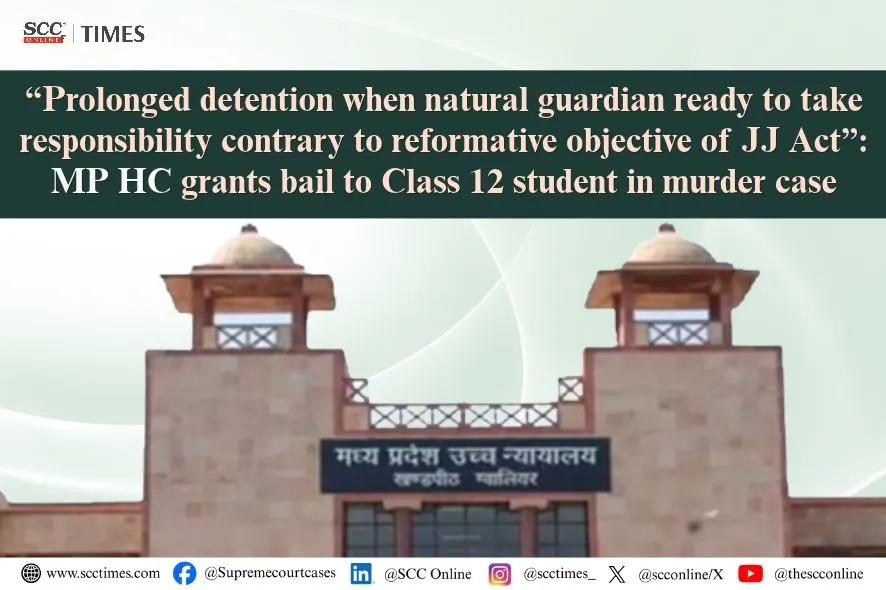
Madhya Pradesh High Court: In a criminal revision petition filed by a Class 12th student, through his father, against the rejection of a bail application in a murder case, the Single Judge Bench of Alok Awasthi, J., allowed the petition, holding that the Courts below did not properly apply the parameters of Section 12, Juvenile Justice (Care and Protection of Children) Act, 2015 (JJ Act). The continued incarceration of the juvenile was not in his best interest. The Court stated that though the observations in the Social Investigation Report (SIR) regarding the surrounding environment and the possibility of the child falling into undesirable company were relevant, the statutory scheme of the JJ Act does not permit denial of bail solely on generalised observations when the three exceptional circumstances enumerated in the proviso to Section 12(1) were not clearly and specifically made out.
The Court remarked,
“Prolonged detention of a Class-12 student in an Observation Home, particularly when the natural guardian is ready to take full responsibility, runs counter to the rehabilitative and reformative object of the JJ Act.”
Background
The child in conflict with law (the juvenile), a Class 12 student, was taken into custody on 1 May 2026 regarding an FIR registered against him under Sections 103(1), 109(1), 115(2), 296-B, 351(3), and 3(5), Nyaya Sanhita, 2023 (BNS), and Section 3(2)(v), Scheduled Castes and Scheduled Tribes (Prevention of Atrocities) Act, 1989.
The Juvenile Justice Board (the Board) rejected the bail application filed under Section 12, JJ Act based on the SIR. Aggrieved, his father filed an appeal, whereby the appellate court affirmed the Board’s order.
Hence, the present criminal revision was filed by the juvenile’s father against the appellate court’s order.
The father contended that there was no material on record to show that the release of the juvenile was likely to bring him into association with any known criminal or expose him to moral, physical or psychological danger, or that his release would defeat the ends of justice. He also had no previous criminal antecedents. The father stated that he was engaged in a dairy business and was ready and willing to take the child under his care and supervision and ensure his presence before the Board. Furthermore, the continued detention of the child for more than three months was contrary to the rehabilitative object of the JJ Act.
The State contended that the SIR indicated that the neighbourhood consisted predominantly of less-educated labour class and releasing the child at this stage might expose him to undesirable company and other risks. Furthermore, the offences were serious in nature, and he had criminal antecedents.
Analysis
The Court noted that, undisputedly, the juvenile was approximately 17 years on the date of the alleged incident. Section 12, JJ Act mandates that a person who is apparently a child and is alleged to have committed a bailable or non-bailable offence shall be released on bail with or without surety or placed under the supervision of a probation officer or under the care of any fit person. The proviso to Section 12(1) carves out only 3 limited exceptions:
-
if there appears reasonable ground for believing that the release is likely to bring the child into association with any known criminal; or
-
expose him to moral, physical, or psychological danger; or
-
that his release would defeat the ends of justice.
While reiterating that bail is the rule and refusal is an exception, the Court stated that the gravity of the offence by itself is not a sufficient ground to deny bail under the JJ Act.
Furthermore, the Court noted that the SIR showed that the juvenile was studying in Class 12, his father was engaged in dairy business, and the family education level was medium. The SIR does note the character of the neighbourhood and suggested that some protective custody may be appropriate. However, it did not record any criminal antecedents or any specific material indicating that he is a hardened offender, or that his release is likely to bring him into association with known criminals. Additionally, no recovery remains pending for him, and he had been in the observation home for more than 3 and a 1/2 months.
Noting that the Board and the appellate court primarily relied upon the observations in the SIR regarding the surrounding environment and the possibility of the child falling into undesirable company, the Court stated that while such concerns were relevant, the statutory scheme of the JJ Act does not permit denial of bail solely on generalised observations when the three exceptional circumstances enumerated in the proviso to Section 12(1) were not clearly and specifically made out.
“Prolonged detention of a Class-12 student in an Observation Home, particularly when the natural guardian is ready to take full responsibility, runs counter to the rehabilitative and reformative object of the JJ Act.”
Thus, the Court allowed the revision petition, holding that the JJ Board and Appellate Court did not properly apply the parameters of Section 12, JJ Act and the continued incarceration of the juvenile was not in his best interest.
Accordingly, the Court directed the release of the juvenile on bail and his handover to his father upon the father furnishing a personal bond in the sum of ₹50,000 with one solvent surety in the like amount to the satisfaction of the Principal Magistrate, Juvenile Justice Board, Indore. The bail was also subject to the following conditions:
-
The father shall keep the juvenile under his continuous care, supervision, and control, and shall not allow him to come into association with any known or unknown criminals;
-
The father shall ensure the presence of the juvenile on every date of hearing before the Board and shall not seek unnecessary adjournments;
-
The juvenile shall not indulge in any criminal activity and shall not leave the jurisdiction of the Board without prior permission;
-
The father shall ensure that the release of the juvenile does not defeat the ends of justice in any manner;
-
The Probation Officer concerned shall periodically monitor the activities and conduct of the child and submit periodic reports to the Board.
The Court directed that a copy of the order be immediately transmitted to the Principal Magistrate, Juvenile Justice Board, Indore, and the Superintendent of the Observation Home, Indore, for compliance.
In the event of violation of any of the above conditions, the bail granted to the juvenile shall stand automatically cancelled, and the Board shall be at liberty to take him back into custody.
[Child in Conflict with Law v. State of M.P., Criminal Revision No. 3824 of 2026, decided on 27-10-2026]
Advocates who appeared in this case:
For the revisionist: Dharmendra Gurjar
For the respondent: Bhaskar Agrawal, Government Advocate
Buy Juvenile Justice (Care and Protection of Children) Act, 2015 HERE