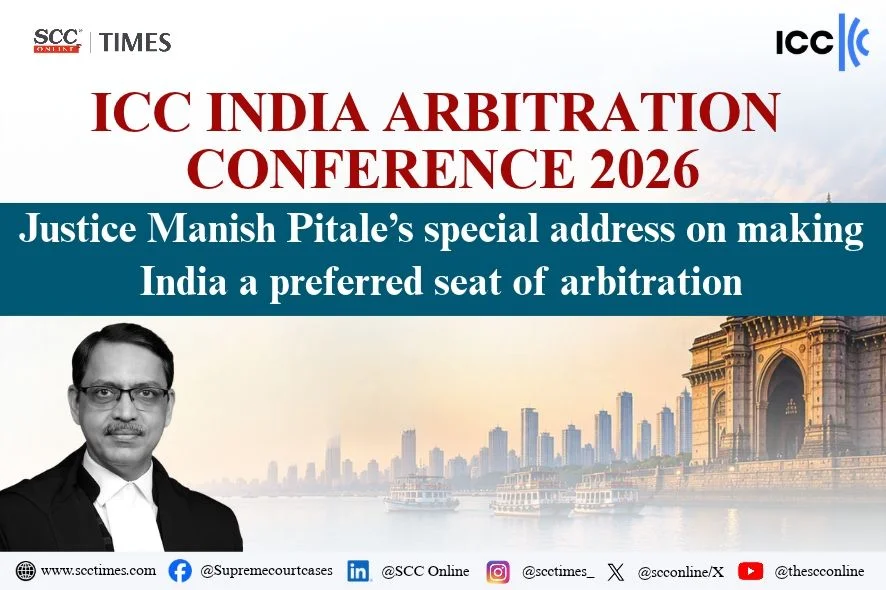
The ICC India Arbitration Conference 2026 held on October 31, 2026, at the Trident Hotel, Nariman Point, Mumbai, bringing together members of the arbitration community to discuss key developments, emerging challenges and the future of international arbitration. The conference features a series of discussions on contemporary issues, including monetary remedies, asset recovery in the digital era and ethical standards in arbitration.
As part of the conference proceedings, Justice Manish Pitale of the Bombay High Court delivered a special address, highlighting India’s potential to emerge as a preferred seat of international arbitration. He emphasised the need for judicial specialisation, a stronger arbitration Bar and a robust ethical framework to strengthen India’s arbitration ecosystem.
Delivering the Special Address, Justice Manish Pitale reflected on the institutional, legislative and judicial developments necessary for India to emerge as a preferred seat of international arbitration.
Referring to Mr. Fessas’s emphasis on bilateral communication, Justice Pitale observed that conferences and professional interactions are essential to strengthening India’s arbitration ecosystem. He noted that India’s current position among preferred international arbitration seats calls for a closer examination of the country’s legislative framework, judicial culture and professional arbitration practice.
Justice Pitale candidly observed:
“India at the present moment is obviously not featuring there as one of the preferred seats. What is the reason for this and where are we going is something we need to think about.”
Evolution of India’s arbitration framework and the need for judicial specialisation
Tracing the development of Indian arbitration law, Justice Pitale contrasted the interventionist and court-supervisory approach under the Arbitration Act, 1940, with the shift introduced by the Arbitration and Conciliation Act, 1996.
He observed that the initial judicial approach to the 1996 Act reflected a continuing influence of the earlier interventionist framework. Referring to decisions such as Bhatia International v. Bulk Trading S.A., (2002) 4 SCC 105 and Bharat Aluminium Co. v. Kaiser Aluminium Technical Service, Inc., (2012) 9 SCC 552, he explained how judicial interpretation and subsequent legislative amendments have gradually shaped India’s arbitration framework.
Justice Pitale noted that the 2015 amendment marked an important stage in this development, followed by further legislative changes in 2019 and 2021, while referring to the proposed 2024 Bill as part of the continuing reform process.
Highlighting the importance of judicial specialisation, he observed that frequent changes in judicial assignments can result in judges dealing with arbitration matters without sufficient exposure to the principles governing arbitral proceedings. In particular, a judge accustomed to exercising appellate jurisdiction in ordinary civil matters may approach a challenge under Section 34 of the Arbitration and Conciliation Act, 1996, with an appellate mindset, which is inconsistent with the limited scope of judicial intervention in arbitration.
He welcomed the gradual development of specialised commercial divisions and the growing presence of judges with arbitration experience, including those elevated from the Bar.
Role of the arbitration Bar and professional institutionalisation
Justice Pitale identified the arbitration Bar as another important stakeholder in strengthening India’s arbitration ecosystem. Referring to the emergence of a formal arbitration Bar in 2024, he observed that the development of a dedicated and specialised professional community remains a gradual process.
He questioned whether arbitration should continue to be treated as a post-court-hours or part-time practice, particularly when complex disputes require specialised professional assistance. He also emphasised the need for experienced arbitrators to be supported by trained professionals and a more institutionalised arbitration practice.
Highlighting the importance of collective institutional development, Justice Pitale observed:
“So if all the three stakeholders, the judiciary, the bar, the legislature work in tandem, you will have a situation in the future and the near future, I hope that India becomes one of the preferred seats of arbitration.”
According to him, the judiciary, legislature and Bar must work in tandem to create an environment capable of supporting India’s emergence as a preferred seat of international arbitration.
Reconciling domestic public policy with international arbitration standards
Addressing the relationship between domestic law and international commercial arbitration, Justice Pitale highlighted the continuing tension between domestic public policy considerations and the standards applied in international arbitration.
He observed that differences in the interpretation of public policy may affect the enforcement or setting aside of arbitral awards, particularly where domestic legal principles are applied to international commercial disputes.
Referring to the introduction of the Fifth and Seventh Schedules to the 1996 Act, he noted that legislative amendments have sought to incorporate internationally recognised principles concerning arbitrator independence, impartiality and disclosure.
He emphasised that aligning domestic laws with international arbitration standards must be a gradual process that recognises the different legal and cultural backgrounds of participants in international arbitration.
Monetary remedies and the scope for standardised frameworks
Reflecting on the conference’s first technical session on monetary remedies in arbitration, Justice Pitale suggested that established principles governing compensatory and restitutionary relief, interest and costs could be organised into standardised frameworks or reference modules.
He observed that although monetary relief is frequently sought in arbitration, determining issues such as loss of profits and the calculation of compensation can involve extensive disputes and expert evidence.
He proposed that commonly applicable principles and checklists could be identified and potentially incorporated by reference into arbitration agreements at the drafting stage. This could reduce the scope of disagreement between parties and improve procedural efficiency, leaving issues of computation to be addressed through appropriate accounting methods and technological tools, including AI.
Recovery of digital assets and emerging legal challenges
Referring to the second technical session on asset recovery amid the age of digital assets, Justice Pitale discussed the challenges associated with identifying, tracing and recovering cryptocurrencies and other digital assets.
He referred to the evolving recognition of cryptocurrency as property in jurisdictions such as the United Kingdom and Singapore, as well as the Madras High Court’s recognition of cryptocurrency as property in Ruti Kumari v. Zanmai.1
He observed that while the recognition of digital assets as property may provide a basis for legal remedies, practical questions remain concerning their identification, movement and recovery, particularly where assets are transferred through complex technological mechanisms or held in fiduciary arrangements.
Codification of ethics and integrity in international arbitration
Addressing the proposed codification of ethics in international arbitration, Justice Pitale emphasised that the integrity of the arbitral tribunal is fundamental to the legitimacy of the dispute resolution process.
He referred to the 2014 IBA Guidelines on Conflicts of Interest in International Arbitration and the corresponding principles reflected in the Fifth and Seventh Schedules to the Arbitration and Conciliation Act, 1996. He noted that issues of independence, impartiality and disclosure are already addressed through existing frameworks, but questions remain regarding the scope and enforcement of a common ethical standard.
Justice Pitale also drew attention to potential conflicts arising from the practice of double-hatting, where the same professional may act as counsel in one arbitration, arbitrator in another and expert witness in a third. He questioned whether such overlapping roles could give rise to a reasonable apprehension of bias or conflict of interest.
He further highlighted the need to examine circumstances in which an arbitrator’s observations in an earlier award may become relevant to their appointment in a subsequent dispute involving the same parties.
While recognising the importance of codifying minimum ethical requirements, he cautioned that any common framework must accommodate differences in domestic legal systems, professional cultures and public policy considerations.
He also raised questions concerning the enforcement of an ethical code and the consequences of non-compliance. Observing that setting aside an arbitral award may not always provide an effective solution, as it could return parties to the starting point of their dispute, he stressed the need to consider more effective mechanisms for maintaining ethical standards.
India as a preferred seat of international arbitration
Concluding his address, Justice Pitale reiterated that India’s aspiration to become a preferred seat of international arbitration requires coordinated efforts by the judiciary, legislature, Bar and arbitration institutions.
He observed that the growth of Indian businesses and their increasing participation in cross-border transactions makes the development of an effective dispute resolution framework particularly important. He referred to a matter before his Court involving two Indian parties who had nevertheless chosen Singapore as the seat of arbitration, illustrating the need to examine why parties continue to select foreign jurisdictions for resolving disputes involving Indian entities.
Explaining why greater institutional engagement is necessary, Justice Pitale observed:
“And conferences like these, exchange of ideas, brainstorming will bring us to a situation where the environment of international arbitration becomes healthy across the world, including India.”
He emphasised that conferences, institutional engagement and the exchange of ideas can help bridge the gap between domestic legal frameworks and international arbitration practices, thereby contributing to a more effective and internationally competitive arbitration ecosystem in India.
SCC Times is the Information & Documentation Partner for the conference. Stay tuned for comprehensive coverage, key insights and highlights from the event!
1. Original Application No.194 of 2025