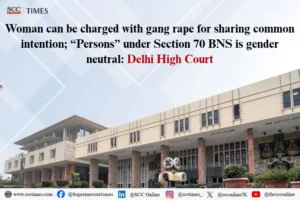
Delhi High Court: In a matter concerning whether a woman can be charged with gang rape despite not physically committing the act of rape, a Single Judge Bench of A.J. Bhambhani, J., held that gang rape under Section 376-D, Penal Code, 1860 (IPC) and Section 70, Nyaya Sanhita, 2023 (BNS) is a separate and substantive offence, and that the word “persons” in it is gender neutral. A woman who forms part of a group or acts in furtherance of a common intention to have rape committed on the victim, can therefore be charged with the offence. The Court clarified that a woman alone cannot be charged with gang rape and expressed no opinion on whether a woman can commit rape or whether the word “man” in Section 63 BNS is gender neutral.
Background
An FIR was registered at the instance of Petitioner 1, the minor victim’s mother , under Section 137(2) BNS, allegingkidnapping. During investigation, on 1 October 2024, the victim appeared at the police station onher own and disclosed sexual assault during her medical examination, although she refused an internal examination. . . Offences under the Protection of Children from Sexual Offences Act, 2012 (POCSO Act) were subsequently added by the charge-sheet dated 27 November 2024.
In her statement under Section 183 BNSS recorded on 4 October 2024, charge-sheet the victim alleged that on 23 December 2023 Petitioner 1 threatened to kill her if she did not have physical relations with Petitioner 2 and forced her to do so despite her protests. She stated that Petitioner 1 remained present in the same room during the incidents, when she was sexually assaulted multiple times between December 2023 and July 2024. Also, a video clip of the incident of 23 December 2023 would be found on Petitioner 1’s mobile phone. She left home on 8 July 2024 after being threatened again.
By the impugned order dated 17 January 2025, the petitioners were charged under Sections 70(2), 351(3) and 64(2)(m) BNS and Section 6, POCSO Act. Since the alleged offences span December 2023 to July 2024, they attract both IPC and BNS. Although the prayer in the petition was worded differently, the petitioners pressed their challenge only on the ground that Petitioner 1, being a woman, cannot be charged with the offence of gang rape.
Notice was issued on 30 January 2025 and further proceedings before the trial court were stayed. By orders dated 2 May 2025 and 9 May 2025, the stay was modified to permit the trial court to record the victim’s deposition so that the petitioners’ bail plea could be considered. The Court appointed an Amicus Curiae on 6 March 2025. The State adopted the Amicus’s submissions.
Petitioners’ submissions
The petitioners’ counsel submitted that only a “man” can commit rape under Section 63 BNS, so the reference to a “group of persons” in Section 70 BNS can only mean a group of men. Reliance was placed on Priya Patel v. State of M.P., (2006) 6 SCC 263 and State of Rajasthan v. Hemraj, (2009) 12 SCC 403, where the Supreme Court held that a woman cannot be prosecuted for gang rape under Section 376(2)(g) IPC (as it stood before 2013), since a woman cannot be said to have an intention to commit rape. Their principal submissions were:
1. The definition of rape in Section 63 BNS is incorporated into Section 70, as in Rafiq Ahmad v. State of U.P. (murder in the offence of dacoity with murder), so “rape” in Section 70 must carry the same meaning.
2. The 2013 Amendment did not replace “man” with “person” in Section 375 IPC, despite the proposal, and the Justice J.S. Verma Committee’s recommendation to make gang rape gender-neutral was not accepted.
3. A woman cannot be liable for gang rape when she could not be liable for the same acts alone, which would be absurd.
4. The deeming fiction in Section 70 only alters the rule of evidence and enhances punishment, and a deeming provision in criminal law must be strictly construed, relying on Ashok Kumar v. State of Haryana, (2010) 12 SCC 350 and Sher Singh v. State of Haryana, (2015) 3 SCC 724.
Submissions of the amicus curiae
The Amicus Curiae submitted that Section 3, POCSO Act has already been held gender-neutral by the Court in Sundari Gautam v. State (NCT of Delhi), 2024 SCC OnLine Del 5412, and that the Allahabad High Court in Suneeta Pandey v. State of U.P., 2023 SCC OnLine All 44, held that a woman can be prosecuted for gang rape if she facilitated the act with a group. He argued the following:
1. Priya Patel and Hemraj were decided on the pre-2013 law, when gang rape was only an aggravated form of rape under Section 376(2)(g) IPC and Explanation 1 to it could not stand alone.
2. Section 376-D IPC and Section 70 BNS are independent offences, so the earlier decisions are not binding in absolute terms after the legislative change.
3. The phrase “acting in furtherance of a common intention” in these provisions refers to a common intention that rape be committed on the victim, and not that each member intends to commit rape.
4. The words “deemed to have committed the offence of rape” show that each member of the group need not individually commit rape, and active facilitation shows a shared common intention, relying on Barendra Kumar Ghosh v. King Emperor, 1924 SCC OnLine PC 49 and State of U.P. v. Iftikhar Khan, (1973) 1 SCC 512.
Issues & Analysis
The Court was called upon to determine whether a woman can be charged with the offence of gang rape under Section 376-D IPC and Section 70 BNS.
The Court first examined the legislative history. It noted that before the 2013 Amendment, gang rape was only an aggravated form of rape under Section 376(2)(g) IPC read with Explanation 1 and was therefore tied to the definition of rape in Section 375 IPC. The 2013 Amendment expanded the definition of rape to include insertion of objects or body parts other than the penis, manipulation of body parts and application of the mouth. At the same time, the legislature introduced Section 376-D IPC, making gang rape a separate offence, although its wording was in pari materia with the earlier Explanation. Section 63 BNS mirrors the expanded definition of rape, and Section 70 BNS retains Section 376-D IPC.
The Court held that this separate placement is intended to create a separate, substantive offence, so the construction of Section 376-D IPC and Section 70 BNS need not be confined to the definition of rape in Section 375 IPC or Section 63 BNS. It clarified that the question before it was whether a woman can be charged with gang rape and not whether a woman can be charged with rape. It therefore expressed no opinion on whether a woman can commit rape, or on the meaning of “man” in the opening words of Section 375 IPC and Section 63 BNS. The Court held that giving the offence of gang rape its ordinary meaning, as one that refers to “persons” and not to men alone, is consistent with the rule that penal provisions are strictly construed and does not widen the offence of rape.
“There is no rationale or basis to restrict the word “persons” appearing in the phrase “one or more persons constituting a group” to mean only a group of men; and therefore, the word “persons” appearing in the said phrase must be construed in its gender-neutral form”
The Court then gave significance to three phrases in Section 376-D IPC and Section 70 BNS, as follows.
1. “One or more persons constituting a group”: The Court saw no basis to restrict “persons” to a group of men and held that it must be read in its gender-neutral form. It also saw no basis to restrict “acting in furtherance of a common intention” to the common intention of men. Relying on Jasdeep Singh v. State of Punjab, (2022) 2 SCC 545, it noted that common intention under Section 34 IPC and Section 3(5) BNS does not require that each co-accused individually commit every act constituting the offence.
2. The disjunctive “or”: The 2 phrases are separated by “or” and not “and”. It is therefore not necessary that a person acting in furtherance of a common intention be among those who physically commit rape. A woman who is not part of the group that physically commits the offence may still have acted in furtherance of a common intention to have rape committed on the victim.
3. “Deemed to have committed the offence of rape”: The Court held that this shows legislative intent that every person who constitutes a group or acts in furtherance of a common intention need not have individually committed rape. Section 376-D IPC and Section 70 BNS create a juristic postulate that each such person is culpable for having committed gang rape.
The Court concluded that a person who has not individually committed the act of rape described in post-2013 Section 375 IPC and Section 63 BNS is nevertheless deemed to have committed rape for the purposes of Section 376-D IPC and Section 70 BNS. Such a person can be charged with gang rape regardless of gender. The Court therefore found no basis to hold that a woman cannot be charged with the offence.
“While interpreting the scope of the offence of ‘gang rape’ under section 376D IPC and section 70 BNS, this court is not expansively construing or widening the scope of the offence of ‘rape’ under section 375 IPC and section 63 BNS; but is merely according its ordinary, natural, and therefore strict meaning to the offence of gang rape, bearing in mind that the offence of ‘gang rape’ refers to “persons” and does not refer to men alone.”
The Court added an important clarification. A woman alone cannot be charged with gang rape, since that would prima facie not conform to the statutory definition of rape in post-2013 Section 375 IPC and Section 63 BNS as currently construed. It observed that this question may have to be revisited in an appropriate case, especially since the expanded definition of rape criminalises acts that can equally be committed by a non-male offender. The Court again reiterated that it was not expressing any opinion on whether “man” in Section 375 IPC or Section 63 BNS is gender neutral.
On the POCSO charge, the Court noted that the charge under Section 6 was in any case sustained on the strength of Sundari Gautam v. State (NCT of Delhi), 2024 SCC OnLine Del 5412, which held Section 3, POCSO Act gender neutral.
Read More – Patna HC: When Prosecutrix Is Not a ‘Sterling Witness’: Benefit of Doubt to Accused in Gang Rape Case”
Decision
The Court upheld the order on charge dated 17 January 2025 and dismissed the petition. Pending applications, if any, stood disposed of.
[ANSXXX v. State (NCT of Delhi), 2026 SCC OnLine Del 7997, decided on 15-10-2026]
Advocates who appeared in this case:
For the Petitioners: Adv. Tanya Agarwal with Advs. Ritu, Akshay Singhal and Vishal M.
Amicus Curiae: Adv. Rohan J. Alva with Adv. Anant Sanghi
For the State: Mr. Digam Singh Dagar, APP with SI Naresh Kumar, P.S. Bhalswa Dairy