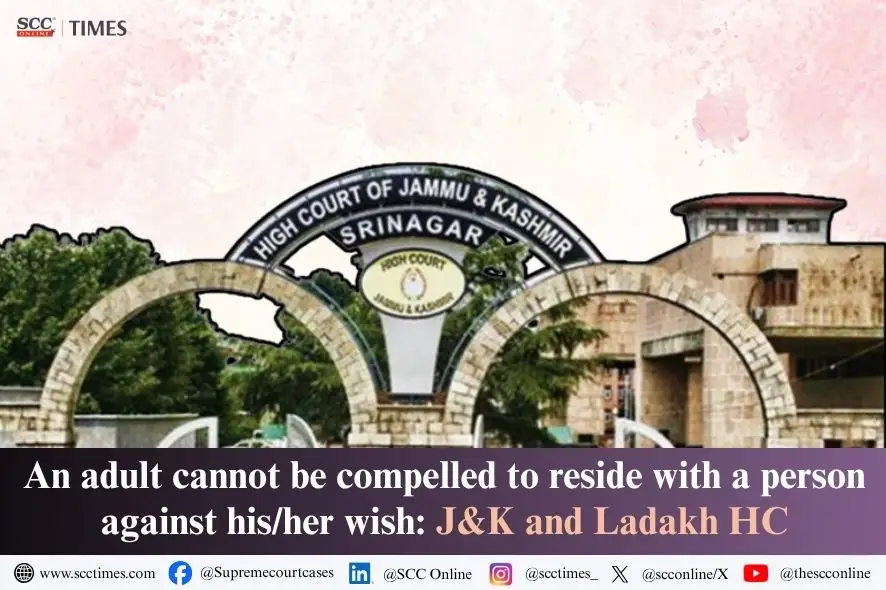
Jammu & Kashmir and Ladakh High Court: While considering a habeas corpus petition in respect of a major woman who was missing, a Single Judge Bench of Sanjay Dhar, J., held that once the corpus had attained majority and made a voluntary and unequivocal choice to accompany and reside with her husband, such decision had legal recognition and could not be displaced through a writ of habeas corpus in the absence of illegal detention. The Court consequently dismissed the petition filed by her father and held that she was at liberty to accompany the person of her choice.
Also Read: Manipur High Court protects adults’ Right to choose spouse
Background
The petition was instituted by the father seeking directions to the official respondents to trace and recover his daughter and further seeking constitution of a dedicated investigation team for conducting a time-bound investigation into her disappearance.
According to the petitioner, his daughter, aged about 20 years, had left her residence on 11 July 2026 for appearing in the Higher Secondary School Part-I Annual Examination and did not return home thereafter. Despite search efforts by the family, her whereabouts allegedly remained unknown, leading to an apprehension that she might have been abducted or kept under illegal detention. It was further stated that a missing report had been lodged with the police station concerned on 12 July 2026, but no effective steps had allegedly been taken to trace her.
During the pendency of the proceedings, the daughter sought impleadment as a party to the petition. In her application, she stated that she had voluntarily left her parental home with a view to marry a person of her choice. She asserted that the decision was neither under any undue influence nor the result of any force and that she had attained majority and was conscious of the nature and consequences of her actions. She also stated that she did not wish to live with her parents and requested that her custody not be handed over to her father.
Pursuant to directions of the Court, the woman appeared in person and disclosed that she was more than 19 years of age and was residing independently with her husband, with whom she had entered into wedlock out of her own free will and volition. She further informed the Court that she and her husband had earlier approached the Court through a writ petition seeking protection from harassment and that directions had been issued in that regard. Thereafter, her statement was recorded on oath before the Registrar Judicial, wherein she reiterated that she had voluntarily married her husband, was residing with him, and desired to continue doing so.
Analysis
The Court observed that once the woman had attained majority and had made a voluntary and unequivocal choice to accompany her husband, such conscious decision was entitled to legal recognition. The Court highlighted that a major person cannot be compelled to reside with or accompany a particular individual, even if such individual happens to be a parent.
The Court further observed that a writ of habeas corpus can only be issued for securing the release of a person from illegal or unlawful detention, and it cannot be utilised to compel an adult person to reside with another person against his or her will and wish when no illegal detention is established.
The Court examined the material available on record and found that the woman was not subjected to any form of unlawful detention and that she had voluntarily left her parental house to join the company of her husband.
Also Read: All HC holds Judicial custody under
Decision
Accordingly, the Court, while dismissing the petition, held that no writ of habeas corpus could be issued and observed that being a major person, the woman was free to accompany and reside with the person of her choice.
[Bashir Ahmed v. State (UT of J&K), HCP No. 66 of 2026, decided on 8-10-2026]
Advocates who appeared in this case:
For the Petitioner: Mumtaz Choudhary, Advocate.
For the Respondents: Adarsh Bhagat, Government Advocate; Surya Dev Singh, Advocate.