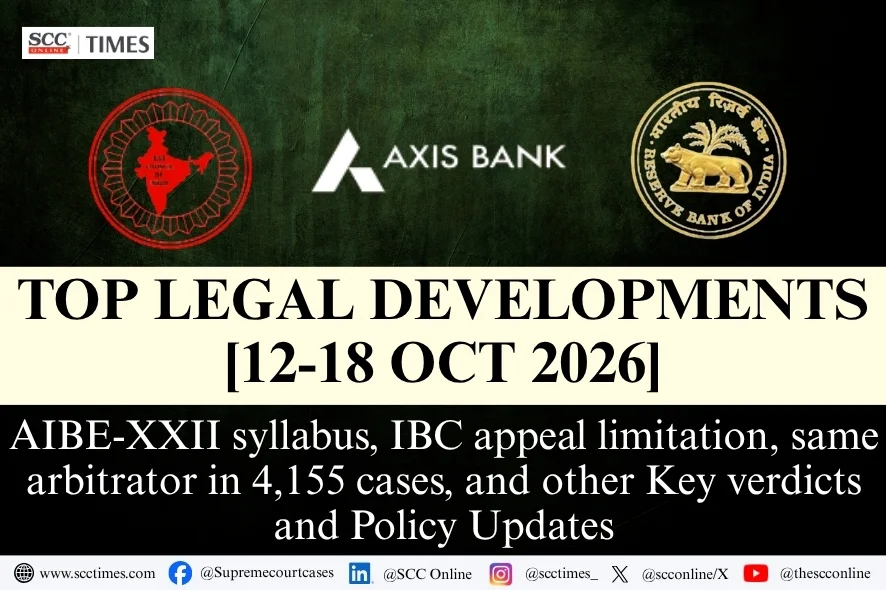
This roundup of weekly legal developments in India covers significant Supreme Court and High Court judgments such as Sahara Group Money laundering case where trial court was directed to frame charges against the executive, period of limitation for appeal under IBC, determining character of Pondicherry electricity subsidy, arbitral award passed by unilaterally appointed arbitrators was held to be void ab initio, pre-release anti-piracy protection to “Drishyam: The Conclusion”, the missing Rifleman case, criminal contempt against 2 lawyers on threatening a judicial officer, application of Section 295-A IPC on mere sale of garments bearing religious images, resignation by MLA while anti-defection proceedings are pending, application seeking change in category after declaration of NEET-UG results and other key rulings.
TOP STORIES OF THE WEEK
Sahara Group Money Laundering Case: Supreme Court grants bail to executive, directs trial court to frame charges within 4 months
In a case concerning the grant of regular bail to an accused in a money laundering case registered under Sections 3 and 4 read with Section 70, Prevention of Money-Laundering Act, 2002 (PMLA), a Division Bench set aside the Calcutta High Court’s order rejecting bail. Taking note of the appellant’s incarceration for about 1 year and 3 months, the fact that cognizance was yet to be taken qua the appellant and the considerable time likely to be required for completion of the trial, the Court held that continued incarceration was not required for that purpose. The Court accordingly granted bail to the appellant, subject to the terms and conditions imposed by the trial court, and directed the trial court to frame charges within 4 months from the date of receipt of a copy of the order. Read More about Sahara Group Money Laundering Case Here
[Anil Valiaparampil Abraham v. Directorate of Enforcement, Kolkata Zone-1, S.L.P. (CRL.) NO. 15488 of 2026, order dated 16-10-2026]
SUPREME COURT HIGHLIGHTS OF THE WEEK
IBC Appeal Limitation: Supreme Court says time runs from NCLAT pronouncement, not collection of certified copy
In an appeal filed under Section 62, Insolvency and Bankruptcy Code, 2016 (IBC), the Division Bench held that the limitation period for an appeal under Section 62 commences from the date of pronouncement of the NCLAT order, and only the time requisite for obtaining a certified copy can be excluded under Section 12(2), Limitation Act, 1963. The Court stated that the period of inaction before applying for the certified copy cannot be excluded. As the appeal was filed beyond the statutory limit of 45 days and the further condonable period of 15 days, the Court dismissed it for being barred by limitation. Read more about limitation for appeal under IBC Here
[Commr. of Central Tax v. Sreenivasa Rao Ravinuthala, 2026 SCC OnLine SC 2150, decided on 14-10-2026]
Supreme Court directs maternal aunt and uncle to take child to father’s Chennai residence for interim transition
In a case concerning the custody of a minor child by her maternal aunt and uncle, despite the father being her sole surviving parent, a Division Bench, issued transitional directions to facilitate the child’s gradual adjustment to her father’s residence in Chennai. Emphasising the need to ensure the child’s comfort and emotional well-being during the transition, the Court directed the maternal aunt and uncle to accompany the child to Chennai, stay at the father’s residence and cooperate with him and his family in helping the child adjust to her new environment. Read more on child custody Here
[Shashikanta Majhi v. State of Odisha, 2026 SCC OnLine SC 2141, decided on 6-10-2026]
Electricity Subsidy: Capital or Revenue Receipt? Supreme Court applies ‘Purpose Test’, holds Pondicherry power subsidy is Revenue
In an appeal against the judgment of the Madras High Court, affirming the concurrent findings that the electricity subsidy received by the appellant constituted a revenue receipt, the Division Bench held that the character of a subsidy must be determined with reference to the purpose for which it is given; the “purpose test” requires the scheme to be examined as a whole, and the general object of fostering industrial growth cannot, by itself, determine the character of the receipt. Accordingly, the Court dismissed the appeal and held the Pondicherry electricity subsidy to be a revenue receipt. Read more on electricity subsidy constituting a revenue receipt Here.
[MEPCO Industries Ltd. v. CIT, 2026 SCC OnLine SC 2080, decided on 7-10-2026]
MAJOR HIGH COURT RULINGS THIS WEEK
Arbitration| Same Arbitrator In 4,155 Cases? Delhi High Court Declares Award Unenforceable, Seeks Affidavits from Axis Bank And RBI
A Division Bench declared an arbitral award unenforceable against the borrower, noting the Axis Bank Ltd.’s (the Respondent Bank) concession awards passed by unilaterally appointed arbitrators are void ab initio, and observed that the repeated unilateral appointment of the same arbitrator by a party in multiple cases strikes at the very essence of neutrality envisaged under the Arbitration and Conciliation Act, 1996 (the Act), thereby rendering the resultant award void ab initio. While allowing the appeal, the Court directed the Respondent Bank & RBI to file its responses via fresh affidavits concerning the case at hand. Read more on unenforceable arbitration award Here
[Shikha Ghosh v. Axis Bank Ltd., FAO (COMM) 91/2025 & CM APPL. 20542/2025, decided on 30-9-2026]
Criminal| Calcutta High Court quashes criminal proceedings against advocate over clients’ property transfer dispute
In a criminal revisional application filed by the petitioner under Section 482 read with Sections 397 and 401, Criminal Procedure Code, 1973 (CrPC) seeking quashing of an FIR registered under Sections 420, 406, 448, 427, 506 and 120-B, Penal Code, 1860 (IPC), along with the consequential charge-sheet and criminal proceedings, the Court allowed the revisional application and held that the continuation of the criminal proceedings was unwarranted and amounted to an abuse of the process of law, having regard to the civil and proprietary nature of the dispute. Read more on quashment of criminal proceedings against Advocate Here
[Subrata Halder v. State of W.B., 2026 SCC OnLine Cal 15286, decided on 6-10-2026]
Contempt of Court| “Apology is not a weapon of defence”: Bombay High Court holds two lawyers who threatened a Judge guilty of criminal contempt
In a criminal contempt reference arising from allegations that 2 advocates threatened a judicial officer during judicial proceedings, the Division Bench held the respondents guilty under the Contempt of Courts Act, 1971; stated that an apology is not a weapon of defence to purge the guilty of their offence, nor is it intended to operate as a universal panacea. The Court directed that: 1. contemnor-respondents shall pay a fine of ₹2, 000 each; 2. in addition to the fine, the contemnor-Respondents 1 and 2 shall pay costs of ₹50,000 each, to be deposited in the High Court’s Public Welfare Account; 3. the Disciplinary Committee of the Bar Council of Maharashtra and Goa to initiate the appropriate action against both the respondents. Read more on Criminal Contempt Here
[Sajiduzzaman Mhammad Hanif Shahid v. Sagar Durgadas Rathod, 2026 SCC OnLine Bom 14695, decided on 5-10-2026]
Criminal| Mere sale of garments bearing religious images does not attract section 295-A IPC, absent deliberate and malicious intent; Gujarat HC quashes FIR against Surat textile businessman
In a criminal miscellaneous application filed under Section 482, Criminal Procedure Code, 1973 (CrPC), seeking quashing of an FIR registered under Section 295-A read with Section 114, Penal Code, 1860, (IPC), the Single Judge Bench allowed the application and quashed the FIR and all consequential criminal proceedings qua the applicant, holding that mere sale of garments bearing religious images does not attract Section 295-A IPC absent deliberate and malicious intent. Read more on Section 295-A IPC Here
[Bharatbhai Hirjibhai Shankar v. State of Gujarat, R/Cl Misc. Appl. No. 854 of 2018, decided on 7-10-2026]
Piracy| Can a film be protected from piracy before its release? Delhi HC On “Drishyam: The Conclusion”
While considering a plea for urgent protection against anticipated online piracy of the plaintiff’s upcoming film “Drishyam: The Conclusion”, the Single Judge Bench granted pre-release anti-piracy protection to “Drishyam: The Conclusion” and restrained rogue websites from hosting, streaming or making the film available online and directed blocking/deactivation of identified infringing domains. Read more on Drishyam’s anti-piracy protection Here
[Digital18 Media (P) Ltd. v. SSRMovies.style, 2026 SCC OnLine Del 7854, decided on 1-10-2026]
Power under Article 226| Inside the Kerala HC Missing Rifleman Case: CBI Probe Ordered After 14 Years
While considering a writ petition seeking effective steps to trace a missing rifleman of the Tripura State Rifles and a direction for Central Bureau of Investigation (CBI) investigation, a Single Judge Bench held that the disappearance of the jawan during the course of a train journey from Ernakulam to Guwahati brought the matter within the Court’s jurisdiction and that the case constituted one of the rarest cases necessitating exercise of powers under Article 226 of the Constitution. Accordingly, the Court directed CBI probe into disappearance of the rifleman missing for over 14 years. Read more to know about the disappearance of the rifleman Here
[Balan P.K. v. State of Kerala, 2026 SCC OnLine Ker 17617, decided on 29-9-2026]
Defection| Resignation does not end Anti-Defection Proceedings: Madras HC on AIADMK MLAs who Resigned and later joined TVK
In a batch of petitions filed by Agri S.S. Krishnamurthy, the official whip and authorised signatory of the All India Anna Dravida Munnetra Kazhagam (AIADMK), and, in one petition, by Desiya Makkal Sakthi Katchi, challenging the Speaker of the Tamil Nadu Legislative Assembly’s acceptance of the resignations of 6 AIADMK MLAs who subsequently joined the Tamilaga Vettri Kazhagam (TVK), the Division Bench held that the Speaker of the Tamil Nadu Legislative Assembly may accept an MLA’s resignation even when proceedings seeking the member’s disqualification under the Tenth Schedule to the Constitution are pending. However, acceptance of the resignation does not render the disqualification proceedings academic or infructuous, and the Speaker must still decide them in accordance with law. Directing expeditious adjudication, the Court ordered the Speaker to conclude the pending disqualification proceedings within 2 months and publish a timetable for their disposal within 7 days. Read more on resignation during defection proceedings Here
[Agri S.S. Krishnamurthy v. Speaker, Tamil Nadu Legislative Assembly, 2026 SCC OnLine Mad 9277, decided on 13-10-2026]
Reservation| NEET-UG Category Change: Madras High Court refuses General To OBC-NCL switch after results
In a writ petition filed by a NEET-UG 2026 candidate seeking permission to participate in the 15 per cent All India Quota counselling as an Other Backward Class—Non-Creamy Layer (OBC-NCL) candidate after having applied for the examination under the general category, a Single Judge Bench held that a candidate who failed to avail the prescribed opportunities to correct the category in the application could not seek a change after the declaration of results, particularly when the counselling rules expressly prohibited such alterations. Read more on NEET-UG category change Here
[Keerthi V. v. Secretary, Medical Counselling Committee, 2026 SCC OnLine Mad 9250, decided on 6-10-2026]
THIS WEEK’S KEY LEGISLATIVE UPDATE
-
Animal Feeds and Feed Ingredients (Quality Control) Order, 2026: Explained | SCC Times
-
DPDP Removal of Difficulties Order 2026: Explained | SCC Times
OTHER DEVELOPMENTS OF THIS WEEK
OP.ED.
-
Police Custody Under BNSS: No Restriction Beyond 15 Days? | SCC Times by Debashish Kar
-
Post-Award Section 9 Relief: Home Care Retail and NPCC | SCC Times by Vaishnavi Agrawal
-
The Architecture of Consent: Rethinking Consent Managers Under the DPDP Act | SCC Times by Rohini Jadhao
-
One Transaction, Many Legal Identities: Rethinking the Parent — Subsidiary Inter-Corporate Deposit | SCC Times by Sneha Bharaj
-
Challenges to the Judiciary? Why India’s Cheque Bounce Backlog Refuses to Budge | SCC Times by Gaurav Kumar and Rishabh Kumar Jain
-
Delhi’s Rs 10 Crore Pecuniary Jurisdiction Proposal Needs an IP Carve-Out | SCC Times by Utkarsh Rai and Vanshika Rai
Also Read:
-
Criminal Law September 2026 Roundup: Key Rulings | SCC Times
-
Legislation Roundup September 2026: Key Legal Updates | SCC Times
-
Alive on 9 September 2005? Madras HC on Section 6 HSA | SCC Times
-
SARR Freights-II: Arbitral Consent and Anti-Arbitral Injunctions | SCC Times
-
Food Safety in India: From Adulteration to Misleading Labels | SCC Times