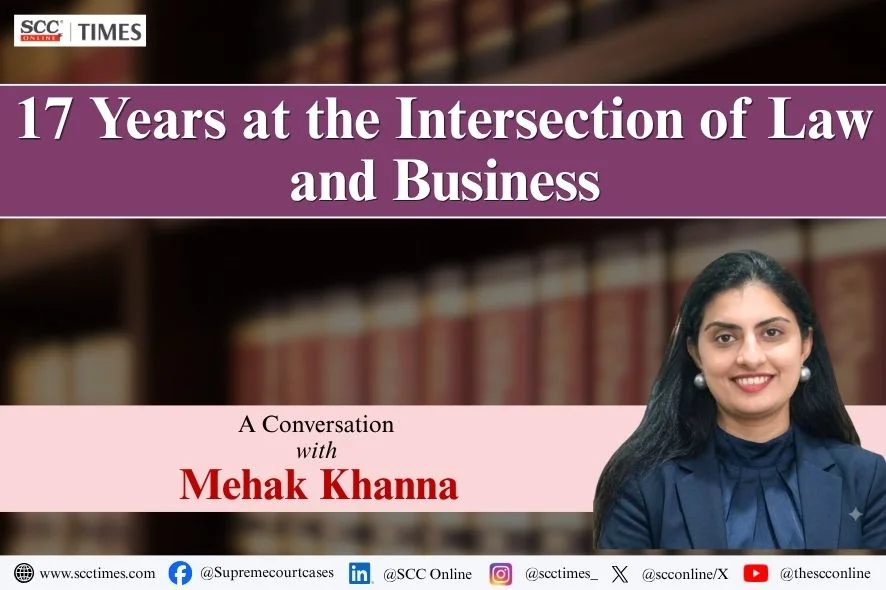
1. Kindly briefly introduce yourself to our readers and take us through the key milestones of your professional journey.
I am a corporate and commercial lawyer with over 17 years of experience spanning private practice and senior in-house legal roles. My career has included working with organisations such as Airtel and Lenskart, followed by my return to private practice as a Partner at Antares Legal. I have advised on Mergers and Acquisitions (M&A), private equity and venture capital, fundraising, commercial contracts, regulatory matters, and emerging businesses across technology, e-commerce, retail and other sectors.
2. You pursued an LLM in corporate and commercial laws from the London School of Economics and Political Science, graduating with high merit. How did your time at LSE influence your approach to corporate transactions and commercial problem-solving, particularly in the Indian legal and business context?
LSE gave me an international and analytical perspective on corporate and commercial law and exposed me to different legal frameworks. It also reinforced the importance of looking beyond the obvious legal issue to understand the engrained purpose and objective for every issue. That approach has been particularly valuable in India’s dynamic and evolving regulatory environment.
3. Your career spans private practice, in-house leadership roles, and now partnership at a law firm. Looking back, what were the most significant transitions in this journey, and how did each role contribute to shaping your understanding of corporate and commercial law?
Private practice gave me strong technical and transactional foundations, while my in-house roles at Airtel and Lenskart taught me to view legal issues through the lens of business priorities, risk and execution. Returning to private practice has allowed me to combine both perspectives, i.e., technical rigour with practical and business-oriented advice.
4. Having served as General Counsel and Chief Compliance Officer at companies such as Lenskart and Airtel, and now returning to law firm practice as a Partner, how would you compare the perspectives of an external advisor and an in-house counsel?
In-house counsels are deeply embedded in the business and understand its priorities, risk appetite and operational realities. Whereas external counsels bring independence, specialised expertise and experience across businesses. The best legal advice combines both perspectives. Legal teams should enable responsible innovation by identifying risks and offering workable solutions, rather than simply saying “no”.
5. You have played an active role in initiatives such as the Airtel Startup Accelerator Program and the Lenskart Accelerator. What are the most common legal and governance mistakes that start-ups make in their early stages?
Some companies defer legal and governance matters until the business has scaled. Common gaps include unclear founder arrangements, poor cap-table management, inadequate intellectual property (IP) ownership, weak day-to-day business contracts and insufficient regulatory planning. Building these foundations early is far easier and less expensive than fixing them later.
6. As Chief Compliance Officer at Lenskart and a legal leader across multiple jurisdictions, how do you see the role of compliance evolving from a regulatory requirement to a strategic business function?
Compliance is increasingly becoming an enabler of sustainable growth rather than merely a regulatory checklist. When embedded into business processes, it helps organisations identify risks early, make informed decisions and innovate with greater confidence. A strong compliance culture ultimately builds both resilience and trust.
7. You have advised clients across sectors ranging from telecommunications, fintech, e-commerce, gaming and digital platforms to sports, media and sustainability. How has the increasing convergence of technology and commerce transformed corporate legal practice?
Technology has made legal and business questions increasingly interconnected. Lawyers today need to understand not just contracts and corporate law, but also data, artificial intelligence (AI), technology, platforms and evolving regulatory frameworks. I expect AI, data-driven businesses, fintech, digital platforms, health technology and sustainability-related businesses to create some of the most significant legal issues of the next decade.
8. You have been recognised by Forbes among the best General Counsels under 40, honoured by ET Prime as an emerging woman leader, and acknowledged among global women leaders. How do you view the progress of women in leadership within the legal profession?
There has been meaningful progress, with more women taking on senior roles across law firms and businesses. Greater sponsorship, mentorship, objective career progression and genuinely inclusive workplaces will be critical to creating a stronger leadership pipeline in the long run.
9. A significant portion of your career involved advising direct-selling businesses, an industry that has historically occupied a complex regulatory space in India. How have you seen the legal treatment of direct-selling models evolve?
The regulatory approach has increasingly focused on distinguishing legitimate direct-selling models from prohibited pyramid or money-circulation schemes. The broader lesson for emerging digital businesses is to prepare for regulatory compliances. Building appropriate safeguards early creates greater certainty and supports sustainable growth.
10. Seventeen years into practice, are there deal terms or negotiation points that young corporate lawyers tend to obsess over but which, in your experience, rarely determine the ultimate success or failure of a transaction? Conversely, are there seemingly minor provisions that deserve far greater attention?
One can sometimes spend too much time negotiating points that have limited commercial impact. The focus should instead be on provisions affecting value, control, risk and execution. Conditions precedent, indemnities, liability caps, termination rights, governance, default scenarios and exits often deserve much greater attention. Good negotiation is about knowing what truly matters to the client.
11. With AI, data-driven businesses, cross-border capital flows and increasing regulatory intervention reshaping commerce, what does the next decade of corporate legal practice look like?
Corporate lawyers will increasingly operate at the intersection of law, technology, regulation and business. Strong technical foundations will remain essential, but commercial judgment, technological awareness, adaptability and the ability to communicate complex issues simply will become equally important. The best lawyers will be those who can translate uncertainty into practical, and actionable advice.
12. For young lawyers aspiring to build careers in corporate and transactional practice, what are the skills, habits or mindsets that proved most valuable but are rarely taught in law school?
Commercial curiosity, clear communication, sound judgment and resilience have been invaluable to me. Understanding why a client wants to do something is as important as understanding the law. I would also emphasise continuous learning, ownership of problems and building a reputation for integrity and reliability, qualities that become increasingly valuable over the course of a career.
1. Partner, Antares Legal.
2. EBC-SCC Online Student Ambassador, Tamil Nadu National Law University.