I. Opening Remarks: A Court Above the Passes
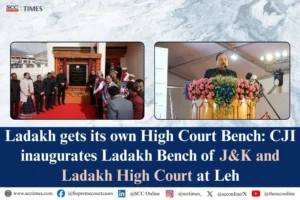
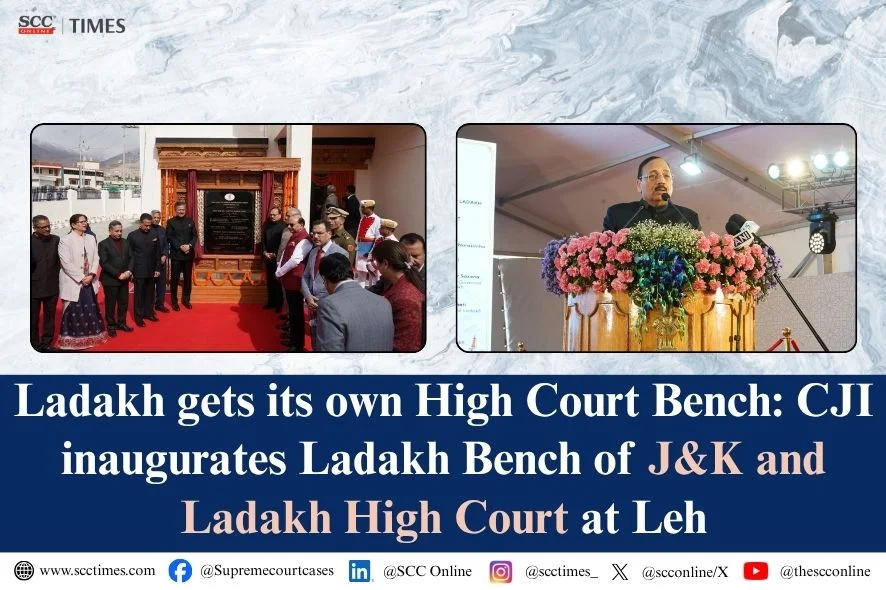
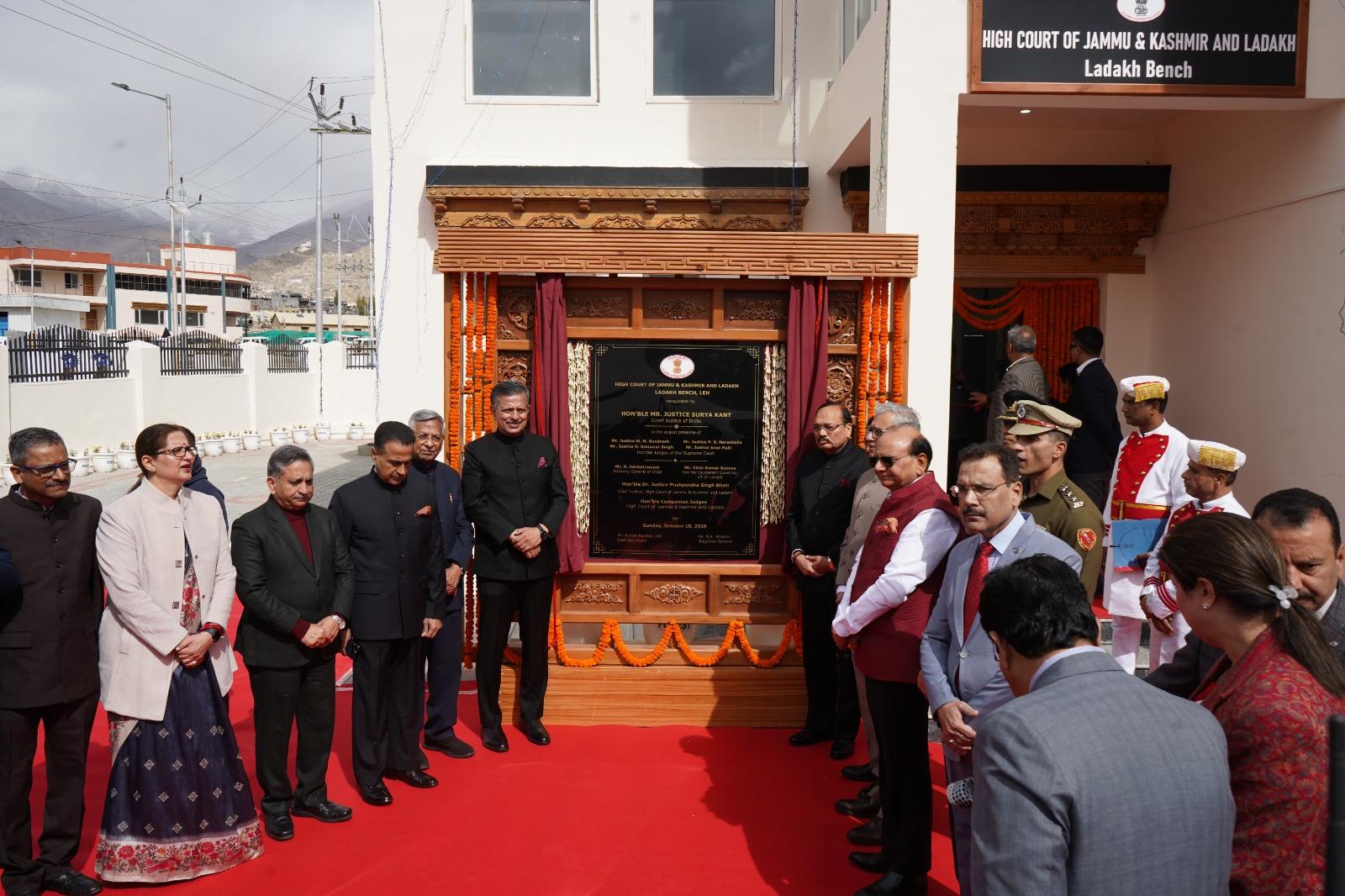
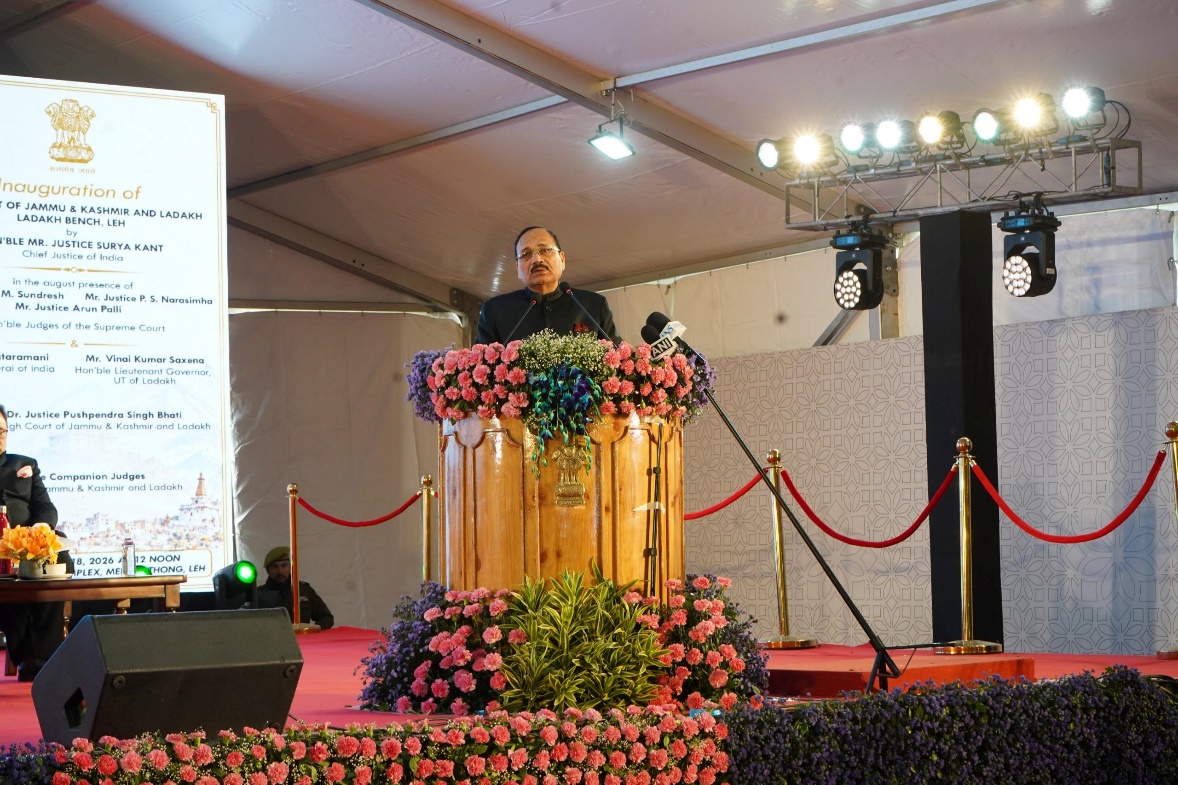
Addressing the inauguration of the Ladakh Bench of the High Court of Jammu & Kashmir and Ladakh at the High Court Complex, Melangthong, Leh, on October 18, 2026, the Chief Justice of India (CJI) described the occasion as another chapter in the story of justice in Ladakh, following the inauguration of new District Court complexes in Leh and Kargil in March.
Observing that the Court was situated approximately 3,500 metres above sea level, the CJI remarked that no High Court in the country had ever sat higher, as far as the CJI had been informed. However, the CJI emphasised that what mattered was not how high the Court sat, but how close it stood to the people it served.
II. A Land That Has Long Known Justice
Tracing the history of justice administration in Ladakh, the CJI observed that various methods of upholding justice existed in the region long before formal courts were established.
In villages, the goba (headman) settled disputes in accordance with thims, the community’s customary rules. The CJI also referred to the chuspon, or “lord of the water”, chosen by villages to ensure that every family received its fair share of water for irrigation, without fear or favour. The CJI observed that there could be no better description of what was expected of a Judge.
The CJI further recalled that a Special Court was established in Leh in 1870, when it was a prominent caravan town, to settle disputes involving its merchants. However, when the snows closed the passes, the Court closed with them. Although that Court had passed into history, the problem posed by the passes had persisted until the present day.
III. Across the Passes: The Long Road to This Day
The CJI observed that for close to a century, the High Court serving Ladakh remained beyond the Great Himalaya, reachable in winter only by air.
For a widow fighting for her pension, a mother seeking reunion with her child, or a senior citizen pursuing an insurance claim, the journey often cost more than the lawyer’s fee. Many could not undertake the journey at all, leaving their right to approach the High Court as a right on paper.
Referring to the reorganisation of Ladakh as a Union Territory in 2019, the CJI observed that the High Court had come to carry Ladakh’s name as well. However, the CJI emphasised that “a name on a Court’s letterhead is not the same as a Court at one’s doorstep”.
The CJI extended appreciation to the Government of India, the Lieutenant Governor of the Union Territory of Ladakh, and the High Court for bridging this distance. The CJI observed that the High Court had now crossed the passes to reach Ladakh instead of asking the people of Ladakh to cross the passes to reach it.
The CJI emphasised that the Bench belonged as much to Kargil as to Leh and that its purpose would be fulfilled only when every corner of Ladakh felt that the Circuit Bench of the High Court was its own.
IV. Access to Justice: Closing the Distance
The CJI observed that the establishment of a Bench in Leh alone would not ensure access to justice for families living in distant villages. Distance was measured not only in kilometres, but also in terms of what people did not know about their rights and what they could not afford.
Identifying technology and legal aid as two instruments to bridge this distance, the CJI observed that technology could bring the Court closer to the people, while legal aid could bring the people closer to their rights.
In a land characterised by vast distances, technology could achieve what roads could not. An electronically filed petition in Kargil could reach the Bench in minutes, a hearing could take place through video-conferencing, and a text message could inform a litigant of the next hearing date.
The CJI emphasised that facilitation centres such as e-Sewa Kendras must assist those who had never used a computer. Technology, the CJI cautioned, must be “a ramp into the Courtroom, never a new wall around it”.
The CJI further observed that technology could help only those who were able to approach the Court in the first place, highlighting the importance of legal aid for those who were unaware of their rights, could not afford a lawyer, or had no one to guide them.
Legal aid, the CJI stated, was not charity but a promise made by the Constitution that no citizen would be denied justice because of poverty or any other disability.
The CJI emphasised that fulfilling this promise required awareness camps in every village, para-legal volunteers who could act as the “first friend” of a person in trouble, competent lawyers providing legal assistance at no cost, Lok Adalats, and prompt compensation for survivors of crime.
Referring to the role of the Ladakh Legal Services Authority, the CJI observed that access to justice began not in the Court’s compound, but at the litigant’s doorstep.
The CJI also highlighted the responsibility of the High Court through its Legal Services Committee and expressed confidence that, working hand in hand with the Ladakh Legal Services Authority, it would discharge that responsibility by reaching every door in Ladakh where justice was still awaited.
V. Closing Remarks: Like the Sindhu
Before concluding the address, the CJI made an announcement regarding the hearing of matters originating from Ladakh before the Supreme Court.
The CJI stated that once video-conferencing facilities were adequately available to lawyers of the Ladakh Bench, the Supreme Court would list all matters coming from Ladakh on a single day and hear them on a day-to-day basis through video-conferencing as well.
The CJI expressed the desire that members of the Leh and Kargil Bars should be able to argue such cases before the Supreme Court without having to leave Ladakh, thereby sparing litigants the time and expense of travelling to Delhi. The CJI observed that this would ensure that distance no longer stood between the people of Ladakh and the highest Court of the country.
Concluding the address, the CJI referred to a child who might be studying in a classroom in Kargil or Nubra and who would one day argue her first case before the Ladakh Bench and perhaps even sit on its Bench as a Judge.
The CJI observed that when that day arrived, it would signify that the Bench had not merely arrived in Ladakh, but had taken root there.
The CJI dedicated the Ladakh Circuit Bench to the people of Ladakh.
The address concluded with the words, “Jai Hind, Jai Bharat”.