Delhi High Court: A Division Bench comprising Pratibha M. Singh* and Dinesh Bhatt, JJ., declared an arbitral award unenforceable against the borrower, noting the Axis Bank Ltd.’s (the Respondent Bank) concession awards passed by unilaterally appointed arbitrators are void ab initio, and observed that the repeated unilateral appointment of the same arbitrator by a party in multiple cases strikes at the very essence of neutrality envisaged under the Arbitration and Conciliation Act, 1996 (the Act), thereby rendering the resultant award void ab initio. While allowing the appeal, the Court directed the Respondent Bank & RBI to file its responses via fresh affidavits concerning the case at hand.
Background
In January 2019, the Respondent Bank disbursed a loan to the Appellant. Alleging that the Appellant had failed to repay the loan, the Respondent Bank initiated arbitration proceedings after communicating the same to the Appellant. In February 2023, the sole arbitrator (arbitrator) is stated to have accepted the reference and allegedly issued a notice to the Appellant. The Appellant disputed receipt of both communications.
The matter proceeded ex parte as against the Appellant by Order dated 16 May 2023 and an Award was passed on 26 May 2023. After receiving a copy of the award, the Appellant challenged it on the ground that it had been passed without the Appellant having knowledge of the existence of the arbitral proceedings.
A petition under Section 34 of the Act was filed before the Commercial Court which was dismissed as time barred. Hence, the present appeal was filed. The case was referred to mediation but the same failed. Moreover, during proceedings, the Court directed the Respondent Bank to file an affidavit on the arbitrator’s appointments, which disclosed that the same arbitrator had been appointed by the Bank in 4,155 cases.
Issue
Whether unilateral appointment of the same arbitrator by a party in multiple cases render the awards unenforceable against the other party?
Also Read: Bombay HC on validity of unilateral arbitrator appointments before 2015 amendment | SCC Times
Analysis
After hearing the arguments of the parties, the Court put forth few queries to the Respondent Bank which were answered as follows:
-
Whether there is any proof of service of the Appellant in the arbitral proceedings? – The Respondent Bank submitted that the notice was duly served at the Appellant’s last known address, which she had repeatedly disclosed in her pleadings and court documents. The award dated 26 May 2023 records that, despite such service, she failed to appear and was proceeded against ex parte. Her subsequent receipt of the award at the same address, and her failure to raise grievance of non-service of notices when seeking the arbitral record in the application addressed to the arbitrator, renders the belated plea contrary to the record and her own conduct.
-
Whether the sole arbitrator is connected to the Respondent Bank in any manner? – The Respondent Bank submitted that the arbitrator had no connection with Respondent whether through employment, engagement, consultancy, retainership, financial interest, or any other relationship contemplated under the Seventh Schedule to the Act.
-
Number of arbitrations handled by the sole arbitrator on behalf of the Respondent Bank. – As per the records of Respondent Bank, the arbitrator conducted 4,155 arbitrations over the past 4—5 years. Currently, no arbitration proceedings are pending or being handled by him on behalf of the Respondent Bank, and no subsisting appointment exists. The Respondent Bank has clarified that it has discontinued the practice of initiating arbitration proceedings through unilateral appointment of arbitrators.
-
Whether any declaration in terms of Schedule VI and VII of the Act was given by the said Arbitrator. — The Respondent Bank replied in affirmative.
Pursuant to the responses, the Court observed that there was no proof of service except the one recorded in the award dated 26 May 2023 by the arbitrator. Furthermore, even though the respondent bank claimed that the arbitrator had no relationship with it of nature as provided under Schedule VII, upon inquiry by the Court, it was found that the arbitrator’s fees was paid through the concerned lawyer of the Respondent Bank.
The Court further pointed out the whopping 4155 cases concerning the Respondent Bank in which the same arbitrator had been appointed. The Court observed the same to be in violation of Section 12 of the Act specifically with grounds provided under Schedule V of the Act as under:
“22. The arbitrator has within the past three years been appointed as arbitrator on two or more occasions by one of the parties or an affiliate of one of the parties.
xxx
24. The arbitrator currently serves, or has served within the past three years, as arbitrator in another arbitration on a related issue involving one of the parties or an affiliate of one of the parties.”
The Court noted that the Section 12 amendments took effect on 23 October 2015, but that unilateral appointments continued to be made by the Bank until 2023. It added that even under the unamended Section 12(1), handling thousands of arbitrations appointed by a single party would give rise to justifiable doubts as to independence and impartiality.
The Respondent Bank has submitted and agreed that the arbitral awards where it has made unilateral appointment of arbitrators, are void ab initio, in view of Supreme Court judgments in Perkins Eastman Architects DPC v. HSCC (India) Ltd., (2020) 20 SCC 760 and Central Organisation for Railway Electrification v. ECI SPIC SMO MCML (JV), (2025) 4 SCC 641. It has further disclosed that there was a total of 76,000 awards which had been passed by such arbitrators pan India concerning the Respondent Bank.
The Court opined that arbitrators appointed without filing proper declarations cannot be said to be independent & impartial. Repeated appointments of such arbitrators go against the core principle of neutrality which is the soul of any arbitral proceeding.
The Court observed that banks, as custodians of public money, cannot avail remedies contrary to law to recover loans, though defaulting borrowers cannot go scot free. It noted that the Bank, having conceded the awards are void, could neither enforce them nor recover the monies, and that an institutional solution would be needed.
Decision
In light of the above analysis, the Court allowed the appeal and held that since on behalf of the Respondent Bank the stand is that the award is void ab initio, the award dated 26 May 2023 stands unenforceable against the Appellant. The Respondent Bank was left free to take steps afresh, in accordance with law, if so permissible, to recover the loan amount in accordance with law.
The Court further instructed the Respondents to file respective affidavits by 16 November 2026 as:
-
Let a fresh affidavit be filed by the Respondent Bank giving the reasons as to why thousands of arbitration cases were being given to the same arbitrator.
-
The Bank shall also file an affidavit as to what is the future course of action that the bank wishes to adopt in respect of such awards which have been passed by unilaterally appointed arbitrators, including enforcement of such awards and steps taken for recovery of loan amounts.
-
Let RBI being the sectoral regulator, file its affidavit regarding guidance for any remedial measures need to be taken by other banks and financial institutions in respect of unilateral appointments.
The matter is part-heard and is listed for 17 November 2026.
[Shikha Ghosh v. Axis Bank Ltd., FAO (COMM) 91/2025 & CM APPL. 20542/2025, decided on 30-9-2026]
*Judgment authored by Justice Pratibha M. Singh
Advocates who appeared in this case:
For the Appellant: Vishal Gupta, Ratneswar Das, Barnali Deka Das and Swati Singh, Advocates.
For the Respondents: Dayan Krishnan and Ramesh Babu, Senior Advocates, Sanjay Kumar and Manisha Singh, Advocates.
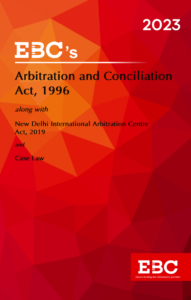
Buy Arbitration and Conciliation Act, 1996 HERE