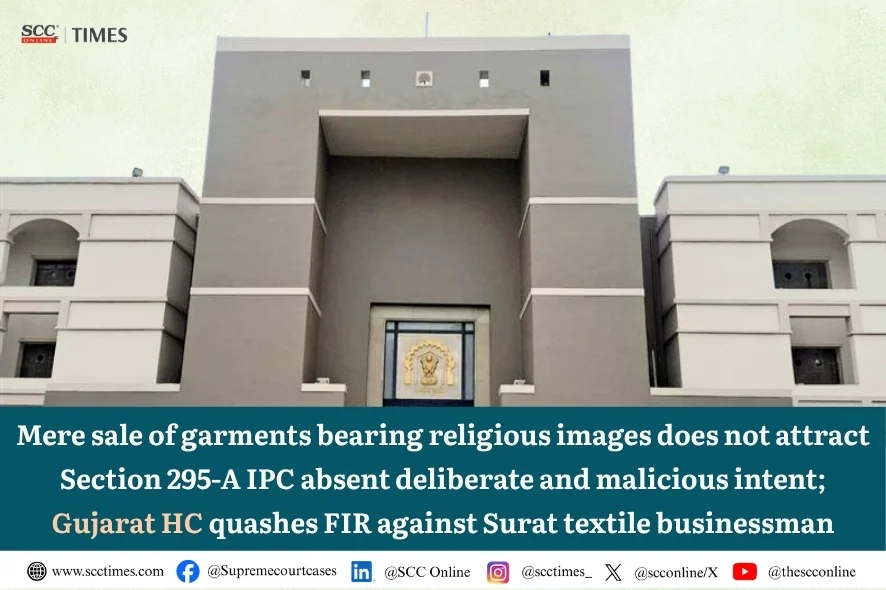
Gujarat High Court: In a criminal miscellaneous application filed under Section 482, Criminal Procedure Code, 1973 (CrPC), seeking quashing of an FIR registered under Section 295-A read with Section 114, Penal Code, 1860, (IPC), the Single Judge Bench of P.M. Raval, J., allowed the application and quashed the FIR and all consequential criminal proceedings qua the applicant, holding that mere sale of garments bearing religious images does not attract Section 295-A IPC absent deliberate and malicious intent.
Facts and Background
The de facto complainant was serving as the President of the Samast Yuva Ambedkar Samaj. The applicant was a businessman selling sarees and other textile materials bearing printed images of Lord Gautam Buddha. The complainant and other community representatives alleged that the images appeared on the lower portion of the garments, including the feet, border and pallu area and that the placement of the images was intended to degrade the revered figure and hurt the religious sentiments of their community.
Consequently, an FIR was registered for offences punishable under Sections 295-A read with Section 114 IPC. In the instant case, the applicant sought quashing of the FIR.
Issue for Consideration
Whether the allegations in the FIR, even when accepted at face value, satisfy the essential statutory ingredients of Section 295-A IPC?
Analysis
At the outset, the Court reiterated the settled principles governing the exercise of inherent powers under Section 482 CrPC. It relied on State of Haryana v. Bhajan Lal, 1992 Supp (1) SCC 335, wherein the Supreme Court had laid down seven illustrative categories of cases warranting interference to prevent abuse of the process of law or secure the ends of justice. These categories include cases where the allegations, even if accepted in their entirety, do not disclose any offence; the allegations are inherently improbable; a legal bar prohibits the institution or continuation of proceedings; or the prosecution is manifestly mala fide and instituted with an ulterior motive. The Court clarified that these categories are illustrative and not exhaustive, as no inflexible guidelines can be prescribed for exercising such extraordinary jurisdiction.
The Court relied upon Mahendra Singh Dhoni v. Yerraguntla Shyamsundar, (2017) 7 SCC 760, which discussed the principles governing Section 295-A IPC in the light of the Constitution Bench decision in Ramji Lal Modi v. State of U.P., (1957) 1 SCC 591. These decisions establish that Section 295-A does not criminalise every act of insult to religion or religious beliefs. The provision targets only aggravated forms of insult perpetrated with the deliberate and malicious intention of outraging the religious feelings of a class of citizens.
Applying these principles, the Court examined the photographs of the sarees and textile materials placed on record, along with the report submitted by the police inspector. Although the material indicated that sarees and other fabrics bearing images of Lord Gautam Buddha were allegedly being sold, the report also indicated that similar materials were being sold by other persons in Surat.
The Court found nothing in the photographs or the material on record to indicate that the applicant had deliberately and maliciously intended to insult a religion or outrage the religious feelings of any particular class. The applicant was engaged in the ordinary commercial activity of trading sarees and dress materials according to prevailing market trends. The mere presence of religious imagery on garments, even when positioned near the lower border or pallu, could not automatically establish the criminal intention required under Section 295-A IPC.
The Court concluded that the foundational ingredients of Section 295-A IPC were absent. The uncontroverted allegations, even when taken at face value, did not establish a prima facie case of aggravated religious insult against the applicant. Consequently, the prosecution could not be permitted to continue merely on the basis of the presence of religious images on commercially sold textile products.
Thus, the Court held that continuation of the criminal proceedings would constitute an abuse of the process of law and warranting the exercise of its inherent jurisdiction.
Decision
Allowing the application, the Court held that the material on record failed to establish the deliberate and malicious intention necessary to attract Section 295- A IPC and accordingly quashed and set aside the FIR along with all consequential criminal proceedings qua the applicant.
[Bharatbhai Hirjibhai Shankar v. State of Gujarat, R/Cl Misc. Appl. No. 854 of 2018, decided on 7-10-2026]
Advocates who appeared in this case:
For the Applicant: Rajesh K. Kanani, Advocate.
For Respondents: K. M. Antani, Additional Public Prosecutor, N. K. Majmudar, Advocate.