


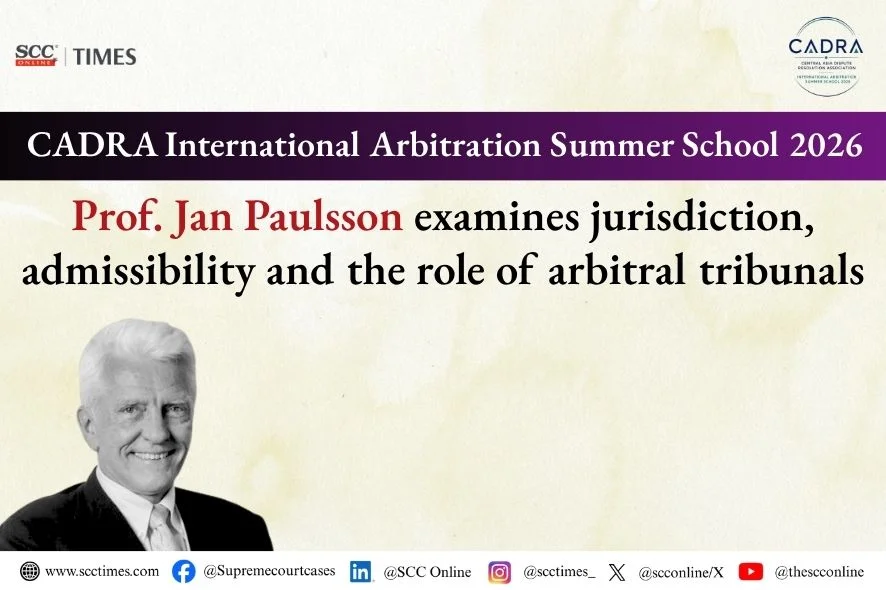
The Central Asia Dispute Resolution Association (CADRA) conducted its International Arbitration Summer School 2026 from 10 to 29 August 2026. It featured a session on “Jurisdiction, Admissibility, and Preliminary Objections”, led by Prof. Jan Paulsson, President of the Bahrain International Commercial Court (BICC) and moderated by Bokhodir Dadaev, President of the Supervisory Board of CADRA. The session focused on the distinction between jurisdiction and admissibility, the effect of contractual conditions precedent, the role of courts in reviewing arbitral decisions, and the treatment of objections concerning timeliness, prescription, waiver, mootness and exhaustion of remedies.
Jurisdiction and admissibility are not synonyms
Prof. Jan Paulsson began with what he described as a useful general way of approaching the distinction. Jurisdiction concerns the authority to decide a case, while admissibility concerns the power to decide a claim.
He cautioned against treating the two concepts as interchangeable simply because the rejection of a claim on either ground may produce a similar practical result. A tribunal may have jurisdiction over a case while finding that a particular claim is inadmissible.
According to Prof. Jan Paulsson, the distinction becomes particularly important because a finding on jurisdiction may be subject to review by a supervising court, whereas an admissibility determination generally concerns the particular claim before a tribunal that already possesses jurisdiction.
He acknowledged that the distinction is not always straightforward. There are cases in which two competing approaches can each appear logically defensible. The difficult questions arise at the margins, where the same objection may be characterised differently depending on what it is understood to affect.
A contractual time limit and a disputed arbitration deadline
To illustrate the distinction between jurisdiction and admissibility, Prof. Jan Paulsson discussed a dispute between an American company and a Dutch company.
Their contract provided for ICC arbitration seated in Switzerland. It also required arbitration to be commenced within 30 days after the parties had agreed that the dispute could not be settled.
A dispute subsequently arose. The claimant informed the other party that it intended to pursue the matter and sought a response. No response was received. About two months later, the claimant sent a further communication asserting that a dispute existed and that it should be resolved through arbitration. The respondent then objected that the contractual 30-day period had expired and that the claim was inadmissible.
The arbitral tribunal took a different view. It considered that the respondent should have responded to the claimant’s initial communication in good faith. On that reasoning, it treated the relevant period as beginning only when the respondent communicated its position and found that the arbitration had been commenced in time.
The Swiss Federal Tribunal subsequently annulled the arbitral tribunal’s decision1 and held that the 30-day requirement had not been satisfied. Prof. Jan Paulsson used the case to highlight the difficulty of determining whether such an objection concerns the tribunal’s jurisdiction or merely the admissibility of the particular claim.
Was the issue really one of jurisdiction?
Prof. Jan Paulsson said the case illustrates why the characterisation of an objection matters.
The arbitration agreement itself was not being challenged as invalid. The parties had agreed to arbitration and the tribunal accepted that the clause was valid. The dispute concerned whether the particular claim could proceed in light of the contractual 30-day requirement.
In his analysis, that made the issue one of admissibility rather than jurisdiction. The tribunal had jurisdiction to determine disputes under the contract. The question was whether the particular claim satisfied the contractual conditions for being heard.
He agreed with a participant’s observation that the difficulty lay in how the reviewing court understood the nature of the tribunal’s decision. The arbitrators had exercised their adjudicatory authority to decide an admissibility question. If that characterisation was accepted, the issue did not concern the existence of the tribunal’s jurisdiction as such.
The importance of identifying what the parties intended
Prof. Jan Paulsson suggested looking beyond the label attached to an objection and asking what the parties intended the contractual requirement to achieve.
In the Swiss case, the question was whether failure to comply with the 30-day requirement meant that the claim could no longer be arbitrated by the ICC tribunal, or whether the claim itself was lost.
If the intended consequence was that the dispute could no longer be heard by that tribunal, the objection would move towards jurisdiction. If the requirement concerned whether the claim should be heard at all, or should be heard at that stage, it would ordinarily concern admissibility.
He considered it difficult to infer that the parties had intended a procedural time limit to remove the tribunal’s authority altogether. In his view, the more natural purpose of such a requirement was to prevent disputes from remaining unresolved indefinitely.
What counts as an admissibility objection?
Prof. Jan Paulsson then proposed a broader framework for identifying objections that ordinarily belong to the tribunal with jurisdiction over the dispute. He referred to timeliness requirements and conditions precedent, including obligations to attempt conciliation before commencing arbitration. He also placed extinctive prescription, waiver of claims, mootness, the absence of a legal dispute and the absence of an indispensable third party within the category of matters that could generally be resolved by the tribunal.
He also discussed the exhaustion of remedies. Drawing on the distinction between a tribunal’s authority and the viability of a particular claim, he treated exhaustion of remedies as an issue of admissibility rather than jurisdiction.
Standing, however, may require a more careful analysis. Prof. Jan Paulsson noted that the answer depends on whether the issue goes to the scope of jurisdiction under the relevant instrument, such as whether a person falls within the definition of “investor” under a bilateral investment treaty.
A practical test: what happens if the objection succeeds?
Prof. Jan Paulsson offered what he regarded as a useful way of approaching difficult cases: examine the consequence of a successful objection.
Where the objection means that the claim should not be brought before the particular forum that has been seized, the issue will ordinarily be jurisdictional and may be subject to further recourse.
Where the objection means that the claim should not be heard at all, or should not yet be heard, the issue will ordinarily concern admissibility. On this approach, the tribunal’s decision should generally be final rather than subject to correction by a supervising court.
He described this as a useful conceptual framework rather than a formula capable of resolving every case. There remain areas of uncertainty in which the classification can be debated.
Contractual ADR requirements and conditions precedent
The discussion then turned to clauses requiring negotiation or mediation before arbitration.
Prof. Jan Paulsson’s position was that where parties have contractually undertaken to participate in a mediation or negotiation process, the arbitral tribunal with jurisdiction should decide whether that obligation has been fulfilled. The question remains part of the tribunal’s adjudicatory function rather than automatically depriving the tribunal of jurisdiction.
He drew a distinction between two issues. The first is whether the contractual requirement to engage in mediation or negotiation has been complied with. The second is the broader question of whether attempting settlement is practically worthwhile.
A tribunal can examine what the parties actually did. It can determine whether a party participated, refused to participate or otherwise failed to comply with the contractual obligation.
When pre-arbitration negotiations become a procedural impasse
The final part of the session addressed a more difficult situation: where one party insists that mediation or negotiation must occur even though the other party considers the process futile.
Prof. Jan Paulsson acknowledged the practical frustration this can create. A claimant may believe that the respondent is using a contractual negotiation requirement simply to delay arbitration, while the respondent may insist that the precondition has not been satisfied.
Rather than proposing a universal rule, he suggested that the tribunal could establish concrete procedural landmarks for the settlement process. It could determine what issues should be discussed, for how long, and when the parties would be permitted to move to arbitration if no resolution emerged.
He stressed that there could be no single model for every dispute. The appropriate approach would depend on the circumstances of the particular case, including the conduct and positions of the parties. At the same time, the tribunal could bring structure and closure to the process by setting clear parameters for the required settlement effort.
Treaty claims and contractual claims may create a second layer of complexity
Prof. Jan Paulsson also examined cases in which a contractual dispute intersects with treaty-based claims.
He referred to SGS v. Philippines,2 where SGS had entered into a service contract with the Philippine Government containing a clause requiring disputes to be referred to the Philippine courts. SGS nevertheless commenced proceedings before the International Centre for Settlement of Investment Disputes (ICSID) under the Switzerland-Philippines bilateral investment treaty.
The tribunal found that it had jurisdiction because the treaty was broadly framed and SGS had alleged breaches of the treaty. At the same time, it held that the existence of treaty jurisdiction did not automatically override the contractual forum clause for contractual claims. Where the essential basis of a claim was a breach of contract, the valid contractual choice of forum remained relevant.
Prof. Jan Paulsson used the example to show how jurisdiction and admissibility issues can become more complex where contractual and treaty avenues coexist.
International courts, arbitral tribunals and supervising courts
The session also considered the different institutional settings in which these questions arise.
Prof. Jan Paulsson distinguished the position of an international court such as the International Court of Justice from that of an arbitral tribunal operating within a national legal framework. In the case of an international court without an appellate mechanism, the practical significance of the distinction may operate differently because there is no supervising court available to overturn the institution’s characterisation.
The position becomes more consequential in commercial arbitration. An arbitral tribunal may determine that it has jurisdiction, while a national court at the seat may subsequently be asked to review that determination.
The Swiss case therefore served as more than an example of a difficult contractual clause. It demonstrated how the classification of an issue can affect the extent to which a supervising court may intervene.
The Model Law question
A participant raised another issue: whether admissibility is always recognised as a distinct concept under national arbitration legislation, particularly where the UNCITRAL3 Model Law4 on International Commercial Arbitration 19855.
Prof. Jan Paulsson agreed that the legislative framework of the relevant jurisdiction matters. He noted that he had spent nine years working on the Model Law and regretted that it did not contain a specific provision addressing admissibility. At the same time, he maintained that, as a conceptual matter, questions concerning the acceptability of a particular claim should generally be determined by the tribunal that has been given jurisdiction over the dispute. Where positive legislation provides otherwise, the statutory framework would have to be considered.
A continuing area of debate
In responding to questions, Prof. Jan Paulsson acknowledged that the distinction between jurisdiction and admissibility remains partly academic and conceptual. Yet he observed that its importance becomes apparent when an actual dispute turns on the classification.
He suggested that the areas of uncertainty may be narrowing as tribunals and courts become more accustomed to asking whether an objection concerns the decision-making authority of the tribunal or the disposition of a particular claim. Some difficult cases nevertheless remain.
The session concluded with Prof. Jan Paulsson returning to what he regarded as the fundamental question: whether the parties have given the particular decision-making body authority to decide the issue before it. The classification of an objection, in his view, should ultimately be examined through that lens rather than through terminology alone.
1. Transport en Handelsmaatschappij “Vekoma” B.V. v. Maran Coal Corp., Swiss Federal Tribunal, 17 August 1995
2. SGS Société Générale de Surveillance S.A. v. Republic of the Philippines (ICSID Case No. ARB/02/6)
3. United Nations Commission on International Trade Law
4. A Model Law designed by UN to assist States in reforming and modernizing their laws on arbitral procedure and align it with the particular features and needs of international commercial arbitration.
5. along with amendments as adopted in 2006





