


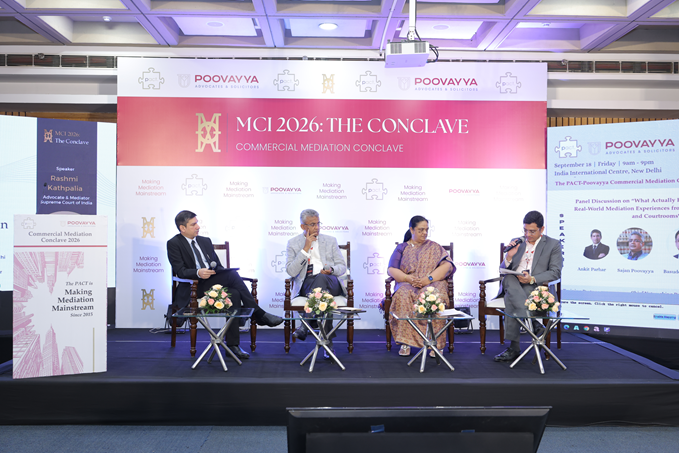
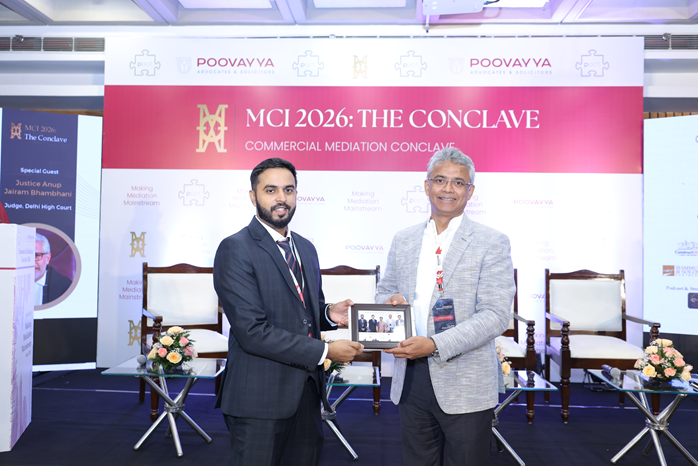
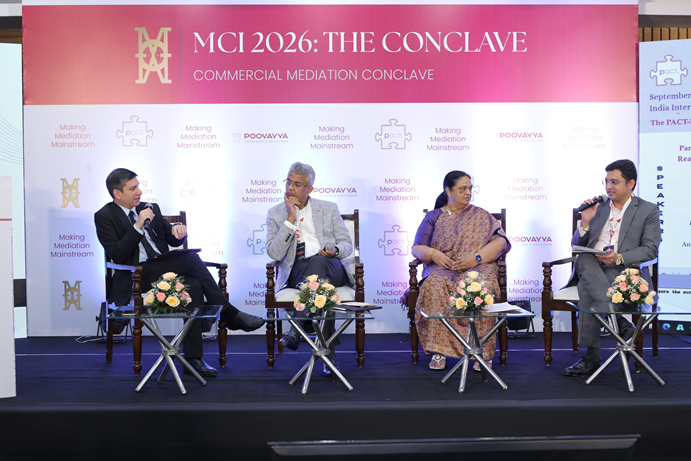
The Commercial Mediation Conclave India 2026, themed “Making Mediation Mainstream”, was organised by The PACT and Poovayya & Co. and held on 18 September 2026 at the India International Centre, New Delhi. One of its panel discussions, “What Actually Happens in the Room, Real-World Mediation Experiences from Indian Boardrooms and Courtrooms”, brought together perspectives from litigation, banking and in-house practice to examine mediation not as a policy proposition but as a lived professional experience.
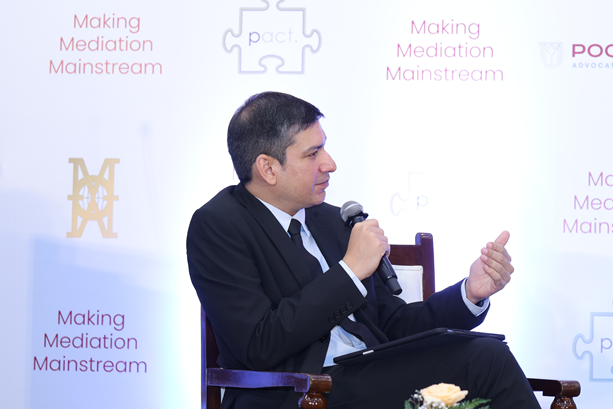
The panel was anchored by Ankit Parhar, Partner at Poovayya & Co., who also contributed substantively at several points in the discussion. The panellists were Sajan Poovayya, Senior Advocate at the Supreme Court of India, Beena Vaheed, Executive Director at Bank of Baroda, and Basudeb Biswas, General Counsel at TARC. Mr Parhar opened by noting that the panel deliberately combined a litigator, a commercial banker and an in-house general counsel, so that the discussion would draw on the room, the boardroom and the courtroom in the same conversation.
The biggest advantage, and the biggest disadvantage
Mr Parhar began by asking each panellist, from personal experience, to identify the single biggest advantage and the single biggest disadvantage of mediation, inviting Mr Poovayya to answer first.
Mr Poovayya chose to begin with the negative. In his assessment, the greatest disadvantage in commercial mediation in India, one that had not changed in the thirty years he had practised, was the continuing shortage of specialist mediators with a genuine understanding of commercial subject matter before they attempt to mediate a dispute. Turning to the advantage, he pointed to the certainty, time and cost benefits mediation offers over adjudication. Even a party that wins decisively, he observed, including a victory in the Supreme Court, may find that its commercial relationship with the other side is dead by the time judgment arrives, and that it will never do business with that party again given the bitterness the fight has produced. Wherever the parties regard the underlying transaction as more important than the dispute itself, mediation, in his experience, is the better route, because it resolves the matter one way or another while keeping the business relationship alive.
Ms Vaheed answered next, prefacing her remarks with what she called a disclaimer, that as a non-lawyer on a panel and in a room of lawyers, her perspective would necessarily be different. From a banker’s point of view, she identified speed of resolution as the principal advantage. She explained that a large amount of a bank’s capital sits blocked in provisions held against non-performing assets, so that unlocking a settlement also unlocks that provision, which flows directly into the bank’s profits. She added that mediation preserves confidentiality over client details and account information that would otherwise enter the public domain through litigation, and that it allows for flexible outcomes, including partial settlements and phased settlements that adjudicated processes do not readily accommodate. On the disadvantage side, she pointed to accountability. Unlike some private sector banks, public sector banks have no settlement framework built into their internal processes, so that the prospect of audit and vigilance scrutiny hangs over any officer who settles through mediation. Mr Parhar observed that the difficulty was not confined to public sector banks alone, noting that the wider public sector faces the same problem wherever mediation lacks institutional backing.
Mr Biswas offered a different framing entirely. Speaking from what he described as a user’s perspective, he said that India does not have a mediation problem, it has a doorway problem. He illustrated this with figures drawn from a Rajya Sabha reply given on 26 January. Under Section 12A of the Commercial Courts Act, 2015, some 2,76,676 pre-institution mediation applications had been filed, of which 2,30,791, or 83 per cent, were closed as non-starters, meaning the other party simply did not show up. Settlements across seven years numbered only 5,854, a rate of roughly 2.12 per cent. Yet, he pointed out, this was only part of the picture. Delhi’s court-annexed mediation centre had achieved a settlement rate of around 57 per cent among the cases that actually proceeded, Bengaluru’s centre around 65 per cent, and the conciliation forums of MahaRERA, the Maharashtra Real Estate Regulatory Authority, settled roughly three or four in every ten complaints referred to them. The conclusion he drew was that mediation itself works. What fails is the mindset parties bring into the room, or rather their reluctance to enter it at all. That reluctance, not the mediation process, is the real doorway problem.
On the advantages, Mr Biswas agreed that mediation is cost effective, fast, and flexible, and, echoing Mr Poovayya, that it helps restore a relationship that adversarial proceedings would otherwise damage beyond repair. But he was equally direct about the disadvantages as they appear from inside a company. As in-house counsel, he said, he is often settling in the dark, without full visibility of the other side’s records or the actual strength of their claim, while still having to put a number on the dispute. He also described a benchmarking problem that is particular to a high-volume consumer business. The first settlement a company agrees to, whether with a retail customer or a homebuyer, sets the benchmark for every claim that follows. Finally, he pointed to a cultural gap within the business itself. An industry that routinely cites judgements and arbitral awards as precedent has not yet learned to treat a mediated settlement the same way, and until it matures in that respect, he said, these disadvantages will continue to hold mediation back.
Why litigants stay away, and the pull of matrimonial numbers
Mr Parhar noted that every panellist had found real advantages in mediation, and turned the question around, asking Mr Poovayya what, in his experience, actually prevents litigants from participating in mediation in a meaningful way, given that more than 60 per cent of applications in Delhi alone are non-starters, and that only around 5,000 disputes have been resolved through mediation against a backdrop of roughly five crore pending cases nationally.
Mr Poovayya’s answer began with a challenge to how mediation’s success is measured at all. He argued that India tends to celebrate or criticise mediation based on statistics that tell only part of the story, because the overwhelming majority of matters referred to mediation are matrimonial disputes, small property disputes and disputes over family succession. This has produced what he called a dangerous over-dependence on treating mediation as a mechanism for resolving disputes between relatives rather than between commercial partners, and even within that matrimonial category the success rate is under two per cent. As he put it, dismissively, many of those disputes amount to little more than “my dog and your cat had a fight.”
The real issue, in his view, is not that commercial mediation fails once attempted, but that commercial matters rarely reach a structured mediation at all. Most land instead in pre-institution mediation under Section 12A, which lawyers and clients alike treat as a procedural checkbox to be cleared before litigation can begin, rather than as a genuine opportunity to settle. Wherever mediation is approached as a task rather than as a venture worth pursuing its own terms, he said, it is bound to fail. He was equally blunt about where responsibility lies closer to home.
“Most lawyers, and that includes me, look at reference to mediation as a sign of weakness with the client.”
Advising a client to mediate, he explained, is too often read by the lawyer as an admission that the case cannot be won outright. Yet, as he put it, a party can win the battle after eight or ten years in the Supreme Court and still lose the war, because by the time victory arrives the underlying business has already crumbled.
“You really don’t have to win a battle and lose the war.”
To illustrate the point, Mr Poovayya recalled the BPL dispute of 2000, one of the largest commercial battles in South India at the time, which moved through the Company Law Board, the High Courts and international arbitration in Paris before finally being resolved through mediation, with a settlement of 1.2 billion US dollars paid to the other side. That outcome, he noted, is rarely celebrated as a mediation success story, precisely because it did not arise from an institutional mediation process but from the intervention of a well-wisher who persuaded the parties and their lawyers to talk. The lesson he drew was that commercial mediation in India needs to be institutionalised, beginning with a proper panel of specialist mediators across sectors such as real estate, intellectual property, oil and gas, and electricity. He offered a pointed example, a dispute over a high-voltage direct current transmission line between Bombay and Chhattisgarh, worth some 12,000 crore rupees, for which he said he could not identify a single domain specialist mediator currently practising in the country.
Mr Poovayya distinguished this from the more familiar, low-stakes failures of party consent, such as a husband willing to mediate while his wife declines because a relative has advised against it, which he said carries no real significance in the commercial sphere. Where two well-resourced commercial parties, a good specialist mediator and encouragement from courts and lawyers are all present, he said he could see no good reason why the other side would not come to the table. Mr Parhar interjected that, institutionally, they will, but that the country still lacks the institutional framework to make that happen consistently, adding that Section 12A has become more of a checkbox exercise than a genuine gateway, not helped by courts routinely granting exemptions from it.
A banker’s view, what makes an account fit for mediation
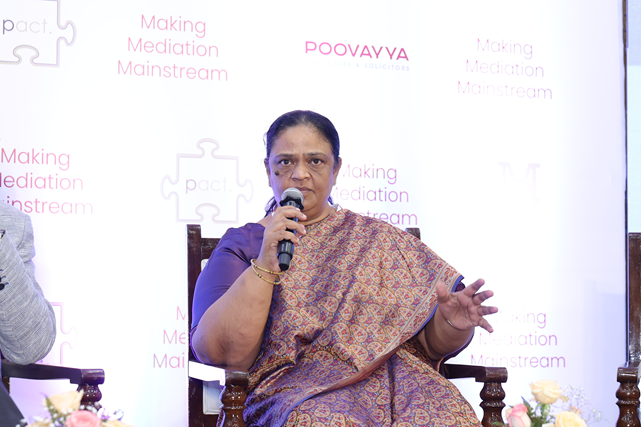
Mr Parhar turned to Ms Vaheed, observing that a large institution such as hers inevitably carries more bureaucracy as it grows, and asked what actually drives an organisation like Bank of Baroda towards embracing mediation, and what might remove the reservations that hold it back.
Ms Vaheed explained that the disputes best suited to mediation are genuine disagreements between a customer and the bank over documentation, collections or the interpretation of contractual terms, rather than cases involving wilful default or a fraudulent account. She distinguished these from accounts where the underlying business remains viable and where both sides have an interest in preserving it, as opposed to accounts where the relationship is effectively already over. What drives the bank towards mediation, she said, is ultimately the capital that sits idle, locked into provisions held against non-performing assets, together with the additional lending capacity that unlocking those provisions makes available. Mediation, in her view, offers a degree of certainty of recovery, provided the other party is genuinely willing to engage, and it allows a workable business relationship to continue rather than closing it off entirely. Mr Parhar noted that this appeared to be a common thread across both commercial and banking mediation, that an interest in preserving the relationship is itself an important catalyst for settlement.
Four filters behind a developer’s choice of forum
Turning to Mr Biswas, Mr Parhar asked how a business like TARC decides, in practice, when a dispute should be litigated and when it should be mediated, using the example of a real estate developer settling with one homebuyer on terms, such as a refund plus 6 per cent, that would inevitably set a benchmark for every other claim.
Mr Biswas explained that he had never approached the choice of forum as a question of who was likely to win. In his words, the choice of forum is not a merits question; it is a control question. He described four filters that, in his experience, actually drive the decision. The first is whether the counterparty is a repeat player, such as a contractor or a landowner the business cannot simply walk away from, since an incentive to preserve that ongoing relationship, a point on which he found himself agreeing with both Mr Poovayya and Ms Vaheed, becomes a major factor in choosing mediation over a fight. The second is whether the business needs a public finding on record, a document that establishes, for instance, that the company’s position aligns with the listing regulations of the Securities and Exchange Board of India, which matters particularly for a listed developer such as TARC.
The third filter, which Mr Biswas described as the most important, is whether all the relevant decision makers can be brought into the same room on the same day. He identified the single biggest point of failure in mediation as a session that runs an entire day only for someone to say, at four in the afternoon, that the matter will have to go back to their seniors before it can be settled. In that gap, he said, the other side inevitably hardens overnight, exposed to naysayers who speculate about what might have been lost by settling. He recalled cases that could genuinely have been resolved through mediation collapsing back into a full-blown fight for exactly this reason, ending up, in his words, neither here nor there. The fourth filter is the carrying cost of time, which he was careful to distinguish from legal fees, describing legal costs as in fact the smallest line on the overall cost sheet.
The cost of staying in litigation
Mr Biswas set out how project economics shape that calculation. A developer’s interest cost on the land or the project, together with the damages payable to a landowner if a project is not completed within its typical twelve to eighteen month window, are largely fixed and predictable. Weighed against a project horizon of five to seven years, he said, a prolonged fight with a party the business will encounter again simply does not make commercial sense. He noted, too, that parties in commercial disputes often wait until pleadings are complete before considering mediation, because that is when each side can finally assess how well or badly the other has prepared its case. In his experience, commercial disputes turn far more on preparation and common sense than on the underlying law, and a party is naturally reluctant to settle before it knows what argument the other side intends to run.
Set against the timeline of litigation, he argued that caution carries a real cost. Citing recent sample studies, he noted that a challenge to an arbitral award under Section 34 of the Arbitration and Conciliation Act, 1996, typically adds around three and a half years before resolution, and an appeal under Section 37 adds roughly six years more, so that what began as arbitration ends up as a longer and costlier litigation in all but name, with rare instances of awards even being reversed through curative petitions. Acknowledging Mr Poovayya’s earlier point about victories that arrive too late to matter, Mr Biswas offered his own image of the cost involved.
“By the time you reach finality, you have given away so much, Shylock’s pound of flesh along with the quart of blood that Antonio saved, that you realise it was not worth it.”
He added that TARC has seen arbitrations concluded in under a year, while a Section 34 challenge in a separate matter has remained pending for seven, which illustrated for him the limits of what any party can control. An arbitral tribunal can be pressed to keep its timelines, he said, but once a matter is in court, it is out of the parties’ hands entirely.
Hard infrastructure exists, soft infrastructure does not
Mr Parhar observed that, on the evidence of the discussion so far, almost no one in the room seemed genuinely opposed to mediation, apart perhaps from a party with little merit in its case, and yet institutions were still not driving mediation forward, with litigants doing most of that work themselves despite a statutory framework that already includes the Mediation Act and mandatory pre-institution mediation. He asked Mr Poovayya what he considered the largest gaps in India’s mediation infrastructure.
Mr Poovayya divided the question into hard infrastructure and soft infrastructure. Hard infrastructure, in his description, covers legislation, institutions and the physical and administrative machinery that supports them, and on that front, he considered India to have made real progress, even though it took years to get the Mediation Council functioning, a development he saw as a positive step this year. The gap, in his assessment, lies almost entirely in soft infrastructure, the surrounding culture that determines whether mediation is treated as a genuine opportunity or merely another box to tick. He illustrated the distinction with an analogy about washing one’s feet before entering a temple, sprinkling a token amount of water regardless of how dirty it is, not because clean feet are the real objective, but because the ritual itself has become the point.
He proposed that soft infrastructure needs to be built in three or four distinct ways. First, commercial mediation should not be confined largely to the pre-institutional stage, since parties tend to keep their positions close to their chest at that early point and only become genuinely open to mediation once pleadings are complete. Mediation midway through litigation, he argued, should be seen as a good sign rather than a bad one, since it reflects a dispute that has matured enough for both sides to understand what they are actually fighting over, and it should ideally be initiated by the courts themselves. He was critical of the extent to which Indian judges nudge parties towards mediation after this kind of diagnostic assessment of a case, noting that the Supreme Court has begun doing more of this, but expressing a wish that more High Courts and commercial courts followed suit, particularly since roughly 80 per cent of commercial disputes are heard by district-level commercial courts outside Delhi, Kolkata and Mumbai, and even a city such as Bengaluru sends its largest commercial matters to the city civil and commercial court rather than the High Court.
Second, he placed responsibility squarely on lawyers, and commercial litigators in particular, for treating a reference to mediation as an admission of weakness in either the case or their own ability to win it, arguing that this cultural attitude needs to change from within law firms themselves, led by senior partners. Third, he pointed to institutions such as banks, where he argued that boards, rather than statutory mandates, need to build softer internal processes that give officers the freedom to choose a mediated settlement without fearing that the decision will later be second-guessed by a Central Vigilance Commission inquiry. Fourth, and finally, he returned to the institutions created under the statutory framework itself, principally the Mediation Council, whose central task, in his view, is to build a genuine panel of specialist commercial mediators, rather than relying on the same generalist mediators who currently handle matrimonial and family disputes.
Why a generalist mediator struggles with a specialist dispute
Mr Poovayya returned to this theme with a detailed example drawn from his own practice. In his experience over thirty to thirty-two years as a commercial litigator, no party to a serious commercial dispute is willing to trust a generalist mediator with the matter. He described a thermal power generator, with a 1,200 megawatt facility running on imported Australian coal, in a dispute worth several lakh crore rupees with the Maharashtra State Electricity Distribution Company Limited, which he described as one of Asia’s largest power distribution utilities, arising from a claim for tariff renegotiation under a fifteen or twenty five year power purchase agreement. He asked, rhetorically, what a retired generalist judge sitting as mediator could be expected to know about energy law, how tariffs are structured, how imported coal is handled, or what a station heat rate is and how it affects tariff calculations over the long term.
“Why will you go and sit before them, have a cup of tea and some biscuits, and say, oh, why don’t you look at it, I know this promoter of yours, I know that promoter of yours?”
Such a mediator, he suggested, will be told everything sounds agreeable, only for the same mediator to report back in the evening that the matter needs to go to the board after all. His conclusion was that institutions must build capacity among people who understand commercial and technical fields well enough to mediate them, rather than continuing to draw exclusively on senior lawyers acting as generalists.
Venue, incentive and the economics of arbitration
Mr Poovayya added a further, more practical observation, that the physical infrastructure for mediation should never be located close to the courts. He described the experience of attending the Delhi High Court Mediation Centre as a genuine ordeal in itself, from the difficulty of finding parking, to obtaining a pass, to the absence of proper rooms and waits of forty-five minutes or more, so that by the time both parties actually sit down, whatever goodwill they had brought with them has largely evaporated. On a lighter note, he suggested that mediation and arbitration have together become what he called a cash-yielding cow for lawyers looking to slow down their litigation practice, and retired judges. He recounted a conversation over dinner with a retired judge who, asked how his experience of arbitration was going, offered a wry summary of his own career.
“My aim was to do well in the profession and become a judge. Now I am a retired judge and I am arbitrating. But my aim for the next life is to become a retired judge without becoming a judge, because the meat is in a retired judge.”
Reading a mediation clause from the business side
Mr Parhar asked Mr Biswas how a business such as TARC actually experiences a standard mediation clause or a pre-institution mediation requirement in practice, whether it is treated as a welcome opportunity or as one more procedural layer and obstacle.
Mr Biswas said that, more often than not, businesses do experience it as an additional layer, and that this wariness is grounded in real experience rather than being irrational. Building on Mr Poovayya’s point about timing, he argued that placing mediation at a stage before either party feels any real pressure to settle is rarely going to succeed. He suggested that if mediation were instead positioned immediately after a party had secured, for example, a favourable interim injunction, settlement rates would change dramatically. For a business like his, the underlying question is always whether mediation represents a high-yield option, weighed against the same considerations that shape any other decision, whether it can be justified to the board, whether it helps preserve a business relationship, whether it translates into measurable numbers, and whether it will satisfy an audit function that, for a listed developer, matters just as much as it does for a public sector bank.
He also pointed to a personal accountability concern that rarely surfaces in public discussion, namely that an in-house counsel who moves from one company to another may later be questioned about why a particular dispute was resolved through mediation rather than adjudication, even though such decisions are not always formally recorded. Even so, he said, when a decision is genuinely taken for the company’s benefit, what ultimately matters is that no business owner goes to court merely to establish a legal principle. Most owners simply want a level playing field on which to negotiate with the counterparty, which is also why the great majority of commercial suits and money claims that are filed do eventually settle outside the courtroom, since continuing to litigate rarely serves anyone’s commercial interest once that stage is reached.
Mr Biswas proposed three concrete practices capable of changing how mediation clauses actually function in business. The first is a written mandate agreed before anyone enters the room, of the kind more commonly associated with board resolutions or the appointment of a company representative, giving that individual clear authority to settle up to a defined amount so that the person conducting the mediation is not left waiting for approval from someone who is not even present. The second is a one-page settlement architecture agreed in advance, so that negotiators are not shuttling back and forth between the room and their lawyers while draft settlement terms take weeks to finalise. The third is ensuring that executable consent terms are carried into the room itself, so that an agreement can be signed on the spot rather than the parties leaving with nothing more than a further round of drafting ahead of them. Adopted as standard practice, he argued, these three steps could make mediation a genuinely more viable route, pointing to MahaRERA as an example of a forum where the dispute is understood simply as one between a customer and a builder, and observing separately that mediation has also proved to be one of the most effective ways of resolving disputes within large family-owned business offices, an outcome he described as undisputed and proven to work, provided the parties genuinely intend to make it work.
What boardrooms need before mediation can work
As the panel moved towards closing remarks, Mr Parhar asked Ms Vaheed what she believed was needed to make mediation genuinely mainstream in Indian boardrooms, beyond the statutory framework already in place.
Ms Vaheed said that Mr Biswas had already covered much of the ground and agreed that bringing mediation meaningfully into the boardroom requires pre-approved internal processes that banks currently lack. She contrasted this with the range of settlement mechanisms banks already operate under, from schemes falling under the Reserve Bank of India’s umbrella, to One-Time Settlement policies, to settlement through Lok Adalats, none of which yet has an equivalent for mediation. Formal policies and guidelines, she argued, would save considerable time, since negotiating teams currently have to keep stepping in and out of the mediation room simply to check whether they may agree to a particular term, rather than being given the headroom and guidance to settle on the spot.
She said the underlying requirement is for the board to empower the team conducting the mediation. She added that the customer’s expectations matter here too, since a customer facing what feels like a faceless institution understandably wants to see someone with genuine seniority and authority sitting across the table, a consideration that carries less weight with a small retail or MSME customer but becomes considerably more important with a large corporate counterparty or another institution, where the other side, in her view, should genuinely have both that option and that authority, conducted in good faith and nothing more elaborate than that.
Closing remarks, mediation begins within the cohort
Closing the discussion, Mr Parhar asked Mr Poovayya where he believed the real problem still lay, and what would actually move mediation towards the mainstream.
Mr Poovayya’s closing view was that, much as charity begins at home, the responsibility is fundamentally an internal one, resting with lawyers, law firms and the clients who receive mediation, whether from the public or the private sector, to begin the process themselves rather than waiting for an external institution or statutory framework to impose it from above. He argued that a top-down structure, appropriate enough in litigation, where parties are simply bound to whatever outcome results, is essentially foreign to the spirit of mediation, which depends instead on a culture of mediation taking root within the cohort of parties themselves. Without that shift, he concluded, no amount of legislative architecture, and no amount of money spent chasing new institutions, would by itself produce more mediated settlements in commercial disputes.
Mr Parhar thanked the panellists for their insights and closed the session, noting that the panellists would remain available afterwards for anyone with further questions.





