


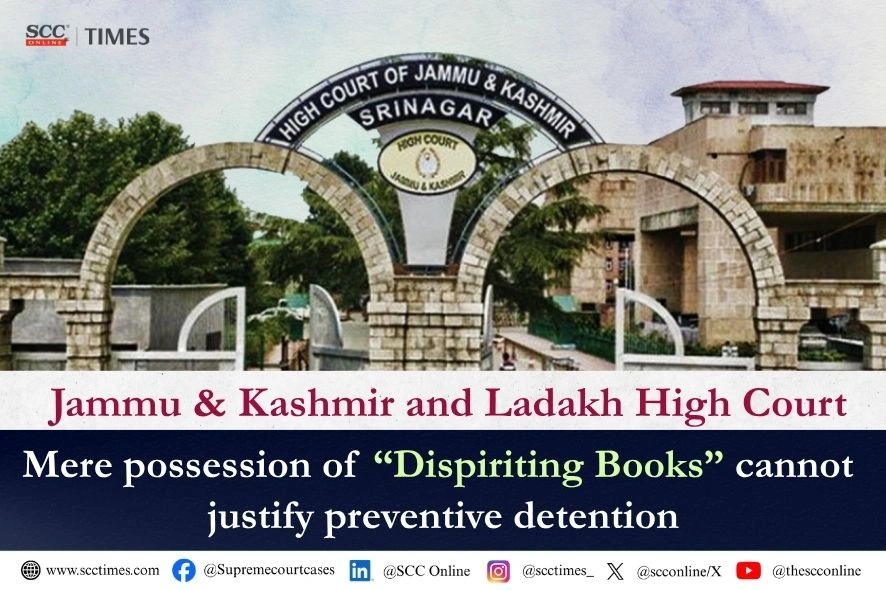
Jammu and Kashmir High Court: In a habeas corpus Petition No. 312 of 2025, order dated 2-9-2026, Moksha Khajuria Kazmi, J., allowed the petition and quashed the impugned detention Order, dated 13-9-2025, issued by the District Magistrate. The Court found that the allegations were based on a false belief, demonstrating a non-application of mind on the part of the detaining authority. Holding that the petitioner’s contention on this point carried substance, the Court directed his release from preventive custody.
Issue
Whether mere possession of books with dispiriting titles ipso facto makes a person criminally liable, against whom preventive detention is required to be invoked.
Contentions
Petitioner contended that the impugned Order is legally unsustainable on the following grounds-
-
the detaining authority acted mechanically by relying solely on FIR No. 69 of 2025 (u/s 7/25 Arms Act and Secs. 13, 17 & 18 of the UAPA) Police Station Handwara, completely ignoring the vital fact that petitioner had already been granted bail by the Special Judge, NIA, Jammu, on dated 13-9-2025.
-
the allegations of detention were fabricated, lack a direct nexus with petitioner and failed to establish any compelling reasons or fresh materials to justify the impugned order of detention.
-
the grounds were highly vague and legally non-existent, effectively depriving petitioner of his constitutional right to make an effective representation.
Respondent, in his counter affidavit, contented that-
-
petitioner was involved in case FIR No. 69 of 2025 for the offence punishable in terms of sections 13, 17 & 18, UAPA. Also, anti-national literature was seized from his possession included a book authored by himself namely “Construction of an Islamic Order in Hindutva Reimagination”, “The Saffronization of Occupied Kashmir”, “Demystifing Hindutva Settlers, Colonial Designer”.
-
petitioner was raised in a family with a separatist ideology which allegedly inculcated anti-India and separatist sentiments since childhood. His father is identified as a former militant associated with the terrorist group Al-Barq, who, lateron, surrendered. Petitioner also had received invitations for attending international conferences.
-
the impugned detention order has been issued validly and legally after proper application of mind, and no rights of petitioner has been violated as he was informed about the representation.
Test for the Legality of Preventive Detention Orders
The Supreme Court, in the case of Ameena Begum v. State of Telangana, (2023) 9 SCC 587 laid down certain principles, in Paragraph No. 28, where the order of detention would be declared bad in law.
“28. In the circumstances of a given case, a Constitutional Court when called upon to test the legality of orders of preventive detention would be entitled to examine whether:
-
the order is based on the requisite satisfaction, albeit subjective, of the detaining authority, for, the absence of such satisfaction as to the existence of a matter of fact or law, upon which validity of the exercise of the power is predicated, would be the sine qua non for the exercise of the power not being satisfied;
-
in reaching such requisite satisfaction, the detaining authority has applied its mind to all relevant circumstances and the same is not based on material extraneous to the scope and purpose of the statute;
-
power has been exercised for achieving the purpose for which it has been conferred, or exercised for an improper purpose, not authorised by the statute, and is therefore ultra vires;
-
the detaining authority has acted independently or under the dictation of another body;
-
the detaining authority, by reason of self-created rules of policy or in any other manner not authorized by the governing statute, has disabled itself from applying its mind to the facts of each individual case;
-
the satisfaction of the detaining authority rests on materials which are of rationally probative value, and the detaining authority has given due regard to the matters as per the statutory mandate;
-
the satisfaction has been arrived at bearing in mind existence of a live and proximate link between the past conduct of a person and the imperative need to detain him or is based on material which is stale;
-
the ground(s) for reaching the requisite satisfaction is/are such which an individual, with some degree of rationality and prudence, would consider as connected with the fact and relevant to the subject-matter of the inquiry in respect whereof the satisfaction is to be reached;
-
the grounds on which the order of preventive detention rests is not vague but are precise, pertinent and relevant which, with sufficient clarity, inform the detenu the satisfaction for the detention, giving him the opportunity to make a suitable representation; and
-
the timelines, as provided under the law, have been strictly adhered to.” (sic)
Decision and Analysis
The Court noted that assertion made was based on a false belief, as respondent had not shown any subversive activity done by petitioner, which was detrimental to the security of the state. Also, invoking preventive detention so casually on such beliefs, demonstrated a complete lack of application of mind which amounted to an unmindful exercise of power by the detaining authority. The Court further noted that the anti-national literature allegedly seized from the petitioner had wrongly been attributed to him as author, undermining one of the principal grounds relied upon by the detaining authority to brand him as anti-national. Hence, the present petition bearing HCP No. 312 of 2025, dated 2-9-2026, was succeeded and allowed, against the impugned detention, dated 13-9-2025, was quashed. The Court observed that petitioner, being an academic scholar, was expected to be in possession of a variety of literally means. Therefore, a mere possession of books with dispiriting titles does not ipso facto make a petitioner criminally liable. The Court, further, directed petitioner to be released from preventive custody and the detention record be returned to respondent.
[Shafat Maqbool Wani v. State (UT of J&K), 2026 SCC OnLine J&K 763, dated: 2-9-2026]
*Judgment Authored by: Justice Moksha Khajuria Kazmi
Advocates who appeared in this case:
For petitioner: Mr. Zahid Hussain Dar
For respondent: Mr. Faheem Nisar Shah





