Disclaimer: This has been reported after the availability of the order of the Court and not on media reports so as to give an accurate report to our readers.
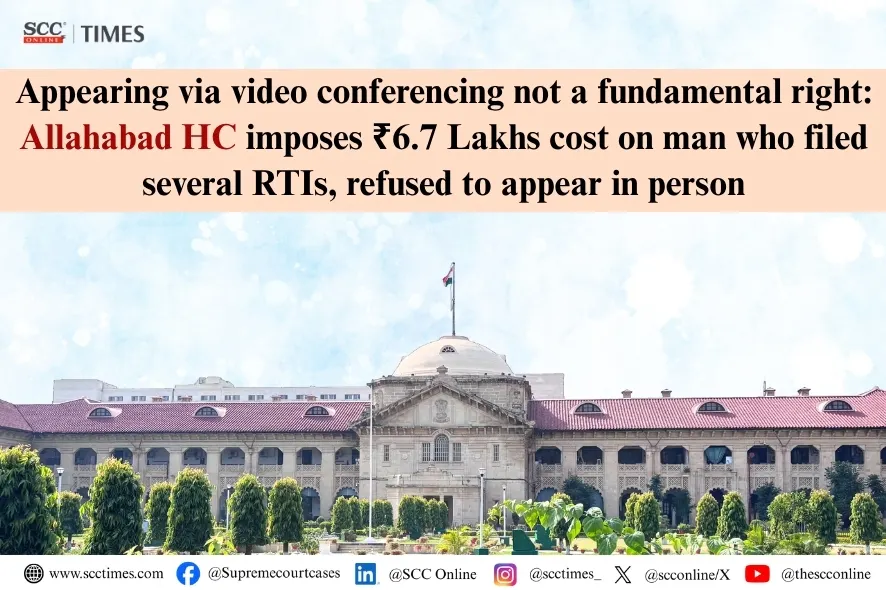
Allahabad High Court: In a writ petition filed by a man against dismissal of his right to information (RTI) appeal, the Single Judge Bench of Saurabh Shyam Shamshery*, J., dismissed the petition, holding that the information sought by the petitioner had already been supplied to him. The Court further held that the 24 applications filed by the petitioner under the Right to Information Act, 2005 (RTI Act) was a misuse of the Act and imposed a total cost of ₹1.2 lakhs on all applications. The Court also rejected the petitioner’s claim that he had an absolute right to appear only through video conferencing and held that apperaing via video conferencing is not a fundamental right but a mode of convenience.
The Court remarked that,
“…appearance through video conferencing is only to facilitate a litigant or an Advocate to expedite the adjudication. It cannot be claimed as a matter of right. It is the Court’s discretion to allow video conferencing or not”.
Background
The petitioner, a resident of Hyderabad, had sought some information in his RTI application dated 6 November 2022. He had asked whether a certain woman or her representative had called the Mahila Helpline or regular police helpline in Gorakhpur on 22 or 23 July 2022 to file a complaint against him. He further sought details of the complaint, the investigation into the complaint, and the result of the investigation. The authorities responded that no such complaint was found registered with them and answered all other queries as well.
The petitioner challenged the order dated 28 July 2023 passed by the Commissioner of the State Information Commission, U.P., Lucknow. His appeal was dismissed on the ground that the required information had already been provided by registered post on 11 January 2023.
Aggrieved, he filed the present writ petition on 5 January 2024 and also various applications under the RTI Act, seeking information regarding the court proceedings in the present case.
The Court, on 24 July 2026, stated that such applications would cause hindrance in the administration of justice and therefore the petitioner could not be allowed to misuse the RTI Act. Accordingly, the Court directed that such applications shall be kept in abeyance untill further orders and the petitioner shall not file any further applications under the RTI Act. The Court also sought personal appearance of the petitioner.
However, despite the order for personal appearance, the petitioner appeared via video conferencing.
Also Read: Electronic Evidence & Video Conferencing: Delhi High Court’s 2025 Rules redefine Digital Justice
Analysis
At the outset, the Court stated that the petitioner’s appearance through video conferencing was a violation of the Court order dated 24 July 2026.
The Court noted that the present petition was initially filed through an advocate on 5 January 2024. Subsequently, on 5 May 2025, the petitioner sought permission to appear in-person and that his counsel be discharged. He further prayed to allow him to appear through video conferencing. He swore the affidavit accompanying the said application at Prayagraj on 5 May 2025.
Furthermore, the Court noted that the said application was disposed of vide order dated 8 May 2025. However, the petitioner’s counsel was not discharged, and no permission was granted to him to appear in person or via video conferencing. Subsequently, the petitioner filed another application to punish Respondents 1, 3 and 4 for wilful disobedience, as despite an order of this Court no counter-affidavit was filed on their behalf. In support of said application, he appeared before the Oath Commissioner on 25 August 2025 at Prayagraj to swear an affidavit. The petitioner again appeared before the Oath Commissioner on 29 August 2025 at Prayagraj regarding a rejoinder affidavit.
Noting the aforesaid, the Court stated that it could not be said that the petitioner had never come to Prayagraj or appeared before this Court; rather, he had visited Prayagraj on many dates.
Accordingly, the Court held that the application whereby the petitioner sought to punish the respondents for not filing a counter-affidavit till 25 August 2025 was liable to be dismissed, as Respondent 2, the contesting respondent, did not file it much before the aforesaid application, but a copy of the same was served upon the petitioner’s counsel. Furthermore, Respondents 1, 3, and 4 were not directed to file such an affidavit. Thus, the Court dismissed the application with a cost of ₹50,000 as the aforesaid application was not only misconceived but was also based on an incorrect statement and contrary to the record.
Regarding the petitioner’s appearance, the Court stated that the application concerned was construed only to the extent that his counsel was discharged and the petitioner was permitted to appear in person. However, the Court rejected the claim that he had an absolute right to appear only through video conferencing since it was not a fundamental right but a mode of convenience.
The Court remarked that, “appearance through video conferencing is only to facilitate a litigant or an Advocate to expedite the adjudication. It cannot be claimed as a matter of right. It is the Court’s discretion to allow video conferencing or not”. If a direction is passed by the Court to appear in person, that must be followed without any unreasonable excuse. However, in the present case, despite a Court order, the petitioner did not appear in person before the Court.
The Court further noted that the petitioner was habitual of making unnecessary allegations and had filed various applications under the RTI Act. According to the report presented by the Deputy Registrar (RTI), he had filed 24 such applications between 4 June and 17 July 2026, making vague prayers, such as
1. to provide a legible copy of the singular unified administrative file bundle containing all internal office note sheets, official routing sheets, correspondence tracking and Action Taken Reports maintained by the Chief Justice Secretariat;
2. to provide automated electronic display board sequence log and server backend history records;
3. to provide physical court attendance register, appearance memos or Bench Secretary log entries of Court;
4. to provide automated network server log report and connection timeline sheets showing the exact login time and logout time;
5. to provide the physical file movement register entries, transit logbooks or electronic computer tracking logs;
6. to provide official administrative orders, constitution notifications, and office note sheets concerning the temporary roster arrangements for a particular date;
7. to provide physical courtroom attendance register signed appearance memos or Bench Secretary log entries of the Court, etc., as well as other information, which had no concern with the petitioner.
The Court reiterated that such information under the RTI Act shall not be entertained, since it not only wastes the time of the Court’s employees but also hinders the administration of justice. The Court remarked that the petitioner had ample time to file various applications under the RTI Act but not to appear before the Court and argue the case on merit.
The Court further stated that on the date of the present order, the petitioner had been offered an opportunity to get a date fixed at his convenience for appearance before the Court, but he insisted that he would not appear in person since he would have to travel about 2000 km away and had logistic problems. The Court remarked that he was well aware that he could take the help of the State Legal Services Authority and his case could be heard on a fixed date and time, but without any good reason he just wanted to avoid the Court for appearance.
The Court also took note of an email titled “Formal Written Declaration of Protest” wherein the petitioner asserted that video conferencing is his fundamental right. This document was not accompanied by verification either through an Oath Commissioner or through a Notary. The Court stated that the heading of the email was not only vague but also contemptuous, and video conferencing was not a fundamental right, but rather a convenience based on the Court’s discretion.
Furthermore, the Court remarked that recently there had been instances where petitioners-in-person have not followed the decorum of the Court and acted in a hasty and unruly manner. They used the video recordings to malign the image of the Courts.
The Court stated that to avoid such an incident, if the petitioner appeared in person, the Court could appoint an advocate on his behalf to argue the case. However, he was adamant and bluntly refused to appear before the Court on grounds of logistical problems, though he had already visited Allahabad about 4—5 times.
Regarding the writ petition at hand, the Court took note of an annexed report wherein it was stated that the petitioner was harassing one complainant and her daughter, who had filed a complaint against him, and details of the report were already provided.
Decision
In these circumstances, the Court held that the petitioner was misusing the RTI Act, and all his applications under the RTI Act were directed to be consigned to record. The Court also imposed a cost of ₹5000 each for 24 applications, i.e. total ₹1,20,000.
Upon perusal of the petitioner’s original RTI application and its reply, the Court held that it was evident that requisite information had already been provided to the petitioner. He could not insist on providing information which was not available with the authorities concerned.
Accordingly, the Court dismissed the petition, holding that since the requisite information had already been provided, there was no reason to interfere with the impugned order.
However, to discourage people such as the petitioner from disturbing the Court’s proceedings and administration of justice, the Court imposed another cost of ₹5,00,000 on the petitioner. All the abovementioned costs, i.e. ₹50,000, ₹1,20,000, ₹5,00,000, total being ₹6.7 lakhs, shall be paid by the petitioner in the bank account of High Court Legal Service Committee within 4 weeks from today. In case of default, the Registrar General shall take appropriate steps.
[Vemula Venkata Vinay Babu v. State of U.P., 2026 SCC OnLine All 24262, decided on 5-8-2026]
Advocates who appeared in this case:
For the petitioner: Petitioner-in-person
For the respondents: C.S.C. (CSC/2012), Kunal Ravi Singh