


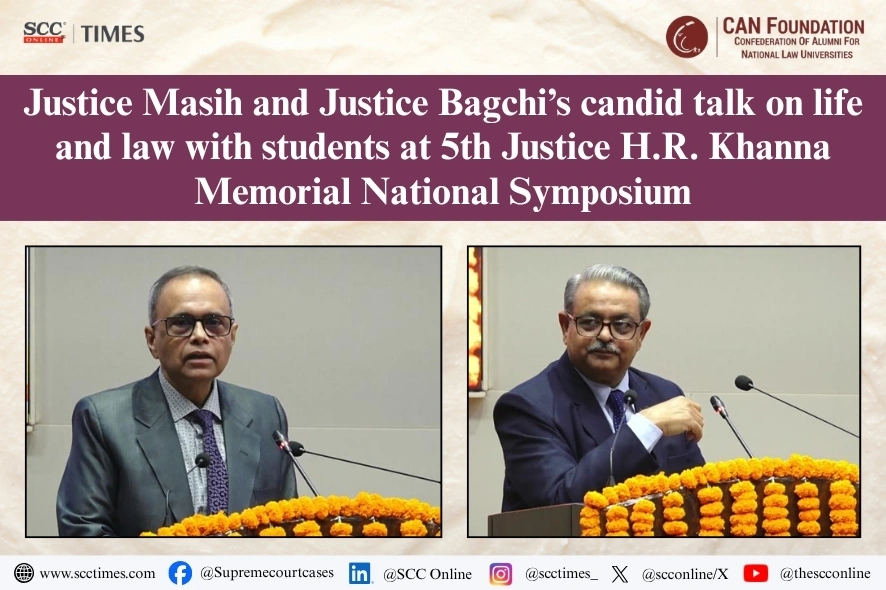
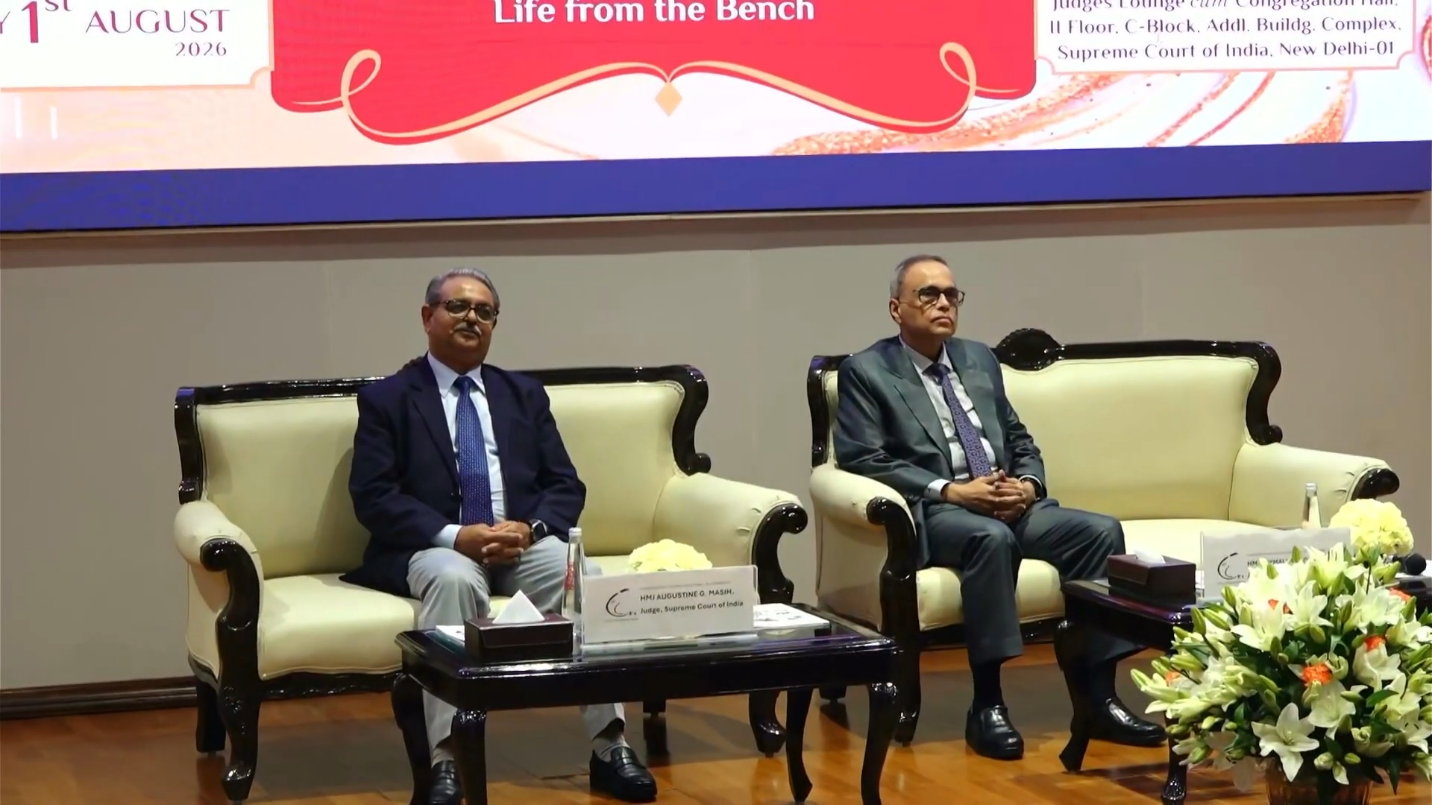
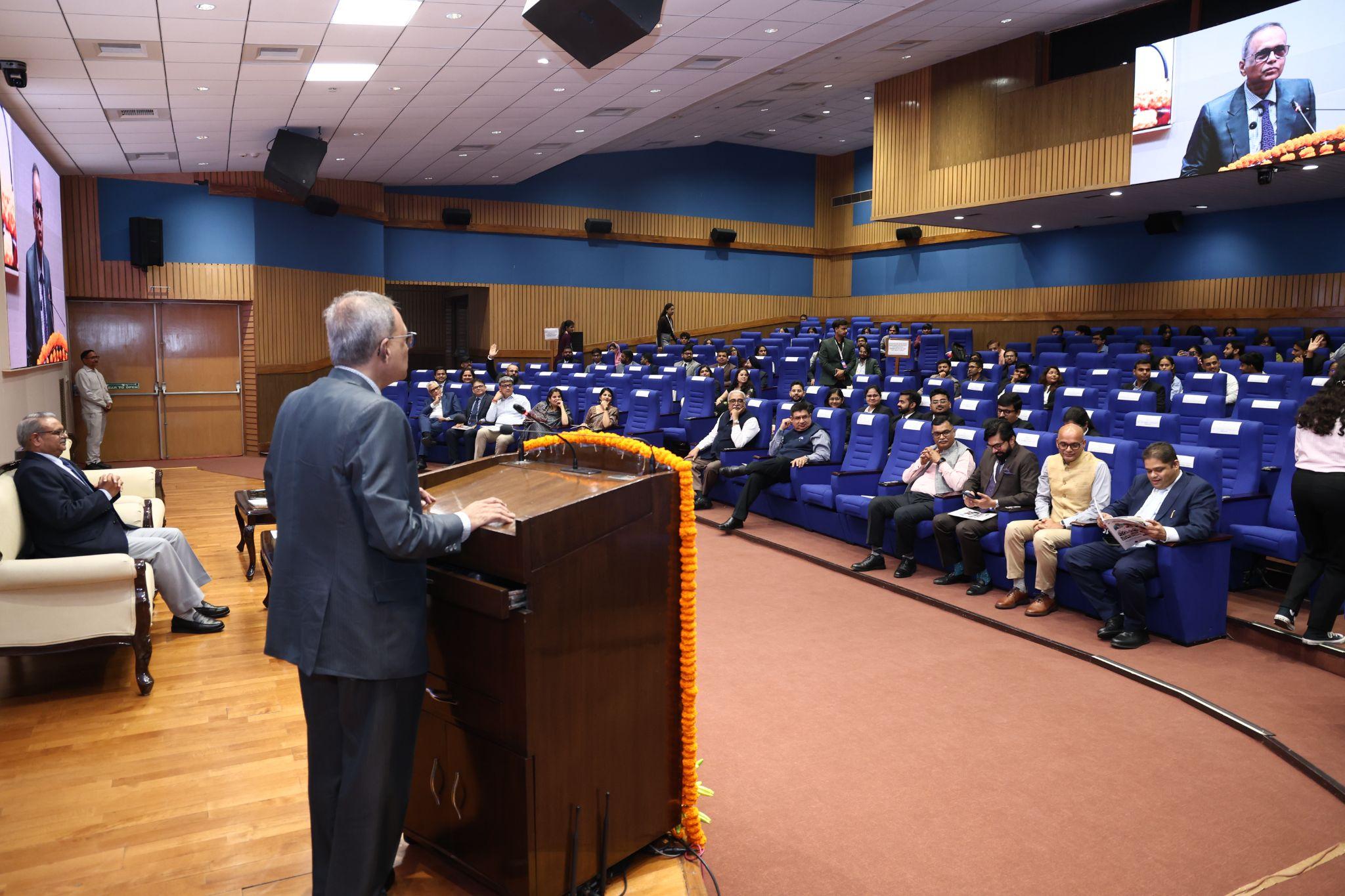
As part of the 5th Justice H.R. Khanna Memorial National Symposium, organised on 1 August 2026 by the Confederation of Alumni for National Law Universities Foundation (CAN Foundation) in collaboration with Damodaram Sanjivayya National Law University (DSNLU), Visakhapatnam, and The West Bengal National University of Juridical Sciences (NUJS), Kolkata, a special ‘Candid Conversation with Students’ was held on the theme “From Classroom to Courtroom: Syllogisms, Stories & Lessons of Life from the Bench.” The interactive session provided law students with an opportunity to engage directly with Justice Augustine G. Masih and Justice Joymalya Bagchi.
The Judges spoke on their judicial journeys, experiences from the Bench, and lessons drawn from legal practice and life, against the broader backdrop of the symposium’s theme, “Without Fear or Favour: Reimagining Perspectives on an Independent Indian Judiciary in the Digital and Globalised World.”
Justice Augustine G. Masih’s Address
Justice Augustine G. Masih, Judge, Supreme Court of India, addressed the audience not merely as a sitting Supreme Court Judge, but as someone who had traversed every stage of the legal profession. He offered deeply personal reflections on his journey to the bench, the values that define good advocacy, the indispensable role of the bar in the administration of justice and the emerging challenges confronting the legal profession in an increasingly digital world.
An Unintended Beginning in Law: A Call from Destiny
Justice Masih commenced his address with an unexpected revelation that instantly resonated with the audience. Contrary to what many might have assumed, law had never been his intended profession. His original aspiration had been to pursue management studies and build a career in business administration. Circumstances, however, charted a different course. Having narrowly missed admission to an MBA, he enrolled in law on the advice of others, a decision that would eventually shape the trajectory of his life. Reflecting on this turning point with characteristic humility, he remarked,
“I never wanted to become a lawyer. That was not my aim. A chance lawyer, as you may call it.”
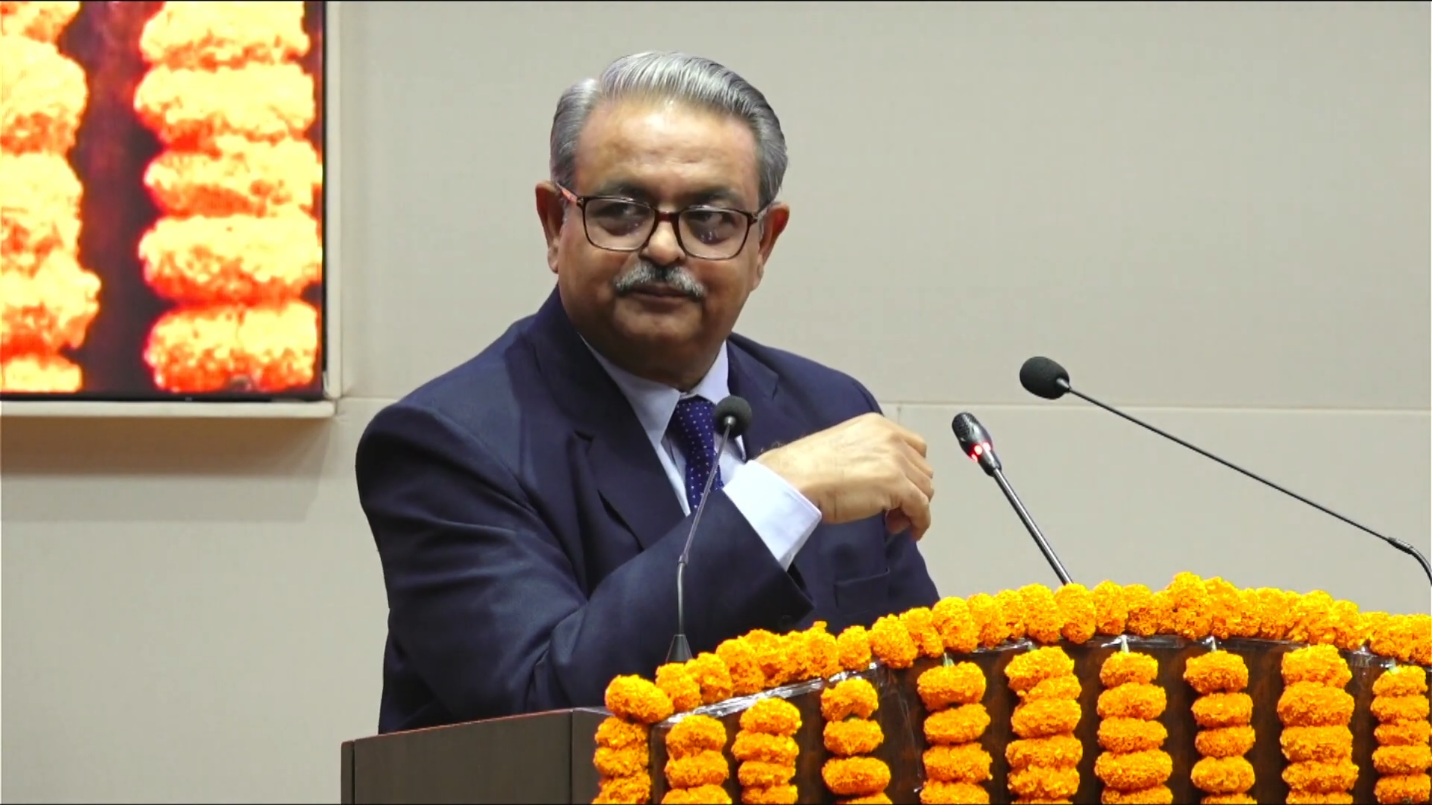
Tracing his professional journey, Justice Masih described himself as a first-generation lawyer. Looking back, he attributed his success not to privilege or influence but to perseverance, seizing opportunities whenever they arose and an abiding faith in divine grace. He observed,
“I didn’t have any contacts. I am a first-generation lawyer and a person who didn’t want to become a lawyer from a family where none had ever gone to a police station. And my parents never wanted me to be a lawyer. So, with these odds, I can only say that God has been really kind to me. And it’s because of his grace that I’m here.”
The sincerity of these reflections served as a powerful reminder to aspiring lawyers that determination and integrity often outweigh inherited advantages.
The Bench and the Bar are Partners in the Administration of Justice
Justice Masih also reflected upon his elevation to the Bench and the unique relationship that exists between judges and the bar. Having been elevated in the same High Court where he had practised for years, he acknowledged the affection and confidence that he continued to receive from members of the Bar. However, he was quick to reject the notion that judicial decisions are products of individual brilliance alone. Justice Masih humbly addressed his perceived popularity among the bar. He attributed his outcomes to the diligence of the advocates standing before him. He further demystified the courtroom dynamic, highlighting that the true catalyst for justice lies in the art of advocacy. He pointed out a simple yet profound truth:
“A judge has the same file as the lawyer. But the way it is presented and projected makes a difference. Whatever judgments I would have rendered would have been, by and large, the credit goes to the bar who would have helped me out in that.”
Acknowledging the intellectual contribution of advocates in shaping judicial reasoning, Justice Masih reaffirmed the symbiotic relationship between the Bench and the Bar and highlighted that justice is ultimately a collaborative enterprise.
Justice Masih in an Engaging Dialogue with the Next Generation of Lawyers
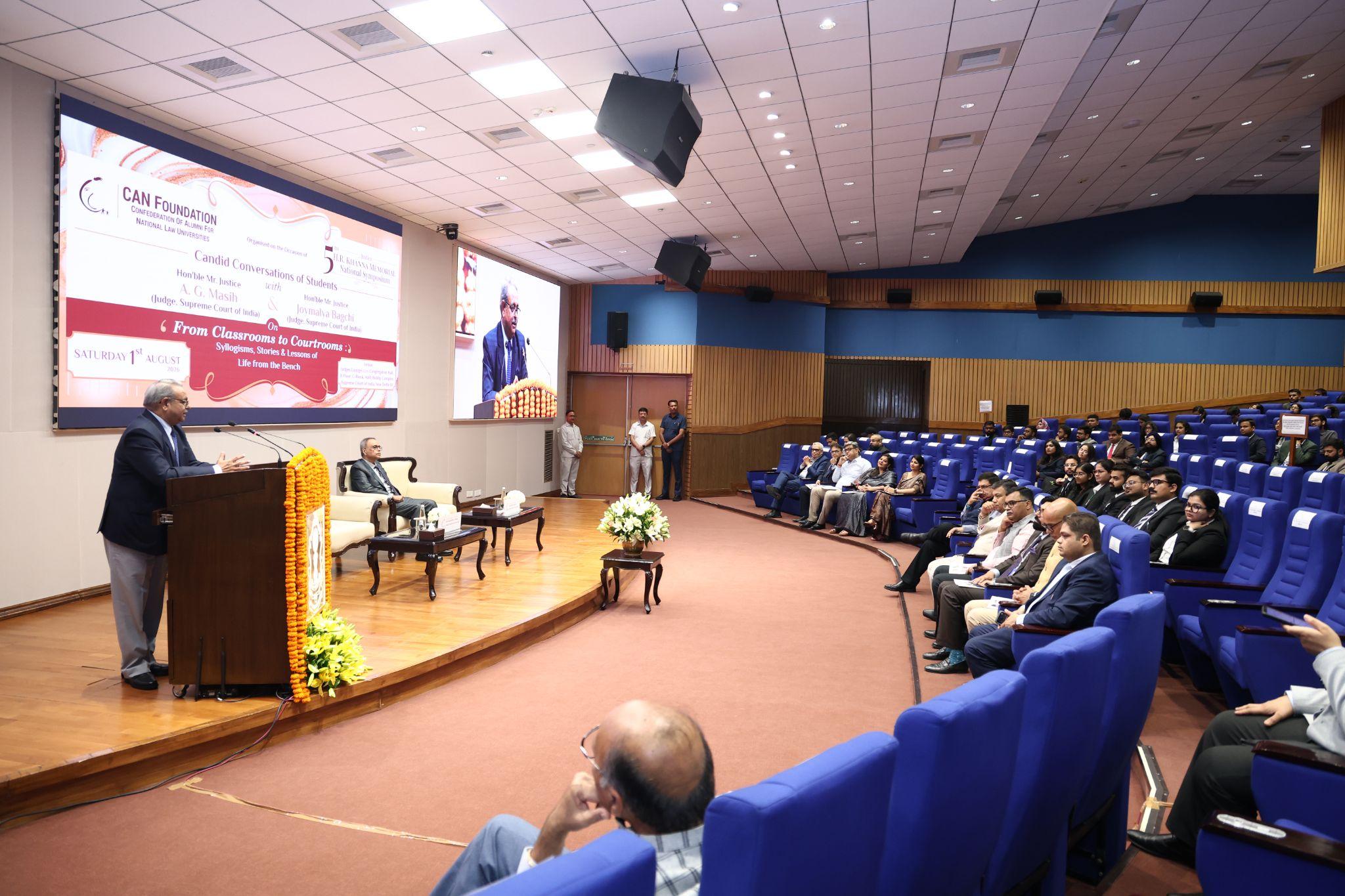
The address seamlessly transitioned into an engaging interactive session, during which students and young practitioners posed thoughtful questions on contemporary issues confronting the legal profession and the judiciary.
The discussion began with concerns regarding professional regulations governing legal education and practice. Some participants questioned whether increasing regulatory frameworks & restrictions on the sharing of reels by students risk curtailing the freedom of thought and expression of future lawyers. Justice Masih responded by encouraging students to view regulations not as obstacles, but as instruments of professional discipline. In his view, ethical rules are intended to guide rather than suppress intellectual freedom.
As he explained:
“Regulations are generally not impediments. We should stop thinking in those terms. Those are only guidelines, helping you out and every one of us to really giving you an idea as to how and what is expected and is required of you. That does not mean that there is any sort of hamper in the thought process or you are unable to express yourself. It’s only that there are certain things which in a given circumstance need to be avoided”
While recognising that violations may attract consequences, he stressed that true professionalism stems not from external compulsion but from an individual’s own conscience and commitment to ethical conduct.
Another participant raised a thought-provoking question concerning the Supreme Court’s practice of dismissing a significant number of matters through brief, non-speaking orders despite consistently emphasising the necessity of reasoned judgments for subordinate courts. Addressing the concern, Justice Masih explained the institutional realities of constitutional adjudication. He noted that judges study the record thoroughly before matters are called, often having the benefit of multiple judgments delivered by lower courts. The brevity of certain orders, therefore, should not be mistaken for an absence of judicial application of mind.
Highlighting the balance that constitutional courts must maintain between efficiency and detailed reasoning, he observed that if elaborate judgments were written in every matter, the judiciary would find it impossible to cope with the enormous volume of cases before it. Where substantial questions of law arise, detailed judgments continue to be delivered; where settled principles clearly govern the dispute, shorter orders often suffice.
The Art of Advocacy: Preparation Above All
The interaction then shifted to the craft of advocacy. A young Advocate-on-Record requested Justice Masih to identify the most important lesson that every law student and practising lawyer should remember throughout their professional lives. Drawing upon decades of experience across trial courts, tribunals, High Courts, and the Supreme Court, He identified preparation as the defining characteristic of effective advocacy.
“Mastery over the facts, that’s the first essential. And then the applicability of the law on the facts. That, if you are able to do, I think you know in the heart of your hearts as to where you stand. And then obviously the articulation and the presentation.”
According to Justice Masih, thorough knowledge of facts not only equips a lawyer with confidence but also enables meaningful legal analysis. Equally important, however, is understanding the judicial temperament of the court before which one appears. Recalling the practices of some of India’s legendary advocates, he narrated how senior counsel would often sit in court well before their matters were called merely to observe the judge’s approach towards cases.
Summarising the essence of successful advocacy, He advised:
“Know the judge. Know your facts and the law. And I think that’s the only thing which can help you out. Obviously, the way you present, that’s another aspect which may make a difference.”
The final segment of the interaction explored the growing role of artificial intelligence within the justice delivery system. While acknowledging that he did not consider himself a technical expert, Justice Masih nevertheless offered a profound perspective on the relationship between technology and legal reasoning. He welcomed technological innovation as an aid to legal research and administrative efficiency but cautioned against excessive dependence upon automated systems.
Delivering what would become one of the most memorable observations of the session, He stated:
“Only thing which, as a judge and as a lawyer, which I would suggest is, let it be a tool and not a master.”
Reiterating this concern in memorable terms, Justice Masih concluded:
“See to it that it becomes our slave and not we being its slave. That’s the only way I think we can regulate artificial intelligence and make good use of it. There is nothing wrong in that. But how and in what terms you try and use it, that would be the determinative factor.”
His remarks encapsulated the need to embrace innovation while preserving the uniquely human qualities of legal analysis, ethical judgment, and constitutional reasoning.
Justice Joymalya Bagchi’s Address
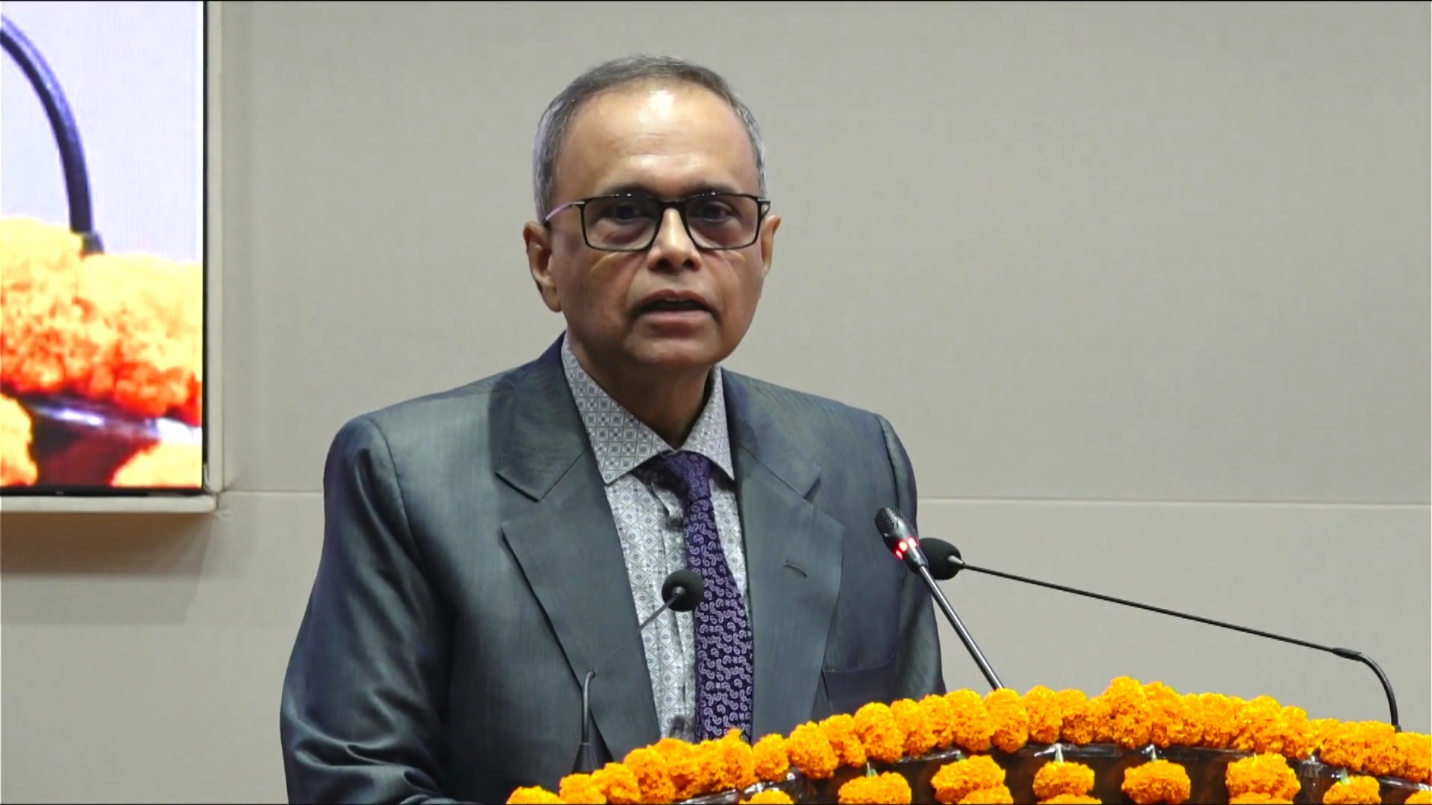
Justice Joymalya Bagchi, Judge, Supreme Court of India, commenced the interactive session by creating an atmosphere conducive to candid, thought-provoking discussions and insightful exchanges of ideas, making the interaction both engaging and intellectually enriching for the audience.
He marked the beginning of the session by extending his greetings to Justice Augustine G. Masih, fellow panellists, office bearers of the CAN Foundation, distinguished guests, and the students gathered for this symposium. Acknowledging the enthusiastic participation of the audience, he remarked that the session was intended to be an open interaction rather than a formal address. Breaking away from convention, Justice Bagchi invited students to take the lead, encouraging them to ask questions and engage in a candid dialogue on issues that mattered most to them.
When Free Speech Meets Public Order
The first question of the session invited Justice Bagchi to reflect on one of the most debated constitutional issues of recent years: the balance between freedom of speech and the State’s responsibility to regulate misinformation in an increasingly digital society. Referring to Justice Bagchi’s appearance as counsel in the litigation concerning activist Taslima Nasreen’s book and his judicial engagement with constitutional questions surrounding digital regulation, a student asked how constitutional jurisprudence should evolve to preserve free expression while addressing concerns of public order and fake news.
Justice Bagchi welcomed the question, recalling his involvement in the litigation, he narrated how the controversy surrounding her writings presented a difficult constitutional dilemma. The State, he explained, often finds itself confronted with two competing obligations: preserving freedom of expression on the one hand and maintaining public order on the other. In such situations, governments frequently choose the easier course of regulating expression rather than protecting it, particularly when public sentiment becomes volatile.
“Whenever you find expression touching raw nerves, the State takes a safe route. It does not preserve expression, it regulates expression and thereby preserves outrage.”
Expanding on this constitutional tension, Justice Bagchi observed that the debate is rarely confined to the text of Article 19 alone. Courts are often required to assess whether restrictions imposed by the State genuinely satisfy the constitutional standard of reasonableness. Yet, in practice, governments across jurisdictions have consistently prioritised maintaining order over expanding individual liberty, making the protection of free speech one of constitutional law’s most enduring challenges.
Reflecting on the outcome of the Taslima Nasreen case, Justice Bagchi noted that although the legal challenge succeeded before the Court, the broader struggle for freedom of expression extended beyond the courtroom. Judicial recognition of a constitutional right, he observed, does not always guarantee its meaningful exercise in society.
“Even if you win in a court of law, you might not enjoy the freedom to stay because the rule of law was suborned by the rule of the mob.”
His response offered students an important perspective on constitutional adjudication. While courts remain the guardians of fundamental rights, the true measure of constitutional democracy lies equally in society’s willingness to uphold and protect those freedoms in practice.
Beyond the Courtroom: A Lawyer’s Life
Having explored constitutional freedoms and the role of courts in safeguarding fundamental rights, the conversation gradually shifted from constitutional philosophy to the personal journey of a lawyer and Judge. A student invited Justice Bagchi to reflect on a question that resonates with every aspiring legal professional, that how does one maintain a healthy work-life balance while pursuing the demanding legal profession?
Justice Bagchi responded with humour, taking the audience back to his childhood. Growing up in a family of lawyers, he often accompanied his father to his chamber and was fascinated by the number of people who came simply to talk to him before paying for the conversation.
“So at the time when I became a lawyer, it was always said that to be a successful lawyer, it should be all roses and no bed, or it is all bed and no roses.”
Moving from humour to reflection, Justice Bagchi spoke candidly about the culture of the legal profession during his formative years. When he entered the Bar in the early 1990s, young advocates were often expected to devote themselves entirely to work, leaving little room for personal interests or family life. He recalled working under a senior who proudly claimed never to have taken a holiday, an approach that many young lawyers then regarded as the benchmark of professional commitment. Encouragingly, he observed that the profession has gradually evolved and that conversations around work-life balance have become far more common today.
“I am happy today that there is a dialogue between life and work balance and that people have come to realise that life is not for the profession, profession is for life”
Justice Bagchi encouraged students to cultivate interests beyond the law, emphasising that hobbies, literature and lived experiences enrich legal understanding rather than distract from it. Law, he explained, does not exist in isolation; it is a reflection of society and human experience. A lawyer who understands people, history and literature is therefore better equipped to understand the law itself.
“I would always say again as a lawyer and to evolve as a lawyer or as a judge, please read beyond law because law comes from life, and if you don’t know crime and punishment you will never understand criminal law”
His reflections struck a chord with the audience, offering reassurance that professional excellence need not come at the cost of personal growth.
Protecting Those Who Protect the Constitution
The discussion then turned to a subject closely aligned with the Symposium’s overarching theme of judicial independence. A research scholar from Punjab University posed a thought-provoking question on whether greater judicial security, including institutional safeguards in politically sensitive matters, is essential to preserving judicial independence. The question invited Justice Bagchi to reflect on an aspect of judicial functioning that often receives little public attention despite being fundamental to the administration of justice.
Justice Bagchi acknowledged the importance of the issue and observed that judicial security remains one of the least discussed facets of judicial independence in India. Drawing from his participation in a judicial exchange programme in the United States, he recalled an interaction with a Judge who had presided over cases arising out of the September 11 attacks. When he requested her personal contact details after the programme she politely declined, explaining that communication could only take place through official institutional channels owing to established security protocols. The experience, he noted, fundamentally changed his understanding of what judicial security truly entails.
“Security in the Indian context is always mistaken as status, but security from a judicial independence perspective is to ensure the judge from the perception of fear, as we say, and the perception of freedom to deliver maybe an unpopular verdict.”
Expanding upon this thought, Justice Bagchi explained that judicial security should never be viewed merely as a matter of privilege or status. Its true purpose is to ensure that Judges are able to discharge their constitutional responsibilities without fear, intimidation or external pressure. In an increasingly polarised environment, he remarked, institutional safeguards become indispensable in preserving public confidence in the justice delivery system.
Justice Bagchi further observed that the concept of judicial security has acquired an entirely new dimension in the digital age. While physical protection continues to remain important, Judges today are equally vulnerable to online harassment, misinformation and targeted campaigns that may affect the perception of judicial independence.
“Today, the challenge is manifold because it is not only the physical spatial domain which needs to be protected for a Judge. The digital space in which the Judge exists today also needs to be secured.”
Concluding his response, Justice Bagchi remarked that judicial security and witness protection are integral to the rule of law. His reflections offered students a deeper appreciation of the institutional safeguards that silently underpin judicial independence, reinforcing that the ability of Judges to decide cases without fear or favour depends not only upon constitutional guarantees but also upon effective systems that protect the independence of the institution itself.
The Books That Shape a Lawyer
Following an engaging discussion on judicial independence and institutional safeguards, the conversation turned towards a more personal aspect of Justice Bagchi’s journey. A student asked him about the books and authors that had most influenced him, and what he would recommend to aspiring lawyers seeking to build a strong foundation in constitutional and criminal law.
Justice Bagchi responded by observing that a lawyer’s education should never be confined to statutes and case law. While legal texts are indispensable, he remarked that a true understanding of the law comes from appreciating the social, historical and philosophical ideas that shape it. Encouraging students to cultivate the habit of reading widely, he reflected on the books that had left a lasting impact on his own professional and personal life.
Among the first works he recommended were the writings of Swami Vivekananda, which, he said, had inspired him from an early age. Turning to constitutional law, Justice Bagchi highlighted the writings of Granville Austin, describing them as essential reading for every law student seeking to understand not merely the provisions of the Constitution, but the vision and aspirations of its framers.
“The Constitution is not a legal document. It is a political document expressed in legal terms, so you must understand why the makers or the framers gave unto us, the people, a constitution as we have today. What were the agonies, what were the aspirations, and that is what would make the bedrock of any constitutional law argument.”
Justice Bagchi explained that constitutional interpretation cannot be divorced from history. Every constitutional provision, he noted, reflects a conscious choice made by the Constituent Assembly in response to the nation’s experiences and aspirations. Lawyers who understand that historical context are better equipped to engage with constitutional questions in both academic and professional settings.
Turning to criminal law, he recommended the writings of Glanville Williams, praising their clarity and analytical depth. He also shared that one of his recent reads was by Yuval Noah Harari, reflecting his continuing interest in understanding the relationship between technology, society and governance.
More than a reading list, Justice Bagchi’s response served as a reminder that the making of a lawyer extends well beyond classrooms and courtrooms. Intellectual curiosity, an appreciation of history and a willingness to engage with ideas across disciplines, he suggested, remain indispensable qualities for anyone aspiring to contribute meaningfully to the development of the law.
Bridging the Gap Between Judgments and Justice
As the interaction drew towards its conclusion, the discussion shifted from constitutional theory to the practical realities of administering justice. A young trial court practitioner shared his experiences from the grassroots, observing that despite the Supreme Court laying down progressive principles of law, their implementation often remained inconsistent at the district level. He asked whether the Court could formulate Standard Operating Procedures (SOPs) or similar institutional mechanisms to ensure that its directions are more effectively implemented by executive authorities and subordinate institutions.
Justice Bagchi acknowledged the concern, noting that it reflected a challenge frequently encountered within the justice delivery system. While the Supreme Court has, on several occasions, stepped in to bridge legislative gaps by laying down guidelines and procedural safeguards, he observed that no judicial pronouncement, however comprehensive, can by itself guarantee effective implementation. The real challenge lies not in the absence of legal principles but in ensuring that constitutional values are carried into everyday governance through committed institutions and conscientious individuals.
“Even if we lay down n number of SOPs, the gap of trickle-down justice may not always be achieved. It can be achieved through these young people like you and like your friends who can be the inspired champions of justice, carrying it to every household, every individual, including the one standing at the end of the line.”
Addressing the students directly, Justice Bagchi emphasised that the responsibility of realising constitutional ideals cannot rest solely upon the judiciary. Lawyers, Judges, public officials and citizens each play an equally important role in ensuring that justice does not remain confined to the pages of judicial decisions.
“We can be the declaration of justice. We can be the guardian of the Constitution, but it requires a gargantuan apparatus, well-oiled, well-manned by intrepid lawyers, by stakeholders, and finally the people of India to champion justice.”
Concluding the interaction, Justice Bagchi left the audience with a powerful reflection on the enduring relationship between law and society. Quoting the renowned American jurist Billings Learned Hand, he reminded students that the survival of justice ultimately depends not only upon courts and constitutions, but also upon the values cherished by the people themselves. He said:
“If the lamp of justice dies in the heart of the people, no court can save it.”
The response brought the discussion full circle. What had begun as a conversation on constitutional rights and judicial institutions concluded with a reminder that the rule of law is sustained not merely through judgments, but through the collective commitment of society to uphold the values of justice, fairness and constitutional governance. It was a fitting conclusion to an interaction that consistently challenged students to look beyond legal doctrine and recognise their own role in strengthening the justice delivery system.
Concluding Note
The interactive sessions with Justice Augustine G. Masih and Justice Joymalya Bagchi offered participants a rare opportunity to engage directly with two distinguished Judges of the Supreme Court of India, each bringing a unique perspective shaped by years of experience on the Bench and at the Bar. While Justice Masih’s reflections centred on perseverance, ethical advocacy, judicial discipline and embracing technological advancements with responsibility. Justice Bagchi’s responses encouraged students to reflect on constitutional values, intellectual curiosity, judicial independence and the importance of understanding the law through the lens of life itself.
Despite the diversity of the discussions, a common message emerged from both interactions: the practice of law is founded not merely upon legal knowledge and professional competence, but upon integrity, humility, continuous learning and an unwavering commitment to justice.
The sessions concluded with an engaging exchange of ideas that left students with invaluable insights extending far beyond the classroom and courtroom. Together, the interactions exemplified the spirit of the 5th Justice H.R. Khanna Memorial National Symposium, reaffirming its enduring theme of “Without Fear or Favour” and inspiring the next generation of legal professionals to uphold the rule of law with courage, conviction and unwavering integrity.
SCC Times was the Official Information and Documentation Partner of the event.
Also Read: AGI R. Venkataramani at 5th Justice H.R. Khanna Memorial National Symposium | SCC Times
The entire session can be viewed here: Candid Conversations of Students with HMJ A.G. Masih & HMJ Joymalya Bagchi – 5th Jus. H R Khanna SYM – YouTube