


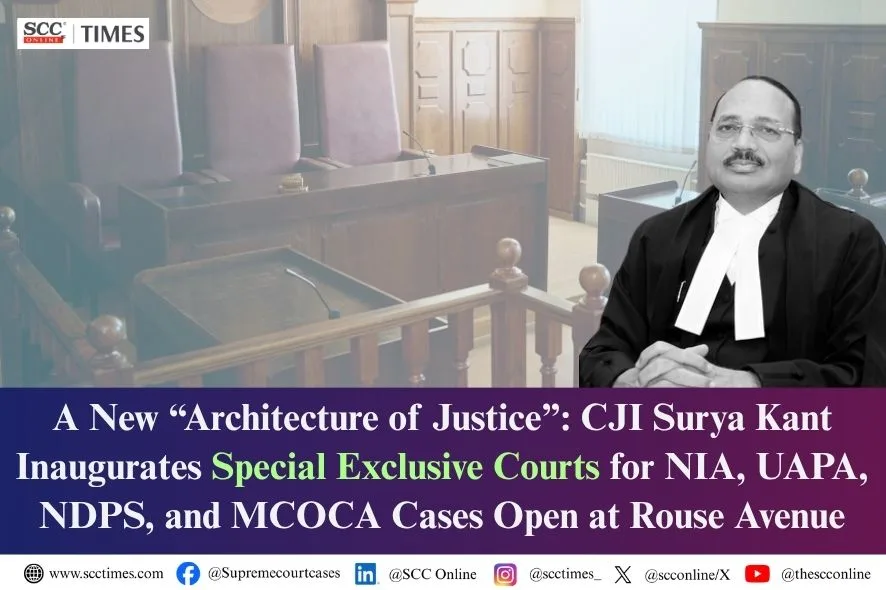
On 3 August 2026, Chief Justice of India, Justice Surya Kant inaugurated the Special Exclusive Courts for trials under the National Investigation Agency Act, 2008 (NIA Act), the Unlawful Activities (Prevention) Act, 1967 (UAPA), the Narcotic Drugs and Psychotropic Substances Act, 1985 (NDPS Act) and the Maharashtra Control of Organised Crime Act, 1999 (MCOCA) at the Rouse Avenue Court Complex, Delhi. Describing the initiative as a significant institutional reform, he said that the justice delivery system must continuously evolve with time to meet the evolving demands of time.
The architecture of justice must match the complexity of the case
Referring to Delhi as the “nation’s laboratory for judicial innovation”, Justice Surya Kant said that the capital has often pioneered reforms that later influenced the justice delivery system nationwide. Whether through technological innovations or administrative reforms in courts, Delhi has often served as the starting point for initiatives subsequently replicated across the country. He expressed his confidence that the establishment of the Special Exclusive Courts would continue this tradition.
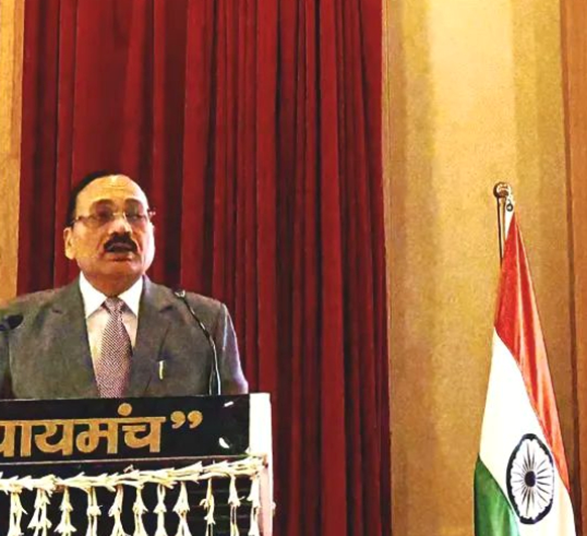
Justice Surya Kant observed that every reform in the justice delivery system begins with a simple question, how can justice be delivered better? To which he answered,
“Every Court is a temple of justice, but every case does not demand the same architecture for adjudication.”
Access to justice incomplete without timely justice
Explaining the rationale behind the establishment of the Special Exclusive Courts, Justice Surya Kant observed that the initiative is founded on the principle that meaningful access to justice requires more than the mere availability of courts. It demands a justice delivery system equipped to adjudicate complex cases with competence, continuity and within a reasonable time. According to him,
“Access is meaningful only when it is accompanied by the assurance that justice will be delivered within a reasonable timeframe by a Court equipped to deal with the complexity of the matter before it.”
In the absence of such assurance, he noted, delay prolongs uncertainty for victims and their families, keeps undertrial prisoners awaiting determination of their liberty, weakens evidence as memories fade and gradually erodes public confidence in the justice delivery system. Timely adjudication, he stressed, is therefore not merely an administrative objective but an indispensable component of justice itself.
Need for specialised courts
Explaining the need for specialized courts, Justice Surya Kant noted that modern judicial administration increasingly recognises that different categories of disputes require different institutional responses, as reflected in Commercial Courts, Family Courts, Fast-Track Courts and Specialised Tribunals. The newly inaugurated Courts continue this institutional evolution by addressing the unique demands of prosecutions under the NIA Act, UAPA, NDPS Act and MCOCA.
He observed that such prosecutions often involve multi-jurisdictional investigations, voluminous documentary and electronic evidence, complex forensic evidence, issues concerning national security, organised crime or transnational drug trafficking, and multiple accused. These characteristics require sustained judicial attention far greater than an ordinary criminal trial.
Continuity in trials
The Chief Justice emphasised that continuity in judicial engagement is critical in complex criminal cases.
As he observed:
“When complex trials are repeatedly interrupted by competing demands on the docket, adjournments become inevitable, hearings lose momentum, and the quality of the trial itself begins to suffer.”
The consequences affect every stakeholder, including victims, witnesses and accused persons. Dedicated courts, he said, seek to address these challenges in a structured and lasting manner and enable Judges to develop subject-matter expertise, ensure continuity of hearings, improve case management and promote consistency in decision-making, while fully preserving fairness and due process.
Justice Surya Kant stressed that infrastructure alone cannot ensure the success of specialised courts but by shared commitment of every institution and every individual who forms part of the criminal justice system. He observed that judges must uphold fairness with firmness, investigating agencies must conduct professional and timely investigations, prosecutors must present their case with diligence and objectivity, the members of the Bar must assist courts with the highest standards of professional responsibility, and court staff must continue to provide administrative support that keeps the wheels of justice moving.
He remarked,
“When each stakeholder embraces this shared responsibility, timely justice ceases to be an aspiration, rather, it becomes a lived reality.”
Concluding Remarks: Building model for future
Concluding his address, the Chief Justice said that the inauguration of these Special Exclusive Courts represents more than the creation of new Courtrooms, it reflects the justice delivery system’s ability to respond to adapt to emerging challenges while remaining firmly anchored in the Rule of Law. He expressed confidence that the courts would contribute to reducing pendency, ensuring continuity in trials and delivering timely and just outcomes.
Expressing hope that Delhi’s experience would guide future reforms across the country, Justice Surya Kant observed that if these courts demonstrate effective case management, judicial specialisation and timely adjudication, they could serve as a replicable model wherever similar institutional needs arise, making justice more timely, effective and accessible nationwide.
Lastly, he congratulated all those whose dedication had made the establishment of the Special Exclusive Courts possible. Expressing confidence in the initiative, he hoped that these courts would stand as enduring examples of how thoughtful institutional reform can make the justice delivery system more timely, effective and accessible.