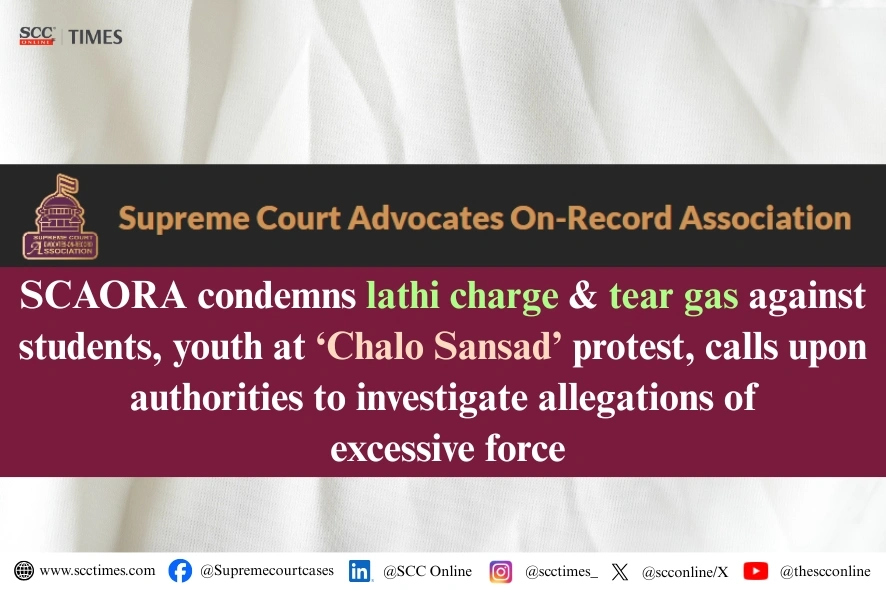
On 22 July 2026, the Supreme Court Advocates-on-Record Association (SCAORA) issued a statement condemning the use of force against student protestors. The Association expressed deep concern over reports and visuals emerging from New Delhi depicting the use of force by the Delhi Police against students and young protestors who had assembled to peacefully voice their grievances concerning the integrity of public examinations and the future of the country’s youth. Reports indicated that force, including lathi charges and tear gas, was used to disperse demonstrators seeking to march towards Parliament during the monsoon session.
SCAORA added that in a constitutional democracy, peaceful dissent is not an act of defiance, but an exercise of the fundamental freedoms guaranteed under Articles 19(1)(a) and (b) of the Constitution. While the State is empowered to maintain public order, every restriction on these freedoms must satisfy the constitutional requirements of legality, necessity, and proportionality. The burden of justifying any use of force against citizens exercising their constitutional rights always rests upon the State.
Furthermore, it mentioned that the Supreme Court has consistently recognised that the right to hold peaceful public meetings flows directly from the freedoms guaranteed by Article 19. In Himat Lal K. Shah v. Commr. of Police, (1973) 1 SCC 227, the Court held that this right cannot be made dependent upon executive discretion. In Ramlila Maidan Incident, In re, (2012) 5 SCC 1, the Court reiterated that police action against peaceful assemblies must satisfy the constitutional standards of necessity and proportionality. These principles continue to govern the exercise of police powers in a constitutional democracy.
SCAORA called upon the authorities concerned to ensure that any allegation of excessive use of force is independently and impartially examined, that those injured receive immediate medical assistance, and that future engagement with peaceful protesters is guided by restraint, dialogue and unwavering fidelity to constitutional values.
“The strength of our Republic lies not in suppressing dissent but in protecting it within the framework of the Constitution. The true measure of constitutional governance is not how the State responds to agreement, but how it responds to peaceful disagreement. At moments such as these, adherence to constitutional liberties remains the surest safeguard of the rule of law.”