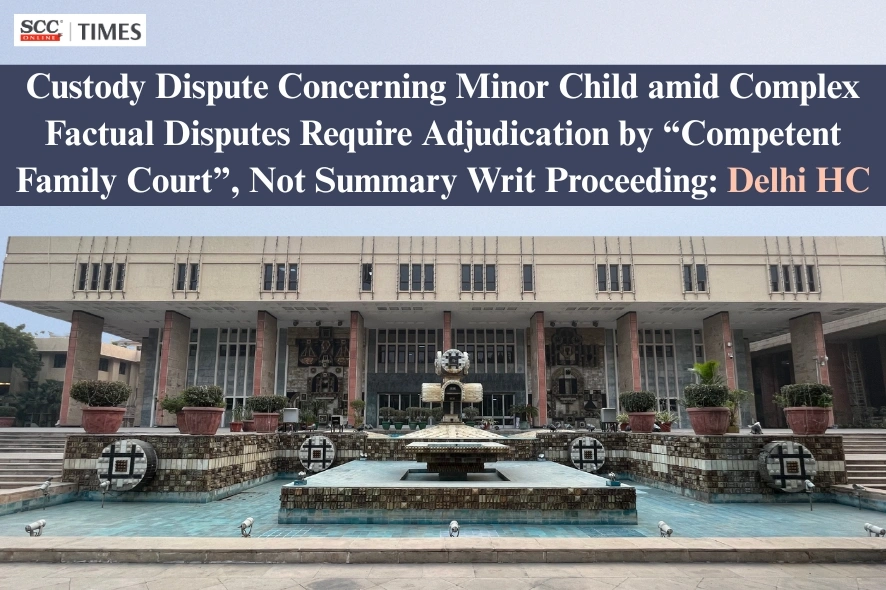
Delhi High Court: In a writ petition instituted by petitioner, mother of a 4-year-old minor daughter, who was born in Singapore and was diagnosed with Autism Spectrum Disorder (ASD), seeking a writ of habeas corpus directing the father to produce the child and restore her custody to the petitioner, the Division Bench of Navin Chawla* and Ravinder Dudeja, JJ., declined to exercise its discretionary jurisdiction under Article 226 of the Constitution and held that the petitioner’s claim regarding custody and visitation should be adjudicated before the “competent family court” where a detailed inquiry into all disputed facts could be undertaken.
Brief Facts and Petitioner’s Case
The petitioner and Respondent 2 met in Singapore in 2016 and were married on 18 November 2016 in Ghaziabad according to Hindu rites. The marriage was subsequently registered on 8 February 2017. After marriage, they established their matrimonial home in Singapore. Their daughter was born in Singapore on 28 September 2021, though she remained an Indian citizen.
According to the petitioner, after the birth of the child, the respondent and his family subjected both the petitioner and the child to cruelty, neglect and emotional harassment. The petitioner alleged that the respondent displayed irresponsible behaviour concerning the child’s upbringing and frequently complained about educational and domestic expenses. She further alleged that during a visit to Mumbai in February 2024, the respondent’s family, particularly his mother, harassed her and denied basic necessities to the child.
On 12 March 2024, the child was diagnosed with ASD. The petitioner asserted that she undertook substantial efforts and expenses for the child’s therapies in Greater Noida while receiving little support from the respondent. She further alleged verbal abuse directed at both herself and the child and claimed that the respondent was a habitual alcoholic, causing her concern for the child’s welfare.
The petitioner stated that she and the child stayed in India from 26 February 2024 until 17 December 2024. She alleged that the respondent induced her to return to Singapore by promising reconciliation and better medical facilities for the child. However, upon reaching Singapore, the respondent allegedly confiscated her passport, retained the child’s travel documents, appropriated her jewellery, attempted to force her to sign divorce papers and subjected her to physical, sexual and psychological abuse.
Fearing for her safety, the petitioner contacted the Singapore police, who facilitated her departure from Singapore on 25 December 2024. She claimed that she could not take the child with her because the respondent had withheld the child’s travel documents and threatened to initiate a false kidnapping case against her.
The petitioner returned to Singapore on 5 July 2025 and lodged further complaints. On 15 July 2025, she obtained a restraint order against the respondent from the Family Justice Courts of Singapore. She alleged that thereafter the respondent sought to alienate the child from her through domestic help, resulting in autistic meltdowns and deterioration in the child’s health. She further alleged that on 6 August 2025 the respondent removed the child to an undisclosed location in Singapore and terminated her dependent pass and residency rights.
The petitioner also instituted guardianship proceedings in India, sought interim custody, and approached governmental authorities including the Ministry of External Affairs and the Indian High Commission. She contended that because the child suffered from ASD, the child required the care and nurturing of her mother.
Respondent’s Case
The respondent opposed the writ petition and alleged concealment of material facts. He disclosed that he had already instituted divorce proceedings before the Family Justice Courts of Singapore on 27 January 2025, much before the filing of the present writ petition. Numerous applications, affidavits and contested proceedings had thereafter taken place before the Singapore Courts.
The respondent specifically pointed out that the petitioner challenged Singapore jurisdiction, the petitioner sought urgent relocation of the child to India, multiple affidavits and supplemental affidavits were filed by both parties, personal protection orders were passed in Singapore and proceedings concerning custody and relocation had already been adjudicated.
The respondent further stated that on 20 August 2025 the Family Justice Court granted personal protection in favour of himself and the child against the petitioner. Further, by order dated 25 November 2025, the Singapore Court rejected the petitioner’s challenge to jurisdiction and also rejected her request for relocation of the child to India. The respondent argued that the petitioner deliberately concealed these proceedings and orders while invoking the extraordinary jurisdiction of the Delhi High Court.
The respondent contended that the child’s welfare was best served in Singapore. According to him, the child was receiving continuous care through specialised institutions, including the National University Hospital Child Development Unit, ABA therapy centres and a structured preschool programme designed specifically for her developmental needs. He claimed that the child had demonstrated measurable improvement under these arrangements.
The respondent denied all allegations of cruelty and neglect. According to him, it was the petitioner who abandoned the child when she left Singapore in December 2024. He alleged that she transferred approximately SGD 207,000 to India and subsequently undertook leisure travel to the United States and Canada instead of caring for the child. He also raised allegations regarding the petitioner’s conduct toward the child.
Analysis
At the outset, the Court observed that extensive proceedings had already taken place before the Singapore Courts before the filing of the writ petition. These proceedings and the orders passed therein had not been disclosed by the petitioner. It asserted that irrespective of whether the petitioner had participated under protest, she was duty-bound to make full and truthful disclosure while invoking the extraordinary jurisdiction of the High Court. The Court held that concealment by itself is a sufficient ground for refusing to exercise the discretionary jurisdiction of this Court under Article 226.
The Court note that the Singapore Court by order dated 25 November 2025 concluded that Singapore was the more appropriate forum because both parties had resided there for over a decade, the child was born there, and her education and treatment for autism and Attention-Deficit/Hyperactivity Disorder (ADHD) were centred there. The Singapore Court had also found that stability and status quo required the child to remain in Singapore. It further observed that the petitioner had left the child in December 2024 and spent substantial time away from the child. Accordingly, it rejected the relocation request.
The Court clarified that while the Singapore order was not binding, it carried persuasive value consistent with principles of comity of courts. The Court also emphasised that this order had been deliberately concealed by the petitioner.
The Court further noted that the petitioner had meanwhile instituted proceedings before the Family Court seeking anti-suit relief against the respondent and had obtained an ad interim ex parte injunction. However, the Court held that those proceedings had no bearing on the maintainability of the present habeas corpus petition.
The Court relied on Tejaswini Guad. v. Shekhar Jagdish Prasad Tewari, (2019) 7 SCC 42, wherein the Supreme Court held that habeas corpus is an extraordinary remedy and is generally maintainable in custody matters only when detention is illegal or without authority of law. The ordinary remedy for custody disputes lies under the Hindu Minority and Guardianship Act, 1956 or the Guardians and Wards Act, 1890. Where detailed inquiry into facts is required, writ courts should ordinarily decline to exercise extraordinary jurisdiction and leave the parties to civil remedies.
The Supreme Court also held that “while deciding child custody cases, the Court is not bound by the mere legal rights of the parent or guardian, but is to be guided by the welfare of the minor, which has to be the prime consideration. The welfare of the child has to be determined keeping in view all the facts and circumstances, and the Court cannot take a pedantic approach”.
The Court observed that the child was receiving treatment for ASD in Singapore and that several disputed factual issues existed, including allegations regarding the petitioner’s conduct, transfer of funds, foreign travel, and the comparative welfare of the child. It also noted a serious dispute concerning territorial jurisdiction in the pending guardianship proceedings, including whether the child had ever been an ordinary resident of Delhi.
The Court opined that the present case involves complexity of the issues and therefore, requires a detailed adjudication by a “competent family court”.
“The proper and appropriate remedy for the petitioner to seek custody and visitation with the child, given the above factors as also the various disputed questions of fact, would, therefore, lie before the concerned Family Court and cannot be determined in a summary jurisdiction on affidavits by us in this writ petition.”
Decision
The Court declined to exercise its discretionary jurisdiction under Article 226 of the Constitution and held that the petitioner’s claim regarding custody and visitation should be adjudicated before the “competent family court” where a detailed inquiry into all disputed facts could be undertaken.
The Court clarified that none of its observations should influence the Family Court while deciding the matter on merits. Accordingly, the Court dismissed the writ petition, with liberty to the petitioner to pursue appropriate remedies before the “competent family court”.
Also Read: Work from Home cannot give parent an upper hand regarding child custody matters: Supreme Court
[Somya Goel v. State (NCT of Delhi), 2026 SCC OnLine Del 4629, decided on 10-6-2026]
*Judgment authored by Justice Navin Chawla
Advocates who appeared in this case:
Ms. Geeta Luthra, Senior Advocate with Mr. Aadarsh Kothari and Ms. Spriha Jha, Advs., Counsel for the Petitioner
Mr. Sanjay Lao, Standing Counsel (Criminal) with Mr. Abhinav Kumar, Mr. Aryan Sachdeva and Mr. Priyam Aggarwal, Advs. with Insp. Surendra, SI Sumit, PS-Jagat Puri, Counsel for the Respondent 1/State
Mr. Vinit Trehan, Mr. Yash Srivastava, Ms. Rashi Agarwal and Mr. Param Jeet Singh, Advs., Counsel for the Respondent 2