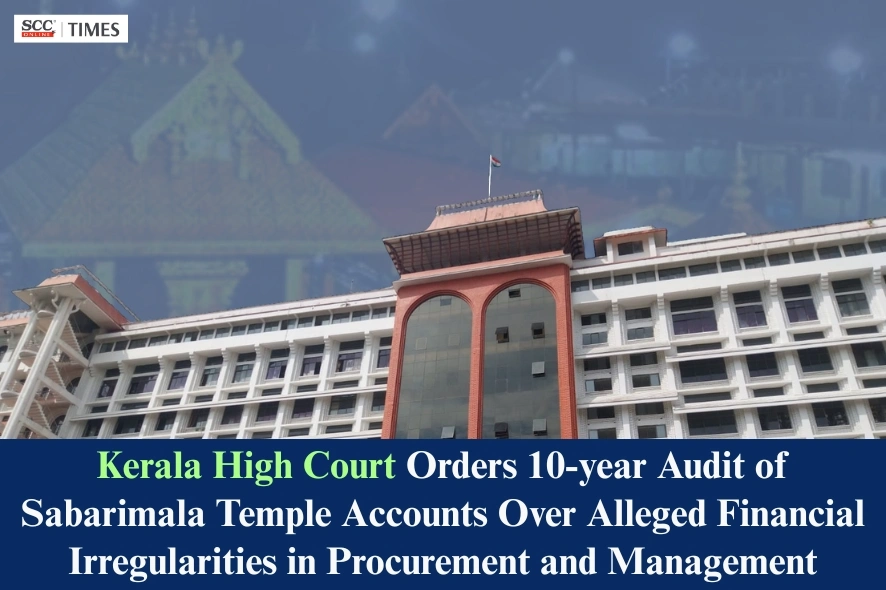
Kerala High Court: In a suo motu matter initiated on the basis of a report submitted by the Sabarimala Special Commissioner, which highlighted alleged misuse of temple funds, failure to maintain mandatory records, acceptance of pooja materials without proper accounting, and the absence of adequate safeguards to prevent financial impropriety within the Travancore Devaswom Board, the Division Bench of Raja Vijayaraghavan V. and K.V. Jayakumar, JJ. directed the Travancore Devaswom Board (TDB) to produce records relating to various temple rituals and offerings (Vazhipadu) conducted at the Sabarimala Temple over the past 10 years and ordered an independent audit of its financial practices. The Court expressed serious concern over alleged irregularities in reimbursement claims, unregulated supply of pooja materials, failure to maintain mandatory records, and the absence of adequate safeguards against financial misuse, emphasising that statutory religious institutions are bound by principles of transparency, accountability, and sound financial management.
Background
The proceedings arise from a report submitted by the Sabarimala Special Commissioner based on a vigilance inquiry into the administration of the Sabarimala Temple under the TDB. The report raised serious concerns regarding financial management, procurement practices, accountability of temple officials, and transparency in the conduct of temple rituals and offerings.
Earlier, the Court had expressed concern regarding the conduct of Ashtabhishekam Poojas and alleged irregularities in reimbursement claims made by temple officials.
Key Allegations
1. Unsupported Reimbursement Claims
The Administrative Officer allegedly claimed ₹ 300 per Ashtabhishekam towards supplier costs without producing bills, vouchers, or purchase records to support the expenditure.
2. Unregulated Supply of Pooja Materials
A devotee allegedly supplied pooja materials worth approximately:
(i) ₹ 3 lakh during monthly poojas; and
(ii) ₹ 18 lakhs during the Mandala-Makaravilakku season.
The Court noted that these supplies were accepted continuously over several years without transparent procedures, authorisation, receipts, or proper accounting.
3. Failure to Maintain Mandatory Records
Despite Board Orders requiring:
(i) issuance of Form No. 3 receipts,
(ii) maintenance of Special Nivedhya Registers, and
(iii) proper stock accounting,
the records were allegedly not maintained.
4. Risk of Double Payment
The Vigilance Report alleged that even when materials were supplied by the devotee, reimbursement claims were simultaneously made by Administrative Officers for procuring the same materials.
5. Lack of Quality Verification
Unlike materials procured through competitive tenders, materials supplied by private individuals were allegedly accepted without independent quality or safety testing.
Analysis and Decision
The Court rejected the Board’s contention that the Kerala Financial Code and Purchase Manual did not apply to Vazhipadu-related purchases.
It held that a statutory body functioning in a fiduciary capacity cannot exempt itself from transparency, prudence, and accountability merely through internal orders.
The Court strongly criticised the Board’s stand that production of bills and vouchers was impractical because pooja materials were perishable.
According to the Court, perishability does not eliminate the need for documentation; proper safeguards and alternative mechanisms could have been devised, and no public expenditure can be recognised without documentary proof.
The Court found it alarming that the Administrative Officer was effectively functioning as purchaser, receiver, verifier, custodian, and accountant of materials. Such concentration of responsibilities violated basic accounting principles and increased the risk of fraud and misappropriation.
The Court observed that mandatory receipt issuance and record maintenance requirements had been ignored despite specific Board orders. The explanation that receipts were not issued because the donor was absent was found wholly unsatisfactory.
The Court noted that the affidavit failed to answer the crucial allegation that reimbursement claims were made even when materials had already been supplied free of cost by sponsors. The Court considered this omission particularly serious.
The Court directed the Travancore Devaswom Board to:
-
Produce within 10 days all records relating to:
(i) Ashtabhishekam,
(ii) Mahanivedhyam,
(iii) Ganapathy Homam, and
(iv) other Vazhipadus conducted during the previous 10 years.
-
Submit complete records regarding materials supplied by the devotee and other sponsors, including:
(i) receipts,
(ii) acknowledgments,
(iii) registers,
(iv) stock records, and
(v) utilisation records.
-
Furnish details of independent auditors or external audit agencies engaged during the relevant period.
-
Produce soft copies of:
(i) accounts,
(ii) audit reports,
(iii) audit observations, and
(iv) related financial records.
The Court also directed the Kerala State Audit Department to conduct an independent examination and submit a report addressing:
1. transparency of existing procedures,
2. accountability mechanisms,
3. audit compliance,
4. adequacy of checks and balances,
5. risks of duplication of claims,
6. revenue loss,
7. misappropriation of funds, and
8. overall financial integrity of the institution.
The matter has been posted for further consideration on 20 June 2026, pending submission of records and audit reports by the Travancore Devaswom Board and the Audit Department.
[Suo Motu v. State of Kerala, 2026 SCC OnLine Ker 5587, decided on 8-6-2026]
Advocates who appeared in this case:
For Respondents: S. Rajmohan, Senior Government Pleader, and G. Biju, Standing Counsel,TDB