The panel on “Law at the Frontiers”, held during London International Disputes Week (LIDW) 2026, brought together experts in the law of the deep seabed, the Arctic and Antarctica, outer space governance and international affairs to examine how emerging frontiers are reshaping international law and dispute resolution. Moderated by Mr. Mark Evans, President of the Law Society of England and Wales, the discussion featured Mr. Toby Fisher, Matrix Chambers, Ms. Alison Macdonald KC, Essex Court Chambers, Ms. Rachael O’Grady, Partner and Co-Head of Space and Satellite at Mayer Brown and Mr. Terence McCulley, former U.S. diplomat and Senior Managing Director at McLarty Associates.
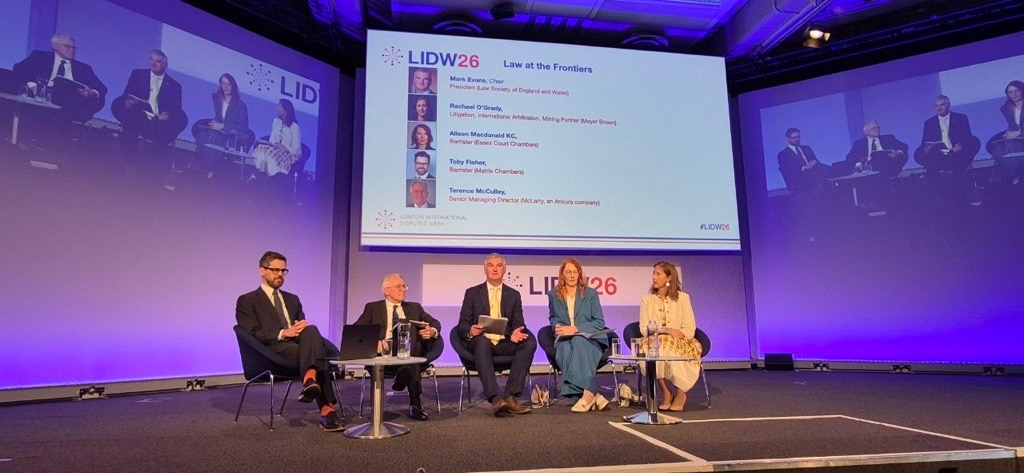
Introducing the discussion, Mr. Evans observed that technological change, environmental pressures and increasing commercial activity are creating entirely new legal questions concerning governance, infrastructure, international cooperation and dispute resolution. The panel explored the legal frameworks governing the deep seabed, the polar regions and outer space, before turning to the geopolitical tensions and future disputes likely to emerge in each area.
The Deep Seabed and the Common Heritage of Humankind
Opening the discussion, Mr. Toby Fisher explained that the deep seabed is governed by one of the most unusual legal regimes in international law. Under Part XI of the United Nations Convention on the Law of the Sea (UNCLOS), the seabed beyond national jurisdiction is designated as the “common heritage of humankind”, with rights over its resources vested in humanity as a whole.
To implement this principle, states created the International Seabed Authority (ISA), headquartered in Kingston, Jamaica, which regulates exploration and exploitation activities in areas beyond national jurisdiction. Mr. Fisher noted that minerals may only be recovered from the deep seabed with ISA authorisation and that benefits derived from such activities are intended to be shared for the benefit of humankind.
Describing the origins of the regime, he observed:
“It was a really extraordinary act of multilateralism.”
While acknowledging that the framework reflects compromises reached during the Cold War, Mr. Fisher noted that it remains the governing legal structure for deep-sea mining and is supported by a specialised dispute resolution mechanism through the Seabed Disputes Chamber of the International Tribunal for the Law of the Sea.
Antarctica, the Arctic and Competing Claims
Turning to the polar regions, Ms. Alison Macdonald KC contrasted the legal treatment of Antarctica and the Arctic.
She described the Antarctic Treaty System as one of the most successful examples of international cooperation. Signed in 1959, the treaty effectively freezes competing territorial claims, prohibits military activity, promotes peaceful scientific cooperation and permits inspection of facilities operated by other treaty parties.
Ms. Macdonald KC explained that the treaty deliberately suspends disputes over sovereignty rather than resolving them, creating what she described as a durable framework built upon cooperation and strategic ambiguity.
The Arctic presents a markedly different picture. Unlike Antarctica, it is not governed by a bespoke treaty system. Instead, legal rights derive largely from UNCLOS and overlapping claims by Arctic coastal states over continental shelves, exclusive economic zones and maritime boundaries.
She noted that the Arctic Council, established in 1996 to promote cooperation on environmental and developmental issues, has historically played an important coordinating role but lacks binding authority.
Outer Space and the Limits of Existing Treaties
Discussing the legal framework governing outer space, Ms. Rachael O’Grady explained that international space law remains centred on the Outer Space Treaty, 1967, supplemented by four additional treaties dealing with specific aspects of space activity.
She outlined several foundational principles, including the prohibition on national sovereignty in outer space, the requirement that space activities benefit all countries, state responsibility for private and public space activities, liability for damage caused by space objects and the obligation to avoid harmful contamination.
Ms. O’Grady emphasised that the treaty continues to shape legal discussions surrounding commercial activity in space, despite being drafted decades before modern private-sector involvement and plans for lunar resource extraction.
Summarising the broader framework, she remarked:
“Space isn’t in a total vacuum.”
Although governed by a distinct treaty regime, she noted that activities in outer space remain subject to international law and the principles of the United Nations.
Geopolitical Conflict and the Consequences of Eroding International Order
Shifting the discussion to contemporary geopolitical realities, Mr. Terence McCulley examined how disruptions to the international rules-based order are affecting economies and societies far beyond the immediate theatres of conflict.
Drawing on his experience as a diplomat in Africa, Mr. McCulley argued that many African states remain among the strongest defenders of international legal institutions because they directly experience the consequences of global instability.
He observed:
“African countries are some of the fiercest defenders, for the most part, of the international system.”
Using examples ranging from Russia’s war in Ukraine to disruptions affecting the Strait of Hormuz, Mr. McCulley explained how challenges to international law can quickly translate into rising fuel prices, food insecurity, pharmaceutical shortages and social instability across developing economies.
Referring to the broader consequences of geopolitical conflict, he remarked:
“These are immediate in terms of rising prices. And then longer term, down the road, we’re looking at food insecurity and economic growth.”
His comments underscored the extent to which international legal frameworks underpin global trade, energy security and economic development.
Deep-Sea Mining and an Existential Challenge to UNCLOS
Returning to the deep seabed, Mr. Toby Fisher argued that technological advances have transformed deep-sea mining from a theoretical possibility into a commercially viable and strategically significant activity.
He noted that polymetallic nodules found on the seabed contain cobalt, nickel, copper and rare earth elements that are increasingly important for both the global energy transition and geopolitical competition.
According to Mr. Fisher:
“It’s technically feasible, it’s also now commercially viable, and it’s strategically desirable.”
The discussion then focused on the United States’ decision to pursue unilateral deep-sea mining authorisations outside the UNCLOS framework. Mr. Fisher explained that U.S. President Donald Trump’s April 2025 executive order directing expedited consideration of deep-sea mining licences represented a direct challenge to the international regime established under Part XI.
Mr. Fisher suggested that commercial operators would naturally gravitate toward regulatory systems offering faster approvals and fewer obligations to share revenues.
As he put it:
“Under the ISA system, you can share your profits with humankind, and under the U.S. system, you simply get to pocket those profits.”
He cautioned that the collapse of the deep-seabed regime could have broader implications for the law of the sea as a whole.
Climate Change, Arctic Competition and Emerging Flashpoints
Ms. Alison Macdonald KC warned that climate change is rapidly transforming both Antarctica and the Arctic, creating new tensions around resources, shipping routes and environmental protection.
While describing the Antarctic Treaty System as a success story, she noted that melting ice is making previously inaccessible resources more attractive and increasing pressures on the existing framework. She also pointed to difficulties in achieving consensus on environmental measures, particularly where major powers oppose conservation initiatives.
As she remarked:
“Consensus under the Antarctic Treaty System is a wonderful thing, until, of course, it starts becoming vetoes on action.”
Turning to the Arctic, she highlighted the impact of Russia’s invasion of Ukraine on regional cooperation and noted that the Arctic Council has effectively ceased normal operations.
She emphasised:
“The Arctic is warming four times faster than the global average.”
As ice melts, shipping routes such as the Northwest Passage and Northern Sea Route are becoming increasingly viable, giving rise to disputes over sovereignty, navigation rights and resource access.
Lunar Resources, Asteroid Mining and Orbital Congestion
Drawing parallels with developments in the deep seabed and the Arctic, Ms. Rachael O’Grady observed that outer space is increasingly confronting similar questions concerning resource extraction and competing interpretations of international law.
She explained that lunar regolith and asteroid resources are attracting growing interest because they may provide oxygen, fuel and other materials necessary for long-duration space missions.
At the same time, states are adopting legal frameworks that permit resource utilisation without claiming sovereignty over celestial bodies.
Summarising this approach, she noted:
“We’re not appropriating asteroids. We’re just saying that our nationals can use them in a commercially viable way.”
The discussion also highlighted the rapid growth of satellite constellations and increasing congestion in low Earth orbit. Ms. O’Grady pointed to developments such as Starlink and Amazon’s Kuiper network as examples of how private actors are reshaping the space sector.
The Future of the Rules-Based Order
In the final segment, the panellists reflected on whether existing legal frameworks are capable of surviving mounting geopolitical and commercial pressures.
Mr. Terence McCulley argued that the greatest challenge facing international law is not the absence of rules but the declining willingness of powerful states to follow them.
He observed:
“The challenge really is what do you do in the current context when you have a U.S. administration which is intent on not following the rules?”
He further questioned whether market actors may ultimately become important enforcers of international norms:
“Are banks and insurance companies going to be willing to insure and invest in enterprises that are manifestly contrary to international law?”
Dispute Resolution and the Future of Frontier Governance
Ms. Alison Macdonald KC noted that dispute resolution mechanisms in Antarctica remain heavily dependent on state consent and questioned whether existing cooperative structures would remain effective if geopolitical tensions intensify.
Mr. Toby Fisher similarly predicted that future disputes concerning deep-sea mining could soon reach the Seabed Disputes Chamber, particularly regarding the obligations of states parties under UNCLOS to prevent participation in unauthorised activities.
He suggested that future litigation may determine the fate of the international seabed regime itself:
“The outcome of which will determine whether we have a common heritage regime or a free-for-all regime.”
Space at a Regulatory Crossroads
Concluding the discussion, Ms. Rachael O’Grady reflected on the extraordinary pace of growth in the space sector.
She noted that while only a single satellite existed in 1957, estimates suggest that 100,000 satellites could be operating in orbit by 2030.
Highlighting society’s growing reliance on space infrastructure, she observed:
“The average person uses space technology about 28 times a day.”
At the same time, she warned that orbital debris has reached critical levels and that regulators must find a balance between sustainability and innovation.
Concluding Reflections
The discussion demonstrated that the legal frontiers of the twenty-first century are no longer theoretical. From deep-sea mining and Arctic trade routes to lunar resource extraction and satellite mega-constellations, technological advances are testing legal frameworks designed for a different geopolitical era. Across each frontier, the panellists returned to a common question: whether international institutions built on cooperation, consensus and shared rules can continue to withstand growing geopolitical rivalry, commercial pressures and environmental change. As activity expands across the oceans, polar regions and outer space, the future of dispute resolution may depend not only on the existence of legal rules, but on the willingness of states to preserve and enforce them.
Also Read: Who Owns the Risk When AI Gets It Wrong? Confidentiality, Governance and Human Judgment at LIDW 2026
This report forms part of SCC Times’ special coverage of London International Disputes Week (LIDW) 2026. As an official Media Partner of LIDW26, SCC Times is reporting on key discussions across the conference, bringing readers insights into the emerging trends, challenges and developments shaping the future of international dispute resolution.
SCC Times extends its appreciation to Zehra Naqvi, EBC–SCC Online Foreign Student Ambassador and Lawyer, for her on ground presence, valuable assistance and contribution to the reporting of this event.