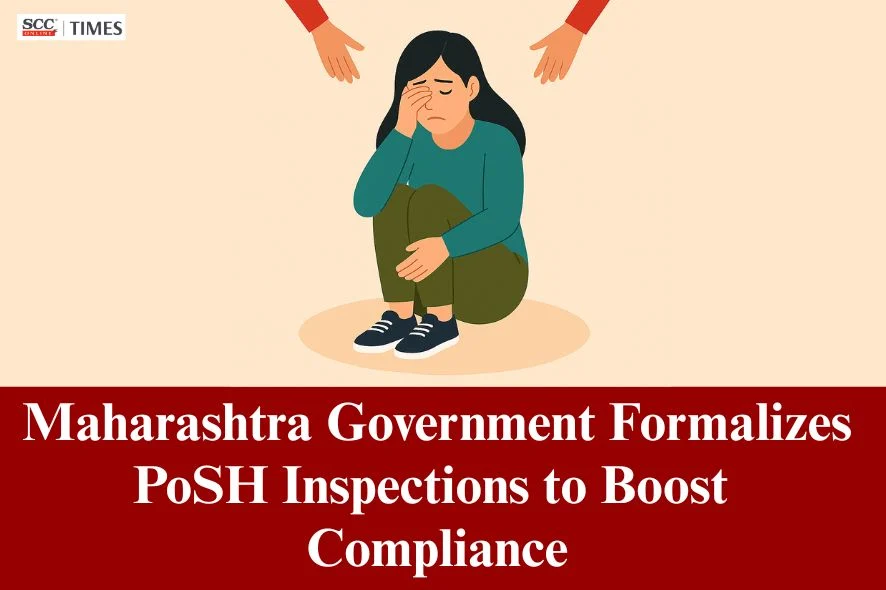
On 14 May 2026, the Government of Maharashtra issued circular to establish a formal inspection framework under the Sexual Harassment of Women at Workplace (Prevention, Prohibition and Redressal) Act, 2013 (PoSH Act), aimed at ensuring compliance related to sexual harassment prevention and grievance redressal mechanisms across workplaces.
Background:
The PoSH Act, 2013 provides framework to protect women against sexual harassment in workplaces and to ensure a safe working environment.
PoSH Act mandates that:
-
Establishments with 10 or more employees must constitute an Internal Committee (IC) (as per Section 4 and Government Resolution dated 19 June 2014).
-
Establishments with fewer than 10 employees fall under Local Committees (Resolution dated 11 September 2014).
For implementation:
-
Sub-Divisional Officers are designated as District Officers.
-
The Commissioner, Women and Child Development (Pune) serve as the State Nodal Officer.
Though the Act prescribes clear obligations for employers, implementation has remained uneven. To address these gaps, the Government has introduced a structured oversight and inspection mechanism, emphasizing substantive compliance over procedural formality.
Also Read: Your Essential Guide to Navigating the PoSH Complaint Process
Key highlights:
-
Under Section 25 of the PoSH Act, 2013, the Government is empowered to:
-
Seek information from establishments or District Officers
-
Conduct inspections of establishments
-
-
Considering the large number of private, government, and semi-government establishments across Maharashtra, the Government has authorized the following officers to conduct inspections:
-
District Officers (all)
-
Officers and staff at the Commissionerate level (Women & Child Development)
-
Divisional Deputy Commissioners (WCD)
-
District Women & Child Development Officers
-
District Programme Officers (Zilla Parishad)
-
Child Development Project Officers (Urban, Rural, Tribal)
-
District Probation Officers
-
Probation Officers
-
District Coordination Officers (MAVIM)
-
Protection Officers (District and Taluka level)
-
Anganwadi Head Workers and Supervisors
-
Superintendents appointed by the Government in institutions (including NGOs)
-
-
To operationalize inspections effectively, responsibilities have been distributed across administrative levels:
-
State Level: The Commissioner, Women and Child Development (Pune), acts as the State Nodal Officer and defines inspection methodology and goals.
-
Divisional Level: Divisional Deputy Commissioners supervise inspection activities.
-
District Level: District Women and Child Development Officers and District Programme Officers coordinate inspections, particularly in rural areas.
-
Urban Areas: Urban Child Development Project Officers function as nodal points alongside district authorities.
-
-
The guidelines mandate that:
-
Inspections must be conducted using a predefined checklist issued by the Government.
-
Only one inspection team should visit an establishment to avoid duplication or confusion.
-
Local functionaries such as Anganwadi supervisors may assist in the inspection process.
-
-
A major focus of the new framework is to reinforce complaint redressal systems:
-
Establishments with 10 or more employees must constitute Internal Committees (ICs).
-
Smaller establishments are covered under Local Committees set up by the administration.
-
The inspection process will evaluate whether these committees are properly formed, functional, and compliant with procedural requirements.
-
-
The circular reiterates the importance of accountability by linking inspection findings to penal consequences:
-
The introduction of a formal inspection framework has several implications for organizations:
-
Employers must ensure strict compliance with PoSH requirements, as inspections may occur at any time.
-
Proper maintenance of records, reports, and committee proceedings becomes essential.
-
Organizations are expected to go beyond basic compliance and demonstrate a commitment to workplace safety.
-
-
This circular reinforces that maintaining a safe workplace is not only a legal requirement but also a core organizational responsibility.