


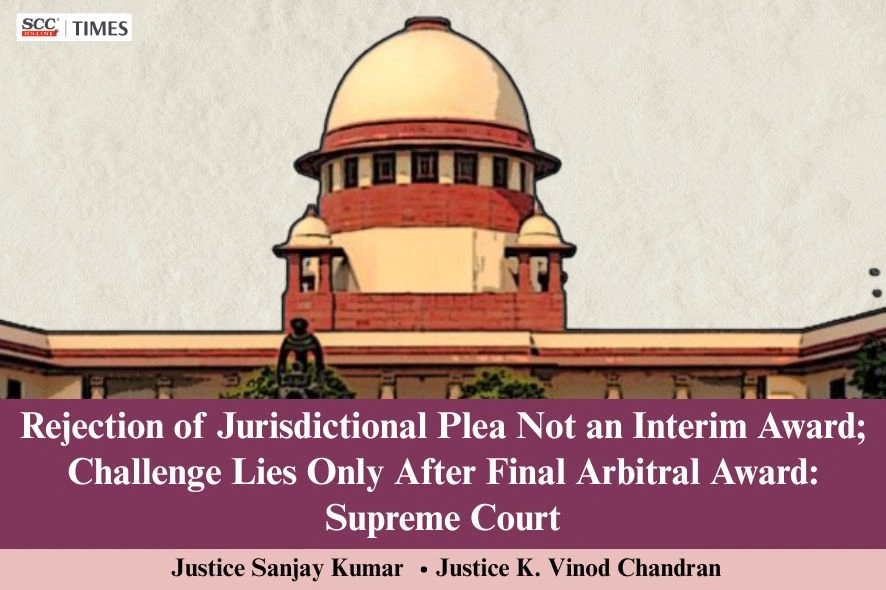
Supreme Court: In an appeal concerning the maintainability of challenges to orders passed by an Arbitral Tribunal under Section 16, Arbitration and Conciliation Act, 1996 (A&C Act, 1996), a Division Bench of Sanjay Kumar* and K. Vinod Chandran, JJ., set aside the judgment of the Delhi High Court which had entertained proceedings under Sections 34 and 37 A&C Act, 1996. The Court held that an order rejecting a plea of lack of jurisdiction under Section 16(2) is not amenable to challenge under Section 34 at an intermediate stage and can be assailed only after the final arbitral award is rendered.
Emphasising the statutory scheme, the Court reiterated that once such a jurisdictional plea is rejected, Section 16(5) mandates continuation of arbitral proceedings, and Section 16(6) defers any challenge to the stage of the final award under Section 34. Clarifying the scope of appellate intervention, the Court underscored that Section 37 permits an appeal only where the Arbitral Tribunal accepts a plea of lack of jurisdiction and terminates proceedings.
Background
Arbitration between the parties emanated from disputes under memorandum of understanding dated 2 March 2006 and 5 May 2008. The appellant had earlier instituted a civil suit for recovery in 2018 before the Saket Courts, New Delhi, which came to be disposed of on 3 August 2019 upon an application under Section 8, A&C Act, 1996, filed by the respondent, resulting in reference of disputes to arbitration. As the respondent failed to concur in the appointment of an arbitrator, the appellant approached the Delhi High Court under Section 11(6), pursuant to which a sole arbitrator was appointed on 27 September 2021 and the appointment stood confirmed on 11 October 2021.
At the stage of framing of issues, the respondent filed an application under Order 7 Rule 11, Civil Procedure Code, 1908 (CPC) seeking rejection of the claim petition on the ground of limitation, which was dismissed by the arbitrator on 16 April 2022. The respondent’s challenge under Section 34 to the said order was rejected by the District Judge as not maintainable, and the Delhi High Court, by order dated 24 February 2023, affirmed the same while granting liberty to the respondent to invoke Section 16, A&C Act, 1996. Availing such liberty, the respondent filed an application under Section 16 before the arbitrator raising limitation as a jurisdictional issue, which too came to be dismissed on 19 May 2023.
Aggrieved thereby, the respondent once again invoked Section 34 by filing OMP (Comm.) No. 64 of 2023. Notably, although the appellant initially questioned maintainability of such challenge to an order under Section 16, it conceded the issue in view of precedent relied upon by the respondent. The District Judge, accordingly, entertained the application but dismissed the same on merits by order dated 26 March 2024. In appeal under Section 37, the Division Bench of the Delhi High Court, by judgment dated 8 May 2025, allowed the appeal on merits without examining the maintainability of the Section 34 proceedings against an order under Section 16, giving rise to the present appeal.
Analysis
Having given its earnest consideration to the matter, the Court held that the District Judge as well as the Division Bench were in error in entertaining the proceedings under Sections 34 and 37, A&C Act, 1996, against an order passed by the Arbitral Tribunal under Section 16 rejecting the plea of lack of jurisdiction.
The Court analysed the scheme of Section 16 and observed that where a plea under Section 16(2) or Section 16(3) is rejected, Section 16(5) mandates continuation of arbitral proceedings culminating in an award, and under Section 16(6), the aggrieved party can assail such rejection only at the stage of challenge to the final award under Section 34. It was further noted that Section 37 permits an appeal only where the Arbitral Tribunal accepts the plea of lack of jurisdiction and terminates the proceedings.
Distinguishing IFFCO Ltd. v. Bhadra Products, (2018) 2 SCC 534, the Court clarified that the said decision dealt with a determination of limitation as a preliminary issue, which amounted to an interim award amenable to challenge under Section 34, and not with a rejection of a jurisdictional plea under Section 16. It was held that construing a rejection under Section 16 as an interim award would run contrary to the statutory scheme and render Section 37(2) otiose. The Court noted that the matter had proceeded on a patent misunderstanding of this ruling, the appellant having conceded maintainability despite having correctly raised it initially. The Court clarified the legal position suo motu notwithstanding such concession, as the error went to the root of the statutory scheme
The Court thus concluded that the respondent was not entitled to maintain an application under Section 34 against the order dated 19 May 2023 passed under Section 16, and consequently, no appeal under Section 37 would lie therefrom.
Decision
The impugned judgment dated 8 May 2025 passed by the Division Bench of the Delhi High Court was accordingly set aside, leaving it open to the respondent to assail the order under Section 16 only after the passing of the final award, in accordance with law.
Also Read: SC: Unsuccessful party can invoke Section 9 A&C Act at post-award stage | SCC Times
[MCM Worldwide (P) Ltd. v. Construction Industry Development Council, 2026 SCC OnLine SC 717, decided on 21-4-2026]
*Judgment authored by: Justice Sanjay Kumar
Advocates who appeared in this case:
For the Petitioner: Shreyan Das, Rishi Raj, Advocates, Mohini Priya, AOR
For the Respondent: Nikhil Nayyar, Sr. Adv., N.K. Kantawala, Prakhar Sharma, Satyendra Chahar, Amaya M. Nair, Advocates, Anu Gupta, AOR
Buy Arbitration and Conciliation Act, 1996 HERE
It means for filing Section 34 Application, Award debtor has to deposite the Money ( 50 % or 100 %) for stay of the operation Award , if final award is passed by Arbitrator without Jurisdiction . God may only save us.