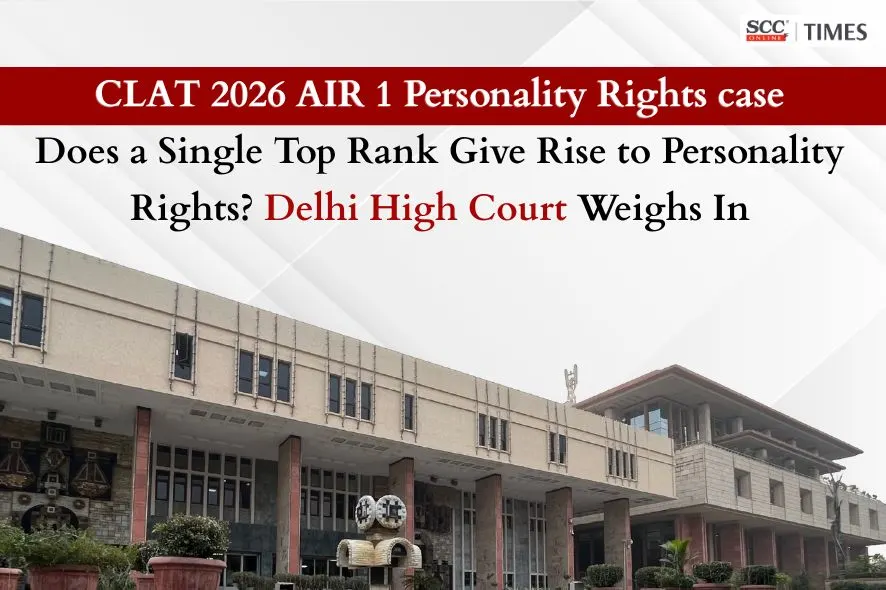
Delhi High Court: While examining the grievance of Plaintiff 3, CLAT 2026 AIR 1 candidate, regarding misuse of her personality rights over single academic achievement, in the application filed by the plaintiffs, Toprankers Edtech Solutions (P) Ltd., seeking ex parte ad interim injunction against the defendants for launching blatant and malicious campaign thereby tarnishing their goodwill and reputation, the Single Judge Bench of Tushar Rao Gedela, J., declined to protect plaintiff’s personality rights, holding that a single achievement, such as securing a top rank, does not automatically confer enforceable personality rights.
However, the Court opined that it was not appropriate for the defendants to carry out any campaign, whether defamatory or otherwise, in Plaintiff 3’s name and therefore, restrained the defendants from using the name, image, or likeness of Plaintiff 3, including any AI-generated or manipulated content.
Factual Matrix
Plaintiff 1 is an established edtech company engaged in coaching and test preparation services under brands such as “Toprankers,” “LegalEdge,” “Creative Edge”, “Judiciary Gold” and “SuperGrads”. Plaintiff 2 is its franchisee operating prominently in Delhi. Plaintiff 3 is a minor student who secured All India Rank 1 in CLAT 2026.
The plaintiffs claimed significant commercial presence, including thousands of enrolled students and substantial revenue generation, particularly in Delhi-NCR. It was claimed that Plaintiff 3 applied for and was selected for a special batch of meritorious students called “CLAT 2026 | Champions batch I” in February 2025. Plaintiff 3 stated that she had limited interaction with Defendant 1 through certain mock tests under its package “CLAT DLP (Distance Learning Program) 2026.”
After Plaintiff 3 secured AIR 1 in CLAT 2026, a reaction video of her result was recorded and shared by Plaintiff 1, gaining wide publicity across platforms including major media outlets.
The plaintiffs alleged that Defendant 1 attempted to portray Plaintiff 3 as its student and even offered to sponsor her entire college fees in exchange for exclusive promotional rights, which was refused. Despite this, the defendants allegedly began using her name and morphed images to claim credit for her success.
The plaintiffs contended that the defendants launched a coordinated defamatory campaign across platforms including YouTube, blogs, LinkedIn, and Instagram. The content included a video titled “CLAT 2026 AIR 1 Geetali Gupta Controversy Exposed” and multiple posts alleging fraud, deceit, and unethical practices by the plaintiffs. Further, it was alleged that AI-generated and morphed images were circulated portraying the plaintiffs as being behind bars, despite no such arrest having taken place. The plaintiffs also pointed to social media posts and news publications with headlines such as “FIR filed against Toprankers,” alongside visual depictions reinforcing the defamatory narrative.
After Plaintiff 1 issued cease-and-desist notice dated 5 January 2026 requesting to take down the defamatory content, the defendants allegedly filed a false and frivolous FIR in Jodhpur against the plaintiffs and Plaintiff 3’s family. Despite a stay of the FIR by the Rajasthan High Court, the defendants continued publishing defamatory material.
Plaintiffs claimed that with respect to Plaintiff 3, the defendants had committed the following unlawful acts:
-
creation and circulation of AI-generated deepfakes,
-
morphed content showing endorsement of defendants,
-
use of her likeness in datasets and AI tools,
-
dissemination of manipulated images.
Also Read: The Judicially Crafted Shield: India’s Evolving Law of Personality Rights
Issue for Determination
Can Plaintiff 3, by virtue of securing in CLAT 2026 AIR 1, claim protection of “personality rights” so as to restrain the defendants from using her identity, image, or association for their commercial benefit?
Analysis
The Court observed that Plaintiff 3 had been drawn into a “turf war” between the rival institutions as a “bait”, even though she had no real stake in the commercial rivalry. It held the defendants’ conduct in continuing to use her name despite her explicit disassociation to be unjustified. Although it was argued that the cause of action is common to all the 3 plaintiffs, however, the Court was not convinced that Plaintiff 3 would have anything in common between the plaintiffs or the defendants, as her situation appeared to be that of a pawn.
The Court made it abundantly clear that its observations regarding Plaintiff 3 were not premised on any assertion of “personality rights”. The Court held that a single achievement, such as securing a top rank, does not automatically confer enforceable personality rights.
The Court cautioned against expanding such rights, for any and every success, or a milestone achieved stories, noting that such an approach would lead to “absurdity and incongruity”. It asserted that a broad interpretation of “personality rights” doctrine would imply that every aspirant, candidate, or student securing a top rank in an examination could claim protection of personality rights, which is neither legally sustainable nor conceptually sound.
Also Read: What are Personality Rights? The rise of Celebrity Lawsuits Explained
The Court stated that individuals who have attained sustained prominence or widespread recognition, such as accomplished sportspersons, celebrated artists, renowned business figures, or public leaders, may, depending on the facts, possess such rights. However, a single instance of success cannot, by itself, justify invocation of personality rights, though the issue may still be examined on a case-to-case basis.
“Of course, this is not to say that the individual achievers who may have achieved continuous top rank results over many years in various examinations, received awards in sporting events, musical maestros, artists of repute, business persons recognised globally or countrywide, political or religious leaders and such like persons in other spheres of life etc., may not have, what may constitute ‘personality rights’, yet it cannot be a sole or a single instance which would lend credence to a person to agitate violation of ‘personality rights’.”
Relying on D.M. Entertainment (P) Ltd. v. Baby Gift House, 2010 SCC OnLine Del 4790, the Court emphasised that public recognition and independent commercial value are essential for invoking publicity rights. It explained that character merchandising and publicity rights are grounded in the commercial exploitation of a persona that has acquired independent public recognition. It highlights that such recognition must transcend the original context and attain a level where the persona becomes a commodity in its own right.
It also cautioned against over-expansion of publicity rights as that could restrict free speech. For instance, “caricature, lampooning, parodies and the like, which may tend to highlight some aspects of the individual’s personality traits, may not constitute infringement of such individual’s right to publicity”. It opined that if such expressions are defamatory, the appropriate remedy lies in libel or slander, rather than an expansive claim of publicity rights.
Decision
The Court granted interim injunction in favour of plaintiffs and restrained the defendants from using images, content, and advertisements of or in the name of Plaintiff 3, including all social and digital media posts and photographs generated by AI or otherwise.
Also Read: Me, Myself and AI: Chasing Deepfakes Across Borders Without Losing Your Rights
[
Advocates who appeared in this case:
Mr. J. Sai Deepak, Senior Advocate with Mr. Ankur Khandelwal, Mr. Chirag Sharma, Mr. Nikhil Saurabh and Mr. Sidhhi, Adv., Counsel for the Plaintifs