Submissions are invited to a national conference by Siddhartha Law College, Dehradun
About Siddhartha Law College, Dehradun
A quality legal education opens up a plethora of opportunities and avenues for students of law. Today, legal education in India is in a very shabby state of affairs. It has become a cause of concern for all the stakeholders and the country at large. Some ameliorative steps were taken by establishing dedicated Law Universities, but due to their own constraints such as inadequate funds, unsatisfactory infrastructure, lack of good and dedicated faculties, etc., the desired result is nowhere in sight.
As an encouraging development in this respect, Siddhartha Law College was established in the year 2009 and registered under the auspices of Siddhartha Group of Institutions (SGI). It is managed by Siddhartha Educational Society (Regd. No. 1363/2002-2003), under the dynamic leadership of renowned social worker Mr Durga Prasad Verma. Siddhartha Law College is developing under the guidance of Justice (Retd.) V.K. Maheshwari, Director Siddhartha Law College. Siddhartha Law College is affiliated to Veer Madho Singh Bhandari Uttarakhand Technological University (Uttarakhand State Govt University) and approved by the Bar Council of India, New Delhi.
About the National Conference
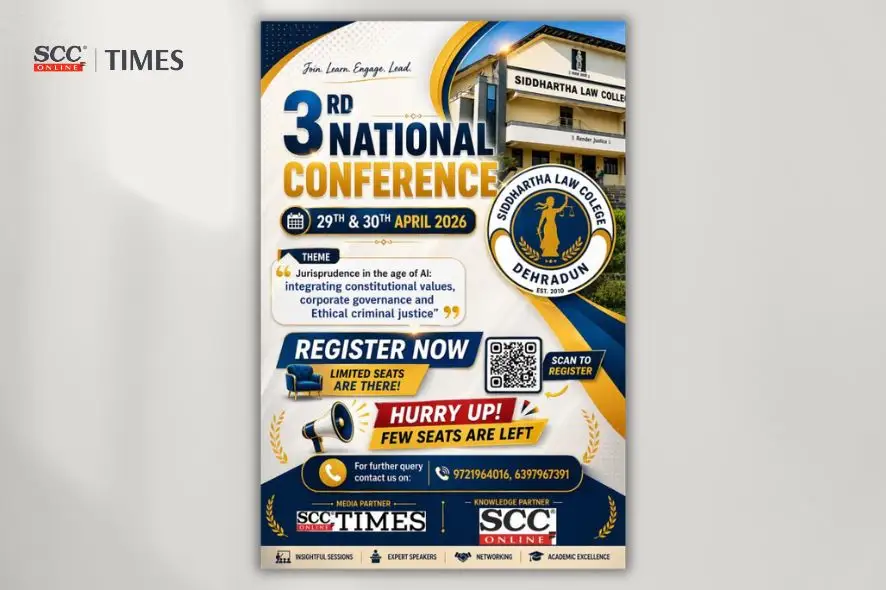
THEME: “Jurisprudence in the Age of AI: Integrating Constitutional, Values, Corporate Governance, and Ethical Criminal Justice.”
The National Conference held under the title Jurisprudence in the Age of AI: Integrating Constitutional Values, Corporate Governance, and Ethical Criminal Justice presents an essential Indian legal discussion of the tremendous impact of artificial intelligence on jurisprudence. The incident in the constitutional democracy of India highlights the necessity to harmonize AI use with the principles that were laid down in the Constitution of India, specifically Articles 14 (equality), 19 (freedom of speech and expression) and 21 (right to life, liberty, and privacy, as elaborated in Justice K.S.Puttaswamy case).
Deliberations under the constitutional values pillar are concerned with the protection of core rights against the risks imposed by AI. Biases in algorithmic decision-making in welfare schemes, surveillance, or e-governance tend to increase, which may result in the breach of equality and non-arbitrariness.
Deliberations under the constitutional values pillar are concerned with the protection of core rights against the risks imposed by AI. Biases in algorithmic decision-making in welfare schemes, surveillance, or e-governance tend to increase, which may result in the breach of equality and non-arbitrariness.
Based on the Indian jurisprudence and recent privacy cases, it proposes the implementation of constitutional morality in the design of AI, and that technology should be used as a means of justice, not a source of arbitrary authority.
In corporate governance, the debates bring out the responsibilities of the Indian companies as enshrined in the Companies Act, 2013, SEBI regulation, and upcoming AI ethics standards.
The conference aims at changing the Indian jurisprudence by interdisciplinary panels and scholarly discussions, calling on active legislation, judicial principles and multi-stakeholder interaction.
Sub-Themes
Participants may submit papers on the following sub-themes:
-
Artificial Intelligence and Child Rights Protection: Constitutional Safeguards under Articles 14, 19 & 21
-
Algorithmic Bias in Juvenile Justice and Child Welfare Decisions
-
AI-Driven Surveillance, Data Privacy, and Child Protection
-
Predictive Technologies and Ethical Limits in Child Protection Systems
-
Artificial Intelligence and Online Child Exploitation: Legal Responses
-
Child Rights in the Age of Artificial Intelligence
-
Access to Justice for Children through Technology and AI
-
Corporate Governance and Liability for Child Rights Violations in AI Ecosystems
-
AI for Child Rights Literacy, Awareness, and Education
-
Corporate Liability, Torts, and Consumer Protection in AI Markets
-
Labour Law, Automation, and the Platform Economy
-
Competition Law, Platform Regulation, and Big Tech Market Power
-
Intellectual Property, AI Creativity, and Data Ownership.
-
Jurisprudence and Legal Theory in the Age of Artificial Intelligence
-
Constitutionalism, Fundamental Rights, and Digital Governance
-
Privacy, Surveillance, and Data Protection Law
-
Algorithmic Governance, Administrative Law, and Rule of Law
-
Judicial Review, Transparency, and Explainability of AI Systems
-
Equality, Non-Discrimination, and Algorithmic Bias
-
Artificial Intelligence in Policing and Criminal Justice
Call for Research Papers
Original and unpublished research papers in English on the above-mentioned theme/ sub-themes are invited for submission from the academicians, research scholars, legal practitioners and law students of various universities/colleges in India.
Abstract
-
The abstract should be on an A4 sheet in Word Document Format typed in Times New Roman in 12 font size with 1.5 line spacing in not more than 300 words, it should not contain more than five keywords.
-
The abstract should contain personal details of the author(s) in the order:
-
Title of the paper,
-
Name, Designation,
-
Institute/ University/ College/Organization,
-
contact number,
-
E-mail and address (is), of the author(s).
-
-
Indicate the name of the main author for correspondence in case of more than one author.
-
All abstracts will be peer-reviewed and evaluated on the basis of originality, research rigour, relevance to the seminar, and contribution to the State and Society. For English: Font “Times New Roman” 16 bold for the title, 14 for the subtitle, 12 for normal text.
Submission of Full Paper
Submissions are to be made only in electronic form. The same may be e-mailed to slc.publications.2022@gmail.com in MS Word format along with a cover letter addressed to Organizing Secretary.
Registration
Registration Link: https://forms.gle/gbGFEbJBP92ZmJpz8
-
Faculty member: ₹1500
-
Advocate/Industry Fellow: ₹1000
-
Research scholar & LL.M: ₹800
-
Students & Others: ₹700
-
Rs. 500 will be charged per person for the accommodation per night

The form and registration fees can be filled through the QR code, or through the information given below.
Alternative Mode of Payment
NEFT/RTGS/IMPS
Account No. 50065378452
IFSC- IDIB000D558
UPTID- slc@allbank
Important Dates
Last date for
-
Date of Conference: 29th and 30th April, 2026
Contact Details:
Swati Singh- +91 9721964016
Sunidhi Singh- +916397967391
Aman Das- +91 6909268110