To prevent the multiplicity of litigation and the risk of conflicting decisions arising from parallel proceedings, any existing private arbitration agreement is subsumed into the Council’s proceedings.
Can a buyer seek a separate arbitration reference during pending Section 18 MSMED proceedings?
The Calcutta High Court in Macmet Engg. Ltd. v. Mecgale Pneumatics (P) Ltd.1 held that any party to a dispute may, with regard to any amount due under Section 17, Micro, Small and Medium Enterprises Development Act, 2006 (MSMED Act), make a reference to the Micro and Small Enterprise Facilitation Council, MSMED Act includes the buyer, emphasising that a supplier’s claim for unpaid dues cannot be adjudicated in isolation from the buyer’s counterclaim for damages. To prevent the multiplicity of litigation and the risk of conflicting decisions arising from parallel proceedings, any existing private arbitration agreement is subsumed into the Council’s proceedings. Consequently, the buyer’s remedy is to file its counterclaim for damages before the Facilitation Council and not in seeking a separate reference., MSMED Act includes the buyer, emphasising that a supplier’s claim for unpaid dues cannot be adjudicated in isolation from the buyer’s counterclaim for damages. To prevent the multiplicity of litigation and the risk of conflicting decisions arising from parallel proceedings, any existing private arbitration agreement is subsumed into the Council’s proceedings. Consequently, the buyer’s remedy is to file its counterclaim for damages before the Facilitation Council and not in seeking a separate reference.
Can Section 18, MSMED Act overrides arbitration clause and contractual seat?
The issue was considered by the Gauhati High Court in Lokopriya Gopinath Bordoloi v. Green Alliance Engg. Services (P) Ltd.2, where it held that once a supplier invokes Section 18, MSMED Act, the statutory framework overrides the arbitration clause in a Government e Marketplace (GeM) contract. Even if the contract specifies a seat of arbitration based on the buyer’s location, such a provision is rendered inoperative by the overriding effect of Section 18(4), MSMED Act.
Is entrepreneur memorandum mandatory under the MSMED Act?
The Himachal Pradesh High Court, in Controller of Stores v. CBM Industries (P) Ltd.3 has held that filing an Industrial Entrepreneur’s Memorandum (IEM) or Entrepreneurs Memorandum Part-II (EM-II) before the supply is not a mandatory requirement. Entities registered with District Industries Centre (DIC) and engaged in production prior to the MSMED Act can file their IEM later and still qualify as “supplier” under the scheme of MSMED Act.
Is Section 7 IBC petition maintainable despite non-compliance with RBI MSME guidelines?
The National Company Law Tribunal (NCLT) Gauhati in Eduvanz Financing (P) Ltd. v. Abutani Mercantile (P) Ltd.4 held that a petition under Section 7, Insolvency and Bankruptcy Code, 2016 (IBC) remains maintainable even if a lender fails to follow Reserve Bank of India (RBI) Circulars regarding Micro, Small and Medium Enterprises (MSME) distress resolution. While RBI Guidelines provide a structured framework for addressing MSME stress, the IBC is a self-contained Code that takes precedence once a financial debt and default are clearly established. Hence, an entity’s status as an MSME does not bar insolvency proceedings even if the lender bypassed the proactive restructuring framework intended to support small businesses facing financial trouble.
Is MSEFC required to follow separate conciliation and arbitration stages in disputes?
The Bombay High Court in Dodal Electro Instruments v. Micro and Small Enterprises Facilitation Council5 held that the MSE Facilitation Council must strictly follow the mandatory two-stage procedure under Section 18, MSMED Act. The Court ruled that proceedings for conciliation and arbitration cannot be clubbed, and upon the failure of conciliation, the Council must formally initiate separate arbitration proceedings in accordance with the Arbitration and Conciliation Act, 1996. A Council cannot straightaway allow a claim or pass an award merely because a party failed to appear during conciliation, it must first terminate conciliation and then provide an opportunity for parties to file claims and present their case during an arbitral stage.
Conclusion
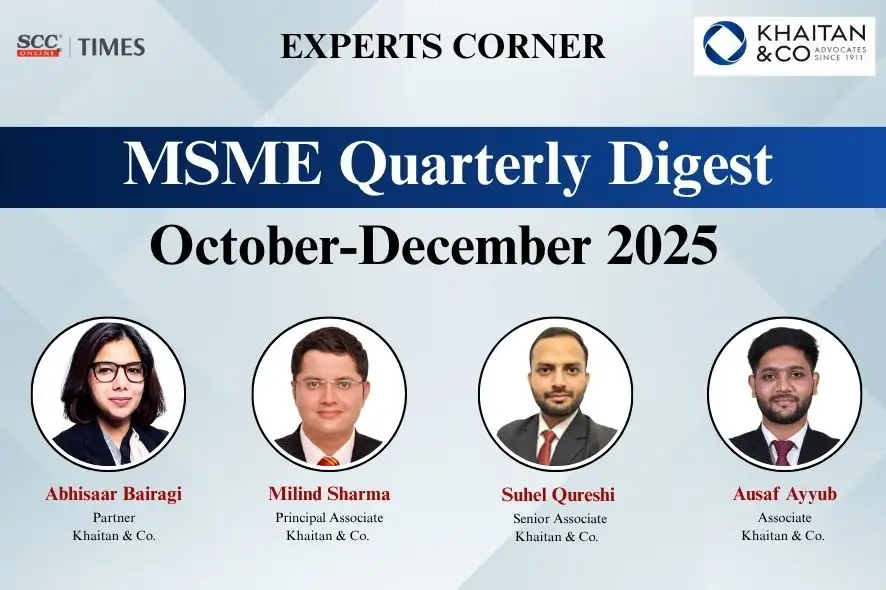
The fourth quarter of 2025 saw several significant judgments that clarified both the substantive and procedural framework governing disputes under the MSMED Act. The High Courts and Tribunals addressed key issues relating to statutory arbitration, recovery mechanisms, and insolvency proceedings involving MSMEs. Taken together, these rulings reflect a consistent judicial approach that reinforces the primacy of statutory mechanisms, ensures procedural discipline, and contributes to the continued development of MSME jurisprudence in India.
*Partner, Khaitan & Co.
**Principal Associate, Khaitan & Co.
***Senior Associate, Khaitan & Co.
****Associate, Khaitan & Co.
4. 2025 SCC OnLine NCLT 10224.