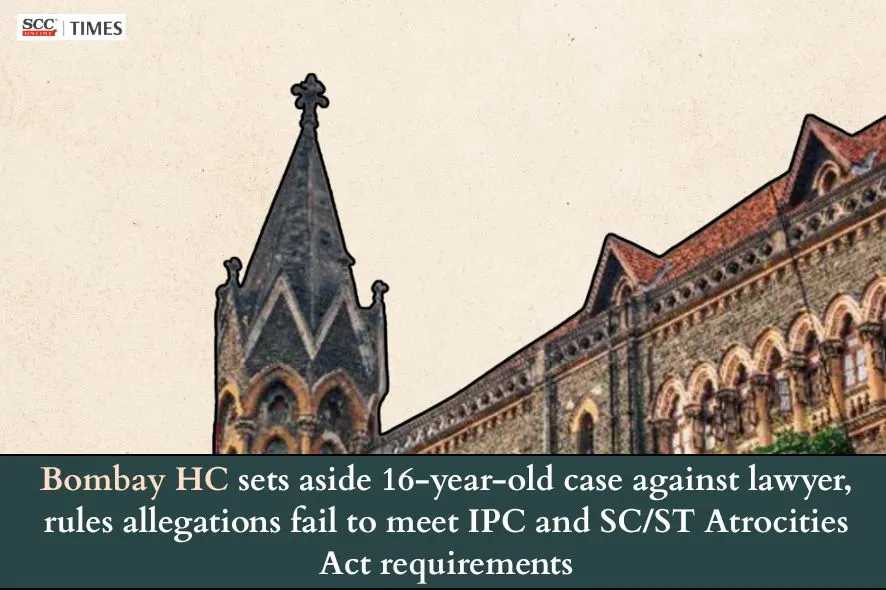
Bombay High Court: In a petition under Section 482, Criminal Procedure Code, 1973 (CrPC), seeking quashing of an FIR registered under Section 324, Penal Code, 1860 (IPC) and Sections 3(1)(x) and (xi), Scheduled Castes and Scheduled Tribes (Prevention of Atrocities) Act, 1989 (SC/ST Atrocities Act), a Single Judge Bench of Ashwin D. Bhobe, J., held that the allegations in the FIR, even if taken at face value, did not disclose the ingredients of the offences alleged. The Court noted that no caste-based humiliation in public view was alleged, the injury described was simple in nature and not caused by a dangerous weapon, and that repeated FIRs suggested mala fide intent. Accordingly, applying the principles laid down in State of Haryana v. Bhajan Lal, 1992 Supp (1) SCC 335, the Court quashed the FIR and charge-sheet to prevent abuse of process of law.
Background
The case arose from a statement dated 2 July 2010 alleging that on 27 June 2007, at Siddharth Law College, the petitioner hurled abuses, claimed the respondent possessed bogus certificates, and assaulted her with an umbrella causing injuries. Based on this, an FIR was registered under Section 324 IPC and provisions of the SC/ST Atrocities Act.
The petitioner contended that the complaint was false, malicious, and motivated by revenge, pointing to two earlier cases under the SC/ST Atrocities Act where he had been acquitted and discharged. He argued that the respondent misused the provisions of the SC/ST Atrocities Act to harass him.
The State submitted that the FIR was registered upon receipt of the statement, investigation was conducted, and charge-sheet filed. However, the respondent acknowledged that the FIR did not reveal caste-based humiliation under Section 3(1)(s), but argued that abusive language and threats invoked Section 3(1)(r), SC/ST Atrocities Act. It was further submitted that the assault constituted an offence under Section 3(2)(va), SC/ST Atrocities Act, and that the petitioner’s intention was to outrage modesty under Section 354 IPC.
Analysis and Decision
The Court emphasised that the FIR and the material collected on record did not reveal the ingredients for an offence under Section 3(1)(s), SC/ST Atrocities Act. The Court noted that to attract Section 3(1)(r), SC/ST Atrocities Act, the impugned FIR or material on record needed to show that the petitioner intentionally insulted or intimidated the respondent (a member of a Scheduled Caste), and that he did so with the intent to humiliate the respondent at a place within public view.
The Court referred to Keshaw Mahto v. State of Bihar, 2025 SCC OnLine Pat 1402, wherein the Supreme Court observed that the offence under Section 3(1)(r), SC/ST Atrocities Act, cannot stand merely on the fact that the informant/complainant is a member of a Scheduled Caste or a Scheduled Tribe, unless the insult or intimidation is with the intention to humiliate such a member of the community. The Supreme Court further held that mere knowledge of the petitioner that the respondent is a member of the Scheduled Caste or the Scheduled Tribe is not enough to invoke Section 3(1)(r), SC/ST Atrocities Act.
The Court further emphasised that the allegations in the impugned FIR, taken at face value, do not meet the ingredients of Section 324 IPC, further the respondent had also stated that the injury caused was simple in nature. It was also noted that, regardless of the reasons the respondent filed the complaints against the petitioner, on two previous occasions the respondent made allegations against the petitioner invoking provisions of the SC/ST Atrocities Act similar to those in the impugned FIR, however, the petitioner was acquitted in one case and discharged in another, which is not disputed.
The Court relied on Mahmood Ali v. State of U.P., (2023) 15 SCC 488, where it was held that the registration of multiple FIRs assumes importance, thereby attracting the issue of wreaking vengeance out of private or personal grudge as alleged, and therefore it will not be just enough for the Court to look into the averments made in the FIR/complaint alone for the purpose of ascertaining whether the necessary ingredients to constitute the alleged offence are disclosed or not.
The Court further referred to Bhajan Lal (supra) wherein the Supreme Court observed that where the allegations made in the FIR or the complaint, even if they are taken at their face value and accepted in their entirety, do not prima facie constitute any offence or make out a case against the accused, then the inherent powers under Section 482 CrPC could be exercised either to prevent abuse of the process of any court or otherwise to secure the ends of justice.
The Court emphasised that the present case in hand falls within the principles established in Bhajan Lal (supra) for exercising powers under Section 482 CrPC to quash the impugned FIR and the charge-sheet arising from it, to prevent abuse of the process of law. Accordingly, the Court thereby quashed the impugned FIR and charge-sheet while allowing the petition with no orders as to cost.
[Virendranath B. Tiwari v. State of Maharashtra, 2026 SCC OnLine Bom 2007, decided on 16-3-2026]
Advocates who appeared in this case:
For the Petitioner: Virendranath B. Tiwari
For the Respondents: Rizwan Merchant a/w Uma Nemlekar, Saurabh Godbole i/b Sahil Mahajan, Sukanta Karmakar, APP
Buy Code of Criminal Procedure, 1973 HERE
Buy Penal Code, 1860 HERE