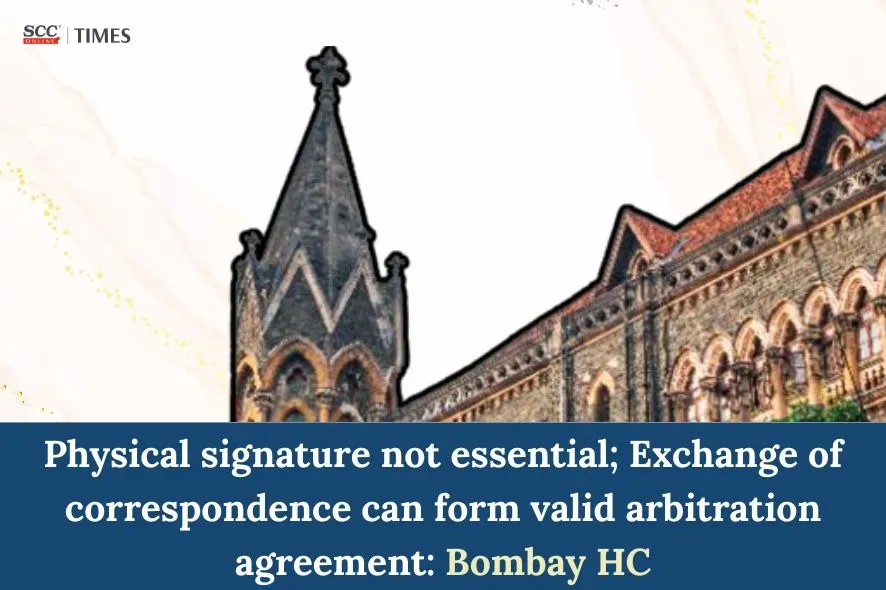
Bombay High Court: In a Section 34, Arbitration and Conciliation Act, 1996 (A&C Act) petition, the issue was whether an arbitration agreement existed and whether the proceedings were genuinely held behind the petitioner’s back or it avoided the same by relying on name and pin code errors. A Single Judge Bench of Somasekhar Sundaresan, J., upheld the Tribunal’s view that the dealings were governed by an agreement with an arbitration clause, service was duly effected and the petitioner chose not to participate. The Court observed that physical signature was not essential and exchange of correspondence between parties could form valid arbitration agreement under Section 7, A&C Act and rejected the challenge to the ex parte award based on name and pin code errors.
Background
The dispute arose in connection with retailing of toys under the brand name Simba Toys. The petitioner was the master franchisee and the respondent, based in Ahmedabad, was meant to be the sub-franchise. The parties initially executed a Letter of Intent (LOI) dated 22 July 2014 which did not contain an arbitration agreement. Based on the LOI, the respondent paid Rs 24.76 lakhs as an advance. Thereafter, by an email dated 25 November 2014, a draft agreement was sent by the petitioner asking for execution and return by courier.
The petitioner submitted that the executed agreement was never received and therefore there was no arbitration agreement in existence, and that Section 11, A&C Act proceedings and the arbitral proceedings were behind its back. The petitioner relied on Registrar of Companies’ (RoC) records to show its official name and address and contended that correspondence sent to it used a name without the word “Company” and an incorrect pin code.
On the other hand, the respondent pointed to multiple letters sent to the same address with the same manner of name and pin code that were well received. It was stated that the draft agreement was printed, executed and couriered to the petitioner. It was alleged that some time in August 2015, the letters started coming back as refused. The respondent also submitted that the Arbitral Tribunal consistently communicated with the petitioner on an email id which appeared in RoC’s records and that minutes, scheduling, draft issues, and notices were sent by email, and referred to a letter dated 6 January 2017 intimating the final hearing date with the correct pin code which was also refused by the petitioner.
Issue
-
Whether the arbitration agreement was in existence.
-
Whether the arbitration proceedings were conducted behind the petitioner’s back or whether it was the petitioner who was avoiding participating in the proceedings while relying on the alleged error in name and in pin code.
Analysis and Decision
The Court noted that the Arbitral Tribunal examined the matter and came to a view that despite service the petitioner chose to remain absent and that refused the notices, constraining the Tribunal to proceed without a statement of defence. The Court also noted that the petitioner alluded to the agreement to assert that any termination of the relationship within a period of five years would be contrary to the agreement between the parties, and on this ground refused to refund the amount paid by the respondent. The Court opined that the Arbitral Tribunal being the best judge of the quality and quantity of evidence, returned reasonable findings that the dealings stood covered by an agreement containing an arbitration clause and that the agreement was circulated by the petitioner.
The Court highlighted that the deposit was made prior to the petitioner sending the draft agreement for execution and its acknowledgement in the correspondence. The petitioner drafted the agreement and asked for it to be signed, and the respondent wanted some changes which were said to have been tabled on email after signing and couriering the document.
The Court opined that the cancellation of franchise by Simba Toys led to the breakdown and termination by the respondent. The Court highlighted that the absence of an actual physical signature would not come in the way of the reasonableness of the arbitrator’s findings and that exchange of correspondence too can constitute an arbitration agreement under Section 7, A&C Act. The Court observed that it must not disturb the Arbitral Tribunal’s view that the respondent’s account was plausible, particularly considering the petitioner’s conduct in avoiding service of notices relying on the pin code from the RoC’s records, when service of the notices by the Arbitral Tribunal were sent to the very email ID that also formed a part of the RoC’s records.
The Court opined that it was open to the petitioner to participate in the proceedings and to prefer an application under Section 16, A&C Act to challenge the existence of the agreement, but it chose to stay away. The Court observed that such conduct indicated a strategy of taking a chance by relying on purported errors to undermine an adverse award and emphasised the principle that the conduct and correspondence before disputes commence i.e. pre litam motam are a strong pointer to truthfulness as opposed to conduct after the dispute begins i.e. post litam motam.
The Court found no reason to disagree with the findings of the Arbitral Tribunal when the sole ground of challenge pressed was the error in the name and pin code, hoping that such error would be accepted as a reasonable basis for holding the proceedings as being entirely behind the petitioner’s back. The Court concluded that the two grounds of objections did not satisfy the Section 34, A&C Act framework for interference with the award.
Consequently, the Court dismissed the petition, leaving the award undisturbed, and in view of the nature of objections and petitioner’s conduct, imposed token costs of Rs 1.5 lakhs payable to the respondent within two weeks.
[Exelixi Management Co. (P) Ltd. v. Nishi Retails (P) Ltd., 2026 SCC OnLine Bom 1753, decided on 23-2-2026]
Advocates who appeared in this case:
For the Petitioner: Harshad Inamdar a/w. Dinesh Masurkar i/b. Tejas Deshpande.
For the Respondent: Sajid Shamim a/w. Sharif Lakdawala i/b. S. Shamim & Co.
Buy Arbitration and Conciliation Act, 1996 HERE