


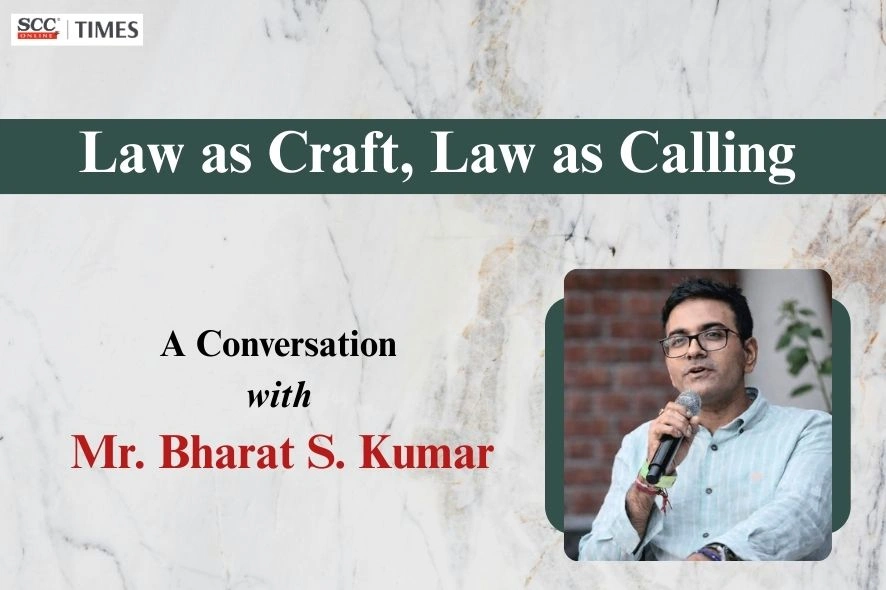
1. Kindly walk us through your professional journey and the formative moments that shaped your approach to litigation and dispute resolution.
From the outset, I was clear that I intended to pursue litigation. My internships during law school played a formative role in affirming that courtroom practice suited both my temperament and professional aspirations. As a first-generation lawyer, my transition from academic study to full-time litigation was both challenging and instructive.
I began my professional journey in 2009 with Saikrishna & Associates, where I had the opportunity to work closely with the Managing Partner, Mr Saikrishna Rajagopal, during my formative years. That early exposure was pivotal in building confidence, learning court craft, and instilling a disciplined, analytical approach to litigation and dispute resolution. Being encouraged to think independently, prepare rigorously, and engage directly with complex legal issues, significantly shaped my professional outlook.
In retrospect, I firmly believe that access to an encouraging and intellectually rigorous senior is crucial to a young lawyer’s development. This is not only in terms of skills, but also in confidence and professional identity. I was fortunate to receive that mentorship early on, and I see the same culture of guidance and responsibility continuing for younger members of the Bar today.
2. Many young lawyers feel pressured to pursue an LLM early in their careers. Based on your years of practice across litigation and arbitration, what are your views on the timing, or even the necessity, of practising lawyers pursuing an LLM?
In my humble opinion, pursuing an LLM is neither a prerequisite for success nor a substitute for sustained courtroom or arbitral practice. The Indian legal system does not confer any procedural or substantive advantage based on academic qualifications alone, and courts ultimately respond to the quality of advocacy, preparation, and professional credibility built through experience.
That said, higher education is a deeply personal and strategic choice. An LLM pursued at the right stage, particularly from a strong institution, can be valuable in specific contexts. Lawyers who undertake an LLM after acquiring some practical exposure often benefit from greater doctrinal depth, specialised subject-matter expertise, and exposure to international perspectives. Equally important is the multicultural and interdisciplinary experience, which can meaningfully enhance a practitioner’s approach to cross-border litigation, arbitration, and complex commercial disputes.
My own view is that young lawyers should not feel pressured to pursue an LLM prematurely or view it as a marker of professional legitimacy. I did my LLM in 2023, many-many years after I got into practice. For many, a few years of rigorous practice before undertaking higher studies allows them to engage more critically with the academic material and extract far greater value from the programme. Ultimately, the necessity and timing of an LLM must align with one’s long-term professional goals rather than external expectations.
3. Apart from high-stakes commercial and intellectual property (IP) disputes, you have been actively involved in matters concerning environmental protection, animal welfare, and fundamental rights. How do you balance commercial practice with public interest litigation, and what role do you believe lawyers should play in advancing constitutional and social causes?
I view commercial litigation and writ/public interest practice as similar rather than competing spheres. High-stakes commercial and IP disputes demand strategic clarity, precision, and procedural rigour, while writ and public interest litigation engage the lawyer more directly with constitutional values such as animal welfare and the enforcement of fundamental rights. Each, in my experience, informs and strengthens the other.
With experience comes a responsibility to contribute beyond purely commercial client-centric disputes, and I have been fortunate to work in an environment that actively encouraged such engagement. One of my early writ petitions before a Division Bench of the Delhi High Court concerned a manufacturing defect in a MiG-21 aircraft produced by a State-run entity, which resulted in a combatant being gravely injured. He lost out on his health and professional prospects, both. Won that case for the client. The matter had significant public and constitutional dimensions, while also raising issues of institutional accountability, national security and long-term national interest.
I believe lawyers play a vital role in assisting Constitutional Courts through well-researched and principled writ advocacy that strengthens governance, promotes accountability and protects vulnerable interests. Sustained engagement with both commercial and writ/public interest litigation not only leads to a more balanced practice, but also ensures that the legal profession continues to contribute meaningfully to constitutional and social causes.
4. You act both as counsel and as an empanelled arbitrator with institutions such as World Intellectual Property Organization (WIPO), National Internet Exchange of India (NIXI), and Gujarat International Maritime Arbitration Centre (GIMAC). How does wearing both hats shape your perspective on arbitral procedure, party conduct, and the quality of arbitral awards?
For WIPO, I serve in the “list of neutrals” and for GIMAC, Gujarat, an empanelled arbitrator. For NIXI, on the other hand, I act both as counsel and as an empanelled arbitrator. I believe this has given me a more holistic understanding of arbitral process and decision-making. When appearing as counsel, the focus is naturally on advancing a client’s case with clarity and strategic force. Sitting as an arbitrator, however, reinforces the importance of procedural discipline, neutrality, and ensuring that the process remains efficient, fair, and proportionate to the dispute.
Wearing both hats has made me particularly conscious of a party’s conduct and the impact it has on the efficacy of arbitration. Excessive procedural skirmishing, poorly focused pleadings, or avoidable delays may serve short-term tactical objectives as counsel, but as an arbitrator they detract from the integrity and efficiency of the process. This dual perspective encourages me, whether as counsel or arbitrator, to promote streamlined procedures, focused evidence, and meaningful hearings.
From the standpoint of arbitral awards, acting as an arbitrator underscores the importance of reasoned, structured, and enforceable decisions. It has reinforced my belief that awards must not only resolve the dispute, but do so in a manner that demonstrates fairness, engages with the party’s core submissions, and withstands judicial scrutiny. Overall, this dual role has strengthened my approach to arbitration by aligning advocacy with institutional responsibility and respect for the arbitral process.
5. With the growing importance of technology-driven disputes, particularly domain name and cyber-IP matters, what trends have you observed in this space, and how prepared is the Indian dispute resolution framework to address these challenges?
The landscape of technology-driven disputes, particularly those involving domain names, cyber-IP matters and digital brand protection has evolved rapidly over the past decade. The first artificial intelligence (AI) dispute is pending adjudication in the Delhi High Court. With the digital economy expanding, I have observed an increase in cybersquatting and other domain-related abuses, requiring both domestic and international alternate dispute resolution (ADR) mechanisms to adapt. In the domain name sphere, globally recognised frameworks like the Uniform Domain Name Dispute Resolution Policy (UDRP )under WIPO continue to serve as efficient, cost-effective mechanisms for resolving disputes in generic top-level domains, while India’s .IN Domain Name Dispute Resolution Policy (INDRP) under NIXI has provided an analogous process for “.in” and “.bharat” domain disputes. These mechanisms focus on clear criteria such as confusing similarity, lack of legitimate interest, and bad faith registration, allowing for expedited administrative resolution outside of traditional litigation.
At the same time, Indian Courts have been actively engaging with digital-age conflicts, often applying trademark and passing-off principles where statutory cybersquatting provisions are absent, and have recently shown willingness to strengthen procedural safeguards, for example, mandating stricter e-KYC requirements for domain registrants to curb misuse and fraud. The recent decision by HMJ Pratibha M Singh, Delhi High Court in Dabur India Limited v. Ashok Kumar3 is one such example.
While the existing arbitration and ADR frameworks are robust in terms of speed and international integration, challenges remain. There is no specific statutory regime solely dedicated to cybersquatting or cyber-IP disputes in India; as a result, courts, arbitration institutions and policies like the INDRP and WIPO’s UDRP operate alongside the Trade Marks Act, 1999 and the Information Technology Act, 2000 to fill regulatory gaps.
Looking ahead, the Indian dispute resolution ecosystem is increasingly prepared but must continue to evolve, both procedurally and substantively, to address technology-driven disputes effectively. This includes deeper integration of international ADR practices, greater doctrinal clarity on cyber-specific harms, and continued judicial engagement to ensure that arbitration, ADR, and litigation together remain responsive to the demands of a rapidly digitising economy.
6. You have represented several public bodies, including the Government of Delhi and the Central Pollution Control Board. How does representing State authorities differ from private clients, especially when questions of policy, public accountability, and constitutional obligations are involved?
Representing State authorities differs to some extent from representing private clients in both orientation and responsibility. While private representation is primarily driven by the client’s commercial or individual interests within the bounds of law, representation of State authorities requires a conscious alignment with constitutional values, public interest, and institutional accountability.
When acting for public bodies such as the Government of Delhi, et al, the lawyer’s role extends beyond adversarial advocacy. It involves assisting the Court in arriving at legally sound and policy-consistent outcomes, ensuring that executive action withstands constitutional scrutiny under principles such as fairness, reasonableness, proportionality, and non-arbitrariness. Decisions are often embedded in broader policy frameworks, statutory mandates, and socio-environmental considerations, requiring a nuanced understanding of governance rather than a purely litigation-focused approach.
Public accountability is central. State authorities are trustees of public power, and their actions are subject to heightened judicial review. Legal advice and representation must therefore emphasise transparency, procedural propriety, and fidelity to statutory and constitutional obligations, even where this may limit tactical flexibility that a private client might otherwise exercise.
Finally, representing the State demands institutional sensitivity, balancing legal defensibility with long-term policy coherence and public confidence in governance. The objective is not merely to “win” a case, but to help balance and protect public interests, uphold the Rule of Law and ensure that State action remains constitutionally compliant and administratively sustainable.
7. You have volunteered as a pro bono legal counsel with People for the Ethical Treatment of Animals India (PETA) India and also with the All India Legal Aid Cell on Child Rights. Drawing from these experiences, what insights have you gained about the role of pro bono work in advancing social justice, and how has it shaped your perspective on law and vulnerable communities?
Through my pro bono work with PETA India, the Delhi State Legal Services Authority (DSLSA) and, under its aegis, the All India Legal Aid Cell on Child Rights (AILACCR), I have come to view pro bono practice (service) not as an adjunct to the legal profession, but as one of its most essential functions in advancing substantive social justice.
Working on cases with the AILACCR exposed me to the systemic and procedural barriers that children from marginalised backgrounds face in accessing justice. It reinforced the idea that the law, while robust on paper, often fails vulnerable communities without timely legal intervention, awareness, and sustained advocacy. My association with DSLSA highlighted the critical role of institutional legal aid mechanisms in translating constitutional guarantees into lived realities, particularly for children who lack both voice and agency.
Similarly, my work with PETA India and Mercy for Animals (MFA) has deepened my understanding of how legal frameworks can be leveraged to protect non-human vulnerable communities. These experiences underscored the evolving nature of rights-based jurisprudence and the responsibility of lawyers to engage with emerging areas of law, such as animal welfare, with sensitivity and rigor. I currently also am an empanelled lawyer with the Small Animal Veterinary Association (SAVA), Delhi helping veterinarians in Delhi with legal disputes.
Collectively, these engagements have shaped my perspective on law as a tool for empowerment rather than mere dispute resolution. Pro bono work with State institutions like DSLSA and AILACCR, early in my career has instilled in me a heightened sense of professional responsibility and reinforced the ethical duty of lawyers to bridge the gap between law and access to justice. It has also strengthened my belief that meaningful legal practice must be grounded in empathy, social awareness, and a commitment to protecting those who are most at risk of being overlooked by the system.
8. Arbitration in India continues to face criticism relating to delays, costs, and enforcement. From your experience as both an arbitrator and a practitioner, what reforms or changes do you believe are most urgently required to strengthen India’s arbitration ecosystem?
From my experience as both an arbitrator and a practitioner, the most urgent reforms required are stricter adherence to timelines, greater judicial restraint at the pre and post-award stages, and stronger institutional arbitration frameworks. Cost transparency and early case management are essential to prevent arbitration from mirroring court litigation. Additionally, consistent enforcement of arbitral awards and continued capacity-building of arbitrators will be critical to enhancing efficiency, credibility, and investor confidence in India’s arbitration ecosystem.
9. Finally, based on your journey in litigation, arbitration, and IP law, what advice would you offer to young lawyers aspiring to build a sustainable and impactful legal career, particularly those entering the profession without traditional networks or legacy advantages?
My advice to young lawyers, particularly those without legacy advantages, is to focus on building credibility through consistency, competence, and integrity. Invest early in strong fundamentals, procedural law, drafting, and research, while remaining adaptable to emerging areas such as IP and arbitration. Actively seek a good mentor, one possibly like Mr Saikrishna Rajagopal, and prioritise learning and exposure over immediate financial gain in the early years of practice. Do not hesitate to take ownership of work at an early stage, and view the profession as a long-term commitment where sustained learning, ethical practice, and resilience ultimately outweigh the absence of traditional networks and lead to both impact and stability.
1. Associate Partner at Sai Krishna & Associates. Mr Kumar completed his legal education in 2009 from Amity Law School and is an accomplished Dispute Resolution Counsel with over 16 years of experience. He is empanelled on the WIPO List of Neutrals, where he adjudicates international disputes. Additionally, he is an empanelled counsel for Bank of Baroda, National Internet Exchange of India (NIXI), and the Central Pollution Control Board (CPCB). He also serves as a seasoned arbitrator at the Gujarat International Maritime Arbitration Centre (GIMAC). He has extensive experience in arbitration, dispute resolution, and institutional practice.
2. Student Ambassador, Tamil Nadu National Law University.

Exceptionally well articulated by the eminent lawyer. His brilliance in law matters as well as the altruistic pro Bono reach out is simply unbelievable in this selfish world. He has come across as a shining light and epitome for the would be young lawyers. His advice to build up consistency, integrity and dedicating learning in initial years by prioritising diligent research over financial gains is WORTH GOLD for the wannabe lawyers without legacy. More power to him and likes of him.
In all, an apt interview, wherein we normal citizens feel so connected with the views expressed by Mr Bharat. We really wish Mr Bharat to continue excelling in this field and become a yardstick of how the lawyers frater should be.
Thanks