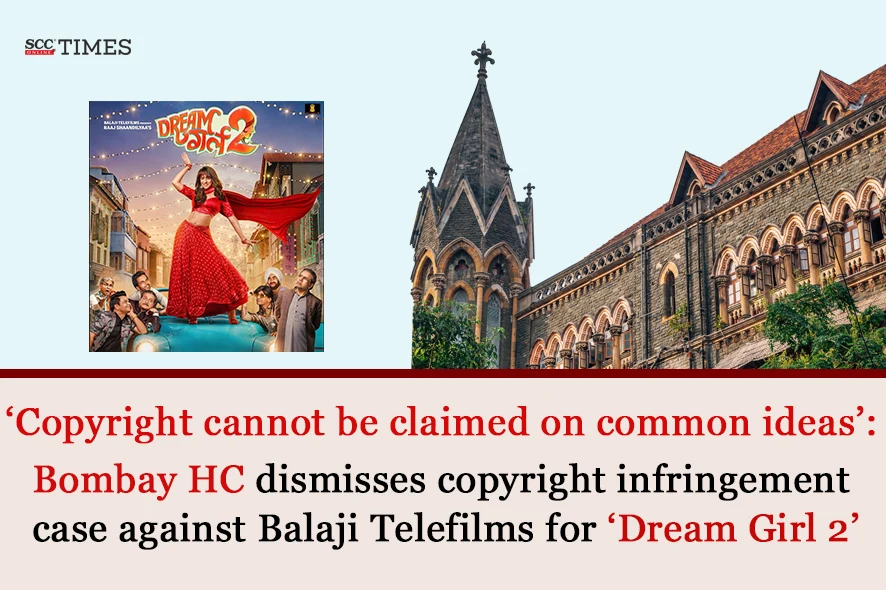
Bombay High Court: The present application was filed by the applicant seeking an injunction to restrain defendant 1-Balaji Telefilms, from exploiting their film titled Dream Girl 2, alleging infringement of his script, ‘Kal Kisne Dekha’ which had been re-registered as ‘The Show Must Go On’, and for the breach of confidence allegedly committed by defendant 4. A Single Judge Bench of R.I. Chagla, J., upon finding that the rival works were completely different and the claim of breach of confidence was far-fetched , dismissed the application and awarded costs to defendant 1 and 5 to be paid by the applicant.
Background:
Balaji Telefilms was the producer and as per the Writer Service Agreement, was the sole and exclusive owner of the concept titled ‘Dream Girl 2’. Defendant 4 was the writer engaged for the purpose of developing literary works based on the above concept which meant the story, screenplay and dialogues for the audio-visual content and he had specifically stated that the original work i.e. Dream Girl 2, was authored by him and was submitted in the name of Balaji Telefilms Ltd. for copyright registration. However, Defendant 5 claimed to have solely and exclusively authored an original literary work of which the synopsis titled ‘Dream Girl 2’ was registered with the Screenwriters Association under Certificate of Registration dated 15-07-2021.
The applicant stated that he had written and developed an original story in the form of the applicant’s script and got it registered on 25-05-2007, for the purpose of having it made into a film with the central idea of gender swap comedy where the protagonist, a male, donned the persona of a female and tackled various comedic situations where his identity might get exposed. He claimed that his script was an original literary work within the meaning of the Copyright Act, 1957. The applicant alleged that contents of his script were also confidential and were shared by him with Defendant 4 under strict conditions of confidence, in pursuit of the possibility of identifying a producer who would be willing to make a film with the applicant’s script. The defendants had, in making their film, infringed the applicant’s copyright in the literary work.
The applicant also alleged that defendant 5 was subsequently introduced only to aver suspicion away from defendant 1 and 4, who had access and knowledge of applicant’s original literary work. He also submitted that the defendants did not produce the concept and script of the infringed film. The applicant had earlier filed a suit against the defendants when they had released the film, but this Court had refused to restrain the release at the eleventh hour.
Analysis and Decision:
The Court observed that the applicant, by alleging copyright infringement of his script by the defendants’ film, was seeking a monopoly over matters in which ex-facie no copyright subsisted to begin with. This included common themes, ideas, unoriginal / stocks / scenes-a-faire matters, and other aspects directly flowing from such elements which were not protectable either by themselves or taken together.
The Court noted that the applicant had referred to ‘salient features’ of his script in Paragraphs 8, 11 and 14 of the plaint, but these features were neither original nor capable of protection under the law of copyright as they were mere themes, concepts or ideas. The applicant attempted to monopolise the theme of gender disguise and though on the one hand, he termed gender disguise a ‘novel idea’, but on the other hand, he used the phrase ‘Mrs. Doubtfire Act’ to describe the male lead in his script dressing up as a woman which was nothing but a reference to the Hollywood film ‘Mrs. Doubtfire’, that employed gender disguise as a core idea. The Court observed that the applicant’s script which was based on such common themes could not be either ‘novel’ or the ‘substance, kernel and foundation’ or ‘salient features’ which were in any way protectable.
The Court examined the comparison tables of the applicant’s script and the defendants’ film where the applicant had undertaken a piecemeal or dissected comparison of the rival works, and observed that copyright did not subsist in such matters and it was settled law that piecemeal or dissected comparison was impermissible.
The Court viewed the rival works and prima facie found that the rival works are entirely different and distinct. The Court referred to R.G. Anand v. Delux Films, (1978) 4 SCC 118, and observed that the applicant failed to make out a case for copyright protection of its script, particularly since protection was being sought of common plots, themes and other unprotectable elements apart from the fact that on a comparison of the applicant’s script with the defendants’ film, the rival works were dissimilar.
Regarding the applicant’s allegation of breach of confidence, the Court opined that there was merit in the submissions of Defendant 1 and 5 that the applicant had fallen back on its claim for breach of confidence being aware of the far-fetched nature of its claim for copyright infringement. The Court applied the test for determining breach of confidence laid down in the Beyond Dreams Entertainment (P) Ltd. v. Zee Entertainment Enterprises Ltd., 2015 SCC OnLine Bom 4223, and held that the applicant failed to satisfy any of the elements provided therein and hence his claim for breach of confidence could not be sustained.
The Court further observed that the applicant’s contention that the prior suit filed by Defendant 5 had a bearing on the present suit, was misconceived as the claim in the suit filed by Defendant 5 against Defendants 1 and 4 had nothing to do with the contents of the defendants’ film and it had culminated into consent terms being filed and a subsequent decree being passed.
The Court found merit in the submissions of Defendant 1 and 5 that being a commercial suit, the Commercial Courts Act, 2015, applied and costs followed the event. The Court opined that the applicant failed to make out the fundamental aspects of the claim and significant time was expended in the hearing and that the Court’s scarce resources could not be allowed to be squandered to indulge in fanciful claims.
Consequently, the Court, while dismissing the application, awarded costs to defendant 1 and 5 in a sum of Rs 2 Lakh (Rs 1 lakh each) which must be paid by the applicant within a period of four weeks from the date of uploading of this order.
[Ashim Kumar Bagchi v. Balaji Telefilms Ltd., 2025 SCC OnLine Bom 2837, decided on 06-08-2025]
Advocates who appeared in this case:
For the Applicant: Priyank Kapadia with Aniketh Poojari i/b. Legal House.
For the Defendants: Rashmin Khandekar, Rahul Dhote, Anushree Ravta, Shwetank Tripathi, Anand Mohan i/b. De Zalmi and Associates.