








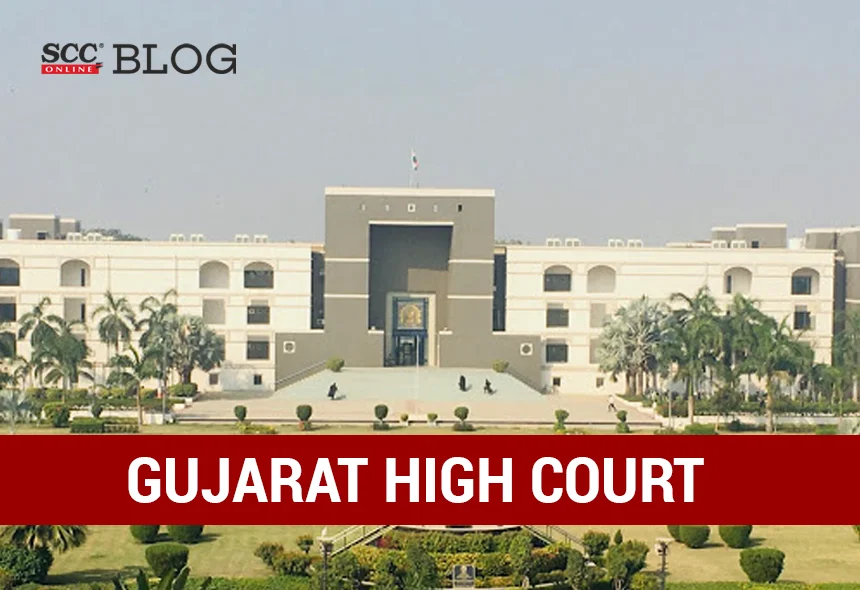
Gujarat High Court: In a bail application under Section 439 of the Code of Criminal Procedure, 1973 (CrPC) for offences under Section 354(a)(c), 376, 376(D), 498(a), 506(2), 508, 509, 34, 114 and 201 of the Penal Code, 1860 (‘IPC’) as well as Sections 66(e) and 67(a) of the Information Technology Act, 2000 (‘IT Act’), the Court refused to grant bail for her equal role in the offence against her daughter-in-law and observed that a man is a man; an act is an act; rape is a rape, be it performed by a man the “husband” on the woman “wife”.
Factual Matrix
The Complainant’s case was that her father-in-law had instigated her husband to record the nude photographs and videos of the complainant for uploading online, and her husband did so and also forward them on her father-in-law’s mobile. The mother-in-law was also aware of the same. The complainant alleged that the said act was done by her marital family as they were in desperate need of money to prevent their hotel being sold out. It was also alleged that her father-in-law molested her when the complainant was alone at home. The complainant had also stated that her husband made her do unnatural things. The complainant lodged a First Information Report (‘FIR’) against her husband and in-laws. The present applicant who sought bail is the mother-in-law of the complainant.
Analysis
Whether cognizance being taken against the applicant-accused for offence punishable under Section 376 of IPC is tenable in law?
The Court said that the chargesheet depicted the demonic lust of the complainant’s husband and her father-in-law whether for money or for sexual satisfaction in which the accused/mother-in-law also participated actively. The Court noted that the husband himself recorded their lovemaking moments in the camera which were subsequently shared in one WhatsApp family group and also, uploaded on a porn website. The Court said that it is not that the husband is doing such an illegal activity with any woman with whom he has an illicit relationship, but with his wife. The Court also noted that the accused /mother-in-law was aware of it all. Further, the Court noted the allegations that the father-in-law got installed the C.C.T.V camera in the bedroom of the complainant and both the accused and the father-in-law watched the lovemaking moments of her own son and complainant on the TV screen in their bedroom and that they also compelled their son to take nude videos and photographs of the complainant and shared it on one family WhatsApp group in which the accused/ mother-in-law was also a member. Therefore, the Court said that the accused was very well aware of such an illegal and shameful act. Hence, the Court refused to allow the accused’s application for bail.
The Court also noted that when the complainant told her mother-in-law about her husband and father-in-law’s sexual assault upon her, she took their side and asked her to keep quiet. The Court also took note of a photograph obtained during the investigation, where the accused is seen touching the private parts of the complainant along with her son. The Court stated that “whatever might be the reason behind doing such a heinous and shameful act, the same must be strictly criticized and the accused must be punished in order to prevent commission of such type of offences in future.” The Court also said that the accused being a woman did nothing to save the integrity of another woman but played an equal role as an accused.
On the issue of marital rape, the Court said that it is illegal in 50 American States, 3 Australian States, New Zealand, Canada, Israel, France, Sweden, Denmark, Norway, Soviet Union, Poland and Czechoslovakia and several others. The Court also referred to R v R [1991] UKHL 12, whereby the exception has been removed. Therefore, the Court said that IPC was made by the rulers then, have themselves abolished the exception given to husbands. The Court observed that a man is a man; an act is an act; rape is a rape, be it performed by a man the “husband” on the woman “wife”.
The Court also said that the actual incidence of violence against women in India is probably much higher than the data suggests, and women may continue to face hostility and have to remain in environments where they are subject to violence and this silence needs to be broken. The Court also highlighted some of the causes and factors of violence against women, such as entrenched unequal power equations between men and women, aggravated by cultural and social norms, economic dependence, poverty and alcohol consumption, etc.
The Court called rape as the most aggravated or highest form of sexual violence. The Court also took a take on the latter category of crimes such as stalking, eve-teasing, shades of verbal and physical assault, and harassment which have been categorized by social attitudes as ‘minor crimes’. The Court said that these offences are regrettably not only trivialised or normalized, rather they are even romanticized and therefore, invigorated in popular lore such as cinema and indulgently view the crime through prisms such as “boys will be boys” and condone them, nevertheless have a lasting and pernicious effect on the survivors.
[Anjanaben v. State of Gujarat, 2023 SCC OnLine Guj 4507, Dated: 08-12-2023]
Advocates who appeared in this case :
For accused: Advocate Urvashi K Mehta
For respondent: Additional Public Prosecutor Manan Mehta
Buy Code of Criminal Procedure, 1973 HERE
Buy Penal Code, 1860 HERE







0 replies