S. 22 ID Act applicable to bank employees
Case BriefsHigh Courts

“Section 22(1), ID Act will apply squarely to the Trade Union and there is no basis for the inference that managerial or supervisory employees of higher ranks or cadres are excluded from the ID Act. The restrictions imposed under Section 22, ID Act are designed to protect the interests of the public and ensure the smooth operation of a Public Utility Service.”

other officers can be opted by Competent Authority
Case BriefsHigh Courts

“Clause 16 of the Government Order uses the term ‘may’ and not ‘shall’, and therefore assistance of a higher authority of the department concerned is not mandatory. Mere irrelevant procedural irregularities would not vitiate the proceedings unless they have an absolute deterrent effect to destroy the prosecution case in toto.”

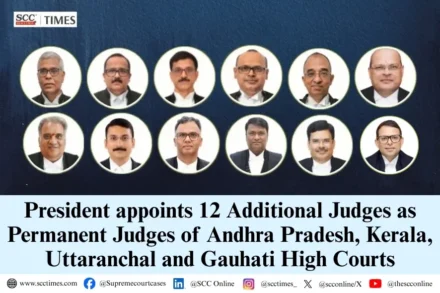
Judges appointed in Kerala HC
Appointments & TransfersNews

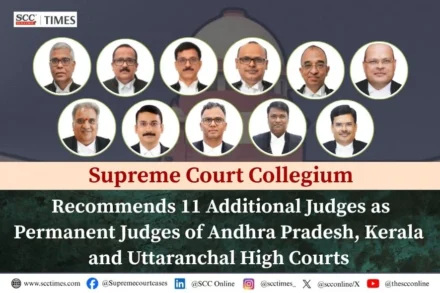
On 12 February 2026, Supreme Court Collegium had recommended the appointment of 7 Additional Judges as Permanent Judges of Kerala High Court.

no inducement of prostitution
Case BriefsHigh Courts

“Section 3, Immoral Traffic (Prevention) Act, 1956 deals with the punishment for keeping a brothel or allowing premises to be used as a brothel, and the said provision has no application to the petitioner who is alleged to be merely a customer.”

set aside arbitral award findings not alive and final
Case BriefsHigh Courts

“It is trite law that if the Arbitrator fails to decide the counter claim in accordance with law, it will vitiate the award and that it is within the Arbitrator’s jurisdiction to decide both the claim and counter claim.”

continuation of existing Labour Courts
Case BriefsHigh Courts

“Permitting existing adjudicatory mechanisms and statutory authorities to continue till new mechanisms are put in place cannot be said to be sidestepping the provisions of the Industrial Relations Code, 2020 or removing obstacles to get over statutory restrictions.”

not accepting resignation is bonded labour
Case BriefsHigh Courts

“When an employee submits resignation, the employer has a duty to accept and relieve, subject only to any contractual conditions, or if it does not follow a stipulated procedure. He can also refuse acceptance when disciplinary proceedings are contemplated against the employee for grave misconduct or causing monetary loss to the establishment.”

Pre-arrest bail not maintainable after arrest
Case BriefsHigh Courts

“Under Section 482(1) BNSS, a pre-arrest bail is maintainable only by a person who has reason to believe that he might be arrested for having committed a non bailable offence. The provision safeguards individuals from the possibility of being arrested with malicious intent, and pre-arrest bail must be sought only before an arrest is made.”

Quantity of substance not required in NDPS arrest
Case BriefsHigh Courts

“The requirement of informing the person arrested of the grounds of arrest is not a formality but a mandatory statutory and constitutional requirement, and the non-compliance with Article 22(1) is a violation of a fundamental right and of the right to personal liberty guaranteed by Article 21 of the Constitution.”

Abetment of Suicide under Section 306 IPC
SCC Times NewsflashWATCH NOW

Maternity leave cannot be clubbed with regular leaves
Case BriefsHigh Courts

The Court stated that extraordinary situations require extraordinary measures. In this unique case, where the petitioner had to avail both maternity and medical leave in the same year, the general rule of termination for exceeding one year’s leave cannot be rigidly applied.

Acquittal in cheque dishonour case
Case BriefsHigh Courts

“A complainant under Section 138 of the NI Act is a victim as defined in Section 2(wa) CrPC as the expression ‘victim’ includes not only the person who has suffered any loss or injury caused by reason of any act or omission for which the accused person has been charged, but also includes his or her guardian or legal heir.”

Section 151 CPC applies to clerical error
Case BriefsHigh Courts

“Clerical mistakes are those that occur in the course of typing or writing, while arithmetical mistakes are those that occur during calculation. As to accidental slip or omission, the decisive test is whether it is apparent from the record that the Court intended to do something but failed to do so owing to an accidental or inadvertent omission.”

Universities must regulate student political activities
Case BriefsHigh Courts

“It is the responsibility of the Universities and Colleges to ensure that no untoward incident takes place in the campuses, and they must make all endeavour to ensure that academics is not compromised for reason.”

unrecognised school teaching Quran
Case BriefsHigh Courts

“It was undisputed that the educational institution was being run without valid recognition from the Government concerned, and the averments in the educational institution’s counter affidavit stated that the said institution was imparting preschool education to about 300 students, teaching Quran and allied subjects.”

Bar Association is not employer
Case BriefsHigh Courts

“The term ‘employer’ means someone who exercises control over a workplace in the context of an employment relationship and discharges contractual obligations towards employees.”

go away and die
Case BriefsHigh Courts

“When the deceased came to know that the accused was about to marry another woman, she inquired about the same over the phone, and enraged by the query, the accused scolded the deceased and said, ‘go away and die’. The deceased feeling mentally disturbed, jumped into a well along with her daughter and committed suicide.”

Confession to police legally non-existent -existent
Case BriefsHigh Courts

“Where a confessional statement is otherwise excluded or is inadmissible by virtue of Sections 25 or 26 of the Evidence Act, there can be no question of such confessional statements being made admissible against another co-accused with the help of Section 30 of the Evidence Act.”

charges under SCST Act
Case BriefsHigh Courts

“Just because the witnesses’ statements do not disclose any overt act, that by itself would not be a ground to discharge the accused as law does not insist plenty of witnesses to prove an offence and the evidence of a solitary wholly reliable witness would suffice the purpose.”

Hindu wife can claim maintenance from husband's immovable property beyond HAMA: Kerala High Court
Case BriefsHigh Courts

“A Hindu wife’s right to have maintenance from her husband’s properties originated the moment she got married to him. Her right remained dormant until denial of maintenance or initiation of legal proceedings, at which point it transformed into an inchoate right and later crystallised into a charge upon judicial declaration.”