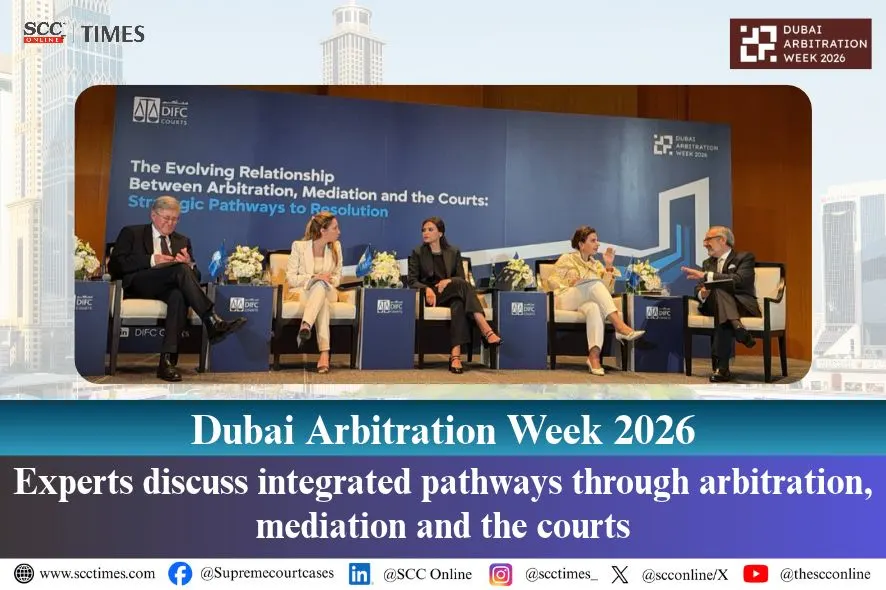
The third day of Dubai Arbitration Week 2026, held from 9 to 13 November 2026 and organised by the Dubai International Arbitration Centre (DIAC), featured a session titled “The Evolving Relationship Between Arbitration, Mediation and the Courts: Strategic Pathways to Resolution” on 11 November 2026. The DIAC Annual Conference, the Centre’s flagship event, brings together stakeholders from the international arbitration community for dialogue, knowledge exchange and networking.
The session examined how arbitration, mediation and court proceedings could operate alongside one another to secure efficient, commercially sensible and enforceable outcomes in increasingly complex cross-border disputes. The discussion covered the strategic use of mediation before and during arbitration, the role of courts and tribunals in facilitating settlement, the authority required for effective negotiations, the enforceability of mediated settlements and the future of integrated dispute resolution.
Justice Michael Black, Judge of the Dubai International Financial Centre Courts, moderated the session, which featured:
-
Rozana ALTayyar, International Arbitrator and Mediator and CEO of Taswea;
-
Noradele Ghubril Radjai, Partner at Lalive;
-
Rima Hadid, General Counsel, Emirates Investment Authority; and
-
Chief Justice Wayne Martin, Chief Justice of the DIFC Courts.
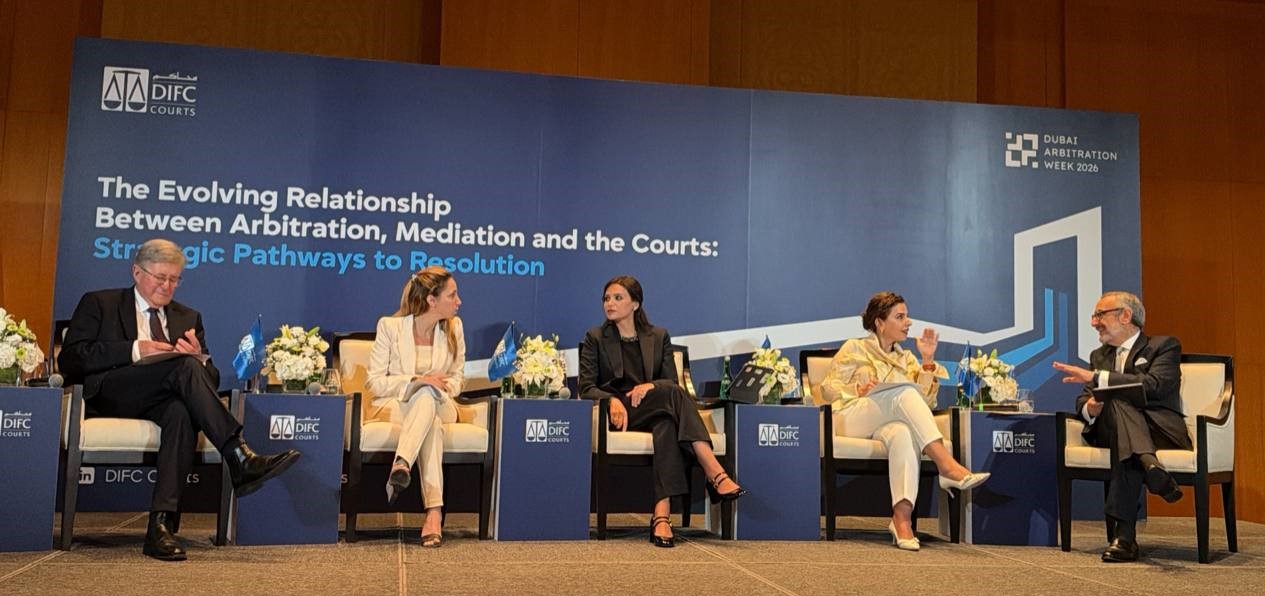
[In picture left to right: Chief Justice Wayne Martin, Noradele Ghubril Rozana ALTayyar, Radjai, Rima Hadid and Justice Michael Black]
Mediation as an integral part of dispute management
Opening the discussion, Justice Michael Black observed that mediation had traditionally formed part of Middle Eastern culture, although its acceptance as a formal mechanism for resolving commercial disputes had developed more gradually. The speakers considered the reasons for this resistance and the changes taking place across the region.
Rozana ALTayyar identified a lack of understanding of the mediation process as one of the principal obstacles. Parties and their counsel were not always familiar with the respective roles of the mediator, the parties and legal representatives, or the value that a mediator could bring to negotiations. The perception that proposing mediation signalled weakness also discouraged parties from taking the first step. Corporate decision-makers could be concerned about how they would justify a settlement internally, while confidentiality and enforceability remained additional considerations.
Drawing on her experience in Saudi Arabia, Rozana ALTayyar observed that the position was changing, particularly among small and medium-sized enterprises. Mediation offered a quicker and less expensive means of resolving disputes while preserving commercial relationships. She expressed the view that the Singapore Convention on Mediation and the anticipated introduction of a mediation law in Saudi Arabia could further encourage its use.
Rima Hadid similarly emphasised the need to familiarise internal stakeholders with the process. In-house counsel and external advisers, she said, had an important role in explaining what mediation involved, how it differed from litigation and what the parties could expect. The assessment should not be limited to litigation costs, but should also account for the internal resources consumed by a dispute and its effect on the business.
Noradele Ghubril Radjai stressed that mediation should be treated as one element of a disciplined dispute management process rather than as an admission that a party lacked confidence in its case. She noted that arbitration was increasingly regarded in the same category as litigation, making it important to recognise the wider range of processes available between negotiation and a final award or judgment.
In that context, Noradele Ghubril Radjai advocated an appropriate, dispute-specific approach. A dispute evolves over time, and the most suitable mechanism depends on the obstacle to resolution at a particular stage. Structured negotiation, mediation, expert determination, dispute boards and combinations such as mediation-arbitration or arbitration-mediation could all have a role. She cautioned against overly prescriptive dispute resolution clauses, while recognising that contractual and institutional frameworks could make parties more comfortable with raising mediation as an option.
Rozana ALTayyar explained that mediators could also help overcome initial hesitation by offering an introductory meeting to explain the process to both parties and their counsel. She observed that some lawyers were reluctant to participate because they were uncertain about their own role or concerned about appearing unprepared before their clients. Explaining the procedure and the expectations of each participant could make the process more accessible and encourage parties to consider mediation.
Chief Justice Wayne Martin highlighted the comparative advantages of mediation. It was generally quicker and less expensive than litigation or arbitration, preserved party autonomy and allowed the parties to determine both the process and the outcome. Unlike a court or arbitral tribunal, a mediator could assist parties in restructuring their commercial relationship and agreeing on arrangements that went beyond the legal rights in dispute. He described mediation as an important part of a broader framework of dispute resolution techniques and observed that its acceptance became easier once it achieved sufficient critical mass within a dispute resolution culture.
Commercial objectives, decision-making authority and the role of advisers
The discussion then turned to the practical requirements for meaningful mediation, particularly where one or more parties were government entities or operated within complex organisational structures.
Rima Hadid explained that in-house counsel should assess the organisation’s objectives, strategy, financial exposure and reputational considerations before recommending a dispute resolution route. She emphasised the importance of identifying the concerns of executives, boards and other stakeholders, and of building internal capabilities to address those concerns.
She advocated incorporating dispute resolution procedures into the organisation’s contractual and documentary framework before a dispute arose. This could include internal playbooks for different departments and guidelines setting out the steps to be followed when entering into transactions or relationships with third parties. Such arrangements would ensure that mediation was already understood and contemplated as part of the organisation’s approach, rather than introduced for the first time after a dispute had emerged.
Addressing the position of government entities, Rima Hadid cautioned against treating sovereign organisations as a uniform category. Their willingness and ability to settle depended on the particular entity, its appetite for settlement and the level of authority held by its representatives. It was therefore necessary to examine the governing law and constitutional documents, identify the relevant decision-makers and understand the limits of their delegated powers. Authority to agree to a payment within a specified threshold, for instance, might not extend to providing a guarantee or taking other consequential decisions.
Noradele Ghubril Radjai agreed that the participation of persons with both the requisite authority and the necessary knowledge was essential to a successful mediation. However, she cautioned that checking decision-making authority should not become an unnecessary procedural obstacle. Rozana ALTayyar added that the flexibility of mediation allowed a representative to negotiate within an authorised limit and seek further approval during the process, rather than treating the absence of unlimited authority at the outset as a reason to abandon negotiations.
Chief Justice Wayne Martin discussed the particular difficulties that can arise when government representatives are asked to approve settlements. Officials may be reluctant to accept a settlement because they fear subsequent criticism for having agreed to pay too much, whereas allowing a court or tribunal to determine liability may appear to be a safer course. Drawing on his experience as a mediator, he described a method of addressing this concern: where the opposing party made a reasonable offer, he would indicate that he might inform the relevant department of his recommendation to accept it. This could make the consequences of rejecting a reasonable settlement more apparent to the official responsible for the decision.
The speakers also considered the role of lawyers during mediation. Rozana ALTayyar observed that legal representatives were generally helpful, particularly when they approached negotiations constructively. However, aggressive conduct or the use of intimidation as a negotiating tactic could obstruct the process. In some cases, she had used private caucuses to address such behaviour and restore constructive dialogue.
Rima Hadid added that commercial disputes were not always driven by legal questions. Sometimes the parties were primarily concerned with cost, liability or the commercial outcome. She explained that stepping back from legal arguments and allowing the business representatives to discuss their actual objectives could help narrow the issues and create space for settlement. Chief Justice Wayne Martin similarly emphasised that mediation could allow parties to move from a rights-based assessment of who was legally responsible to a values-based discussion about how to resolve the commercial problem.
To illustrate this, Chief Justice Wayne Martin recounted his experience with a major infrastructure dispute in Australia. After a project had stalled and the parties commenced arbitration, they recognised that continuing the adversarial process would not help them resume the project. Chief Justice Wayne Martin was therefore asked to undertake a non-binding expert determination on responsibility and the allocation of risk. The parties subsequently shifted from debating legal rights to discussing how to distribute a substantial cost burden. Through commercial discussions facilitated over several months, they reached an agreement on the allocation of approximately 3.5 billion dollars, enabling the project to move forward. He noted that the lawyers’ return to the process created difficulties in documenting the settlement, illustrating the need to keep the commercial objective in focus.
The qualities of an effective mediator and the limits of hybrid processes
The speakers identified empathy, careful listening, emotional control and the ability to build trust as central qualities of an effective mediator. Rozana ALTayyar stressed that a mediator must be willing to ask difficult questions while managing the emotions of both the parties and the mediator. The mediator should demonstrate an understanding of the parties’ concerns without appearing to take sides. Without trust, she observed, the process would be difficult to sustain.
Rima Hadid highlighted the importance of cultural appropriateness alongside emotional awareness. In cross-border disputes, parties may approach negotiations with different cultural expectations, communication styles and understandings of personal space. Noradele Ghubril Radjai described the ideal mediator as someone who could combine empathy with emotional distance, authority without domination, confidence without ego and persistence without undue pressure. The mediator should also know when to intervene and when to allow the parties to take ownership of the process.
Chief Justice Wayne Martin distinguished the skills required of a judge and those required of a mediator. A judge issues directions and makes decisions while maintaining institutional distance from the parties. A mediator, by contrast, listens, builds rapport and makes suggestions without directing the parties towards a particular outcome. The two functions therefore require different professional approaches.
The discussion also examined the use of hybrid processes such as arbitration-mediation and mediation-arbitration. Noradele Ghubril Radjai acknowledged that an arbitrator who had become familiar with the dispute might be able to assist the parties in understanding the other side’s position and identifying opportunities for resolution. However, any such intervention required safeguards. An arbitrator who received confidential information during mediation might subsequently face difficulties in maintaining impartiality or the appearance of impartiality while performing an adjudicative function.
Chief Justice Wayne Martin explained that a mediator who later determines the dispute could face a similar difficulty because successful mediation depends on parties speaking candidly and making proposals within a confidential environment. He described a model used in an Australian court under which a judge managed a case until the parties were ready for mediation, then acted as mediator on the understanding that another judge would take over if the dispute did not settle. This allowed the mediator to use knowledge of the dispute without compromising the subsequent adjudication. He observed that adopting the same model in arbitration could be more difficult because appointing a replacement arbitrator might take considerable time.
Courts and arbitral institutions as facilitators of settlement
The speakers considered how courts and arbitral institutions could bring mediation into the dispute resolution process without making it a mere procedural formality.
Chief Justice Wayne Martin referred to the Australian experience, where parties in many courts could not obtain a trial date without first attending mediation. He explained that, in his former court, an early strategic conference was used to discuss the future course of the dispute. The parties would consider two parallel tracks: the steps required for litigation, including disclosure and other procedural directions, and the steps required to prepare for mediation. This enabled mediation to be integrated into the case timetable rather than treated as an isolated exercise.
He noted that courts were better placed to facilitate such arrangements because they could draw on dedicated mediators. In his former court, eight registrars worked as full-time mediators. Arbitral tribunals, on the other hand, may need to bring in an independent mediator, making the arrangements more complex.
Rozana ALTayyar referred to Saudi Arabia’s Taradi platform, through which cases are required to pass through mediation before proceeding to court. She observed that its introduction around 2019 or 2020 had helped familiarise parties and counsel with mediation and had contributed to a substantial increase in its use.
Rima Hadid expressed reservations about making mediation compulsory in every case. Based on her experience in certain local jurisdictions, mandatory mediation could become a box-ticking exercise, with parties attending only to complete a procedural requirement. Noradele Ghubril Radjai similarly cautioned that a forced or excessively prescriptive process, introduced at the wrong stage, could be counterproductive. She nevertheless recognised the value of institutions making mediation rules and establishing pools of mediators available, thereby normalising the process and giving parties a practical option.
The discussion also addressed the role of arbitral tribunals in encouraging settlement. Noradele Ghubril Radjai observed that parties in some jurisdictions continued to expect arbitrators to determine disputes without actively encouraging settlement. She considered that a neutral could sometimes help parties reassess their positions, but stressed that the tribunal’s impartiality and adjudicative role must remain protected.
DIFC Mediation Centre, proposed legislation and cross-border enforcement
A significant part of the discussion focused on developments concerning mediation in the Dubai International Financial Centre (DIFC). Justice Michael Black referred to the DIFC Courts Mediation Centre and indicated that a standalone DIFC Mediation Law was expected to be enacted in the following month. The mediation legislation had initially been considered alongside the proposed arbitration legislation, but the decision had been taken to proceed with separate laws.
Chief Justice Wayne Martin explained that the Mediation Centre operated under the DIFC Courts framework introduced in 2025 and was not restricted to parties with proceedings before the DIFC Courts or those otherwise within the court’s jurisdiction. It was open to anyone seeking to use mediation. He considered this an important recognition of mediation as a mechanism that could operate independently of the jurisdictional limits associated with court proceedings.
Chief Justice Wayne Martin further explained that the proposed DIFC Mediation Law would provide a mechanism under which, with the parties’ agreement, a mediated settlement could be embodied in a judgment of the DIFC Court. This would give parties an enforceable judgment in the event that the settlement was not performed, thereby addressing one of the concerns that had historically discouraged parties from choosing mediation.
Justice Michael Black also discussed the UAE’s accession to the Singapore Convention on Mediation on 8 June. He explained that the UAE had made two reservations: the Convention would not apply to government entities, and its application would be subject to an opt-in requirement, meaning that parties would have to agree in advance to its application to their settlement agreement. He stated that the Convention was due to enter into force in the UAE on 8 December 2026. The proposed DIFC Mediation Law, he noted, incorporated the Convention’s provisions in substantially similar terms.
Noradele Ghubril Radjai considered the Convention an important development because uncertainty about the enforceability of mediated settlements had been one of the factors discouraging parties from mediation. Rozana ALTayyar agreed that greater certainty on enforcement could encourage parties to participate in the process.
Rima Hadid cautioned, however, that questions concerning government entities required closer examination. Whether an entity was regarded as an integral part of the government, whether sovereign immunity had been addressed by agreement, the location of assets and the commercial nature of the entity’s activities could all affect the analysis. She nevertheless reiterated that enforceability remained a principal concern for parties considering mediation.
Audience discussion: confidentiality, expedited resolution, AI and family businesses
During the audience discussion, Claudia F. El Hage, Founding and Managing Partner of Al Marri & El Hage Law Offices, asked about the emotional experience of mediators during the process. Rozana ALTayyar explained that mediators had to manage their own emotions while remaining attentive to the parties. She emphasised the importance of listening carefully, accurately summarising the parties’ positions and ensuring that the mediator did not lose focus or appear to favour either side.
Michael Patchett-Joyce, Barrister, Arbitrator and Mediator at 3 Hare Court Chambers, questioned whether resistance to mediation was declining. He referred to mediated settlements by government ministries and in-house legal teams that often did not become publicly known, and suggested that mediation may have reached a stage of wider acceptance. He also raised the growing emphasis on risk sharing rather than simply allocating risk through commercial contracts.
Rima Hadid agreed that mediation was witnessing a positive increase across jurisdictions. She described the changing role of in-house counsel, who were increasingly expected to act as trusted advisers and partners to the business, rather than merely refer disputes to external counsel. She also observed that newer generations of legal professionals were more familiar with alternative dispute resolution and increasingly expected it to be considered at the outset of a commercial relationship.
Responding to the discussion on risk sharing, Chief Justice Wayne Martin described his experience chairing a dispute avoidance board for a major infrastructure project involving a road tunnel under Sydney Harbour, with an estimated project cost of 6 to 7 billion dollars. The contract allocated some risks to the contractor, while a substantial part of the work was governed by a pain-share and gain-share arrangement. The parties shared the consequences of budget overruns and savings. Despite the project entering a period in which both parties were experiencing financial pressure, the collaborative arrangement had helped avoid disputes during the first three and a half years of the project.
Noradele Ghubril Radjai observed that dispute boards and independent expert evaluation could be particularly useful where the difficulty concerned technical issues. She referred to work on a proposed fast-track arbitration mechanism, being developed in collaboration with FIDIC, to address compliance with dispute board decisions.
Mohammed Al Dahbashi, Managing Partner of ADG Legal, emphasised the importance of cooperation between practising lawyers, in-house counsel, external counsel, mediators, arbitrators and judges. Referring to the historical role of mediation in the region, he supported greater use of the process but also raised the possibility of mandatory mediation in the DIFC Courts. He acknowledged the risk that mandatory mediation could become a box-ticking exercise, while suggesting that some parties might not consider it unless required to do so.
Chief Justice Wayne Martin responded that the international character of the DIFC Courts presented practical difficulties for compulsory in-person mediation, particularly where parties were based in different countries. He considered virtual mediation less satisfactory than in-person mediation and noted that requiring parties to travel could impose disproportionate expense in some cases. He favoured encouraging mediation through multiple measures, including a proposed amendment to the claim form asking parties whether they were interested in mediation. Mandatory mediation could be reconsidered if these measures did not result in sufficient participation.
Sameer A. Khan, Founder and Managing Partner of SK Legal Consultants, raised concerns about the protection of communications made during mediation, particularly where the underlying dispute was subject to the jurisdiction of UAE national courts. He questioned whether a corresponding legal framework was required to protect without-prejudice communications from being used against a party if mediation failed. Justice Michael Black referred to confidentiality agreements as a practical safeguard, while Chief Justice Wayne Martin stated that his standard mediation agreement required everyone attending the mediation to sign a confidentiality undertaking.
Kim Franklin KC, King’s Counsel, International Arbitrator and Construction Adjudicator, asked whether the jurisdiction could benefit from expedited procedures for disputes requiring a prompt evaluative decision. Referring to the 28-day construction adjudication procedure in the United Kingdom and expedited procedures under ICC rules, he asked whether similar mechanisms could be introduced locally.
Justice Michael Black referred to the use of expedited trials in the DIFC Digital Economy Court, particularly after the first case management conference. Rima Hadid welcomed the prospect of quicker adjudicative procedures from a commercial perspective. Chief Justice Wayne Martin added that Justice Roger Stewart, who heads the construction division of the DIFC Courts, was working on a proposed contractual adjudication scheme. The initiative envisaged standard clauses, primarily for construction contracts, through which parties could agree to a contractual adjudication process modelled on approaches used in the United Kingdom and other jurisdictions.
Vishal Aditya Paul, a student at the University of Birmingham, Dubai, asked whether mediation practices differed across regions and whether artificial intelligence could replace mediators. Rozana ALTayyar explained that the fundamental skills required of a mediator remained consistent, but the process had to be adapted to the cultural background, language and expectations of the parties. Cultural sensitivity, she stressed, was essential to maintaining trust and avoiding conduct that could undermine the mediation.
Noradele Ghubril Radjai viewed artificial intelligence as a support tool for existing dispute resolution mechanisms rather than a replacement for them. She suggested that AI might be more likely to replace certain forms of adjudication before mediation, given the importance of interpersonal engagement in the latter. Rozana ALTayyar maintained that trust, human connection, body language, facial expressions and the ability to understand the parties’ concerns and emotions remained central to mediation. She did not consider AI capable, at that stage, of replicating that relationship.
Responding to a question on the types of disputes most suitable for mediation, Rima Hadid observed that she had not encountered a dispute that could not be mediated. In her view, the willingness of the parties was more important than the jurisdiction, number of parties or sector involved. The nature of the dispute could influence the choice of mediator and the design of the process, but did not necessarily exclude mediation.
The role of mediation in family businesses also featured prominently. Rozana ALTayyar explained that such disputes often involved several generations and family members who might not initially be included in the negotiations. Identifying and bringing these individuals into the process could be essential because they could influence the parties and the eventual outcome. She noted that mediation had become increasingly popular among family businesses in Saudi Arabia over the preceding four to five years, with some businesses incorporating mediation clauses into their family charters.
Noradele Ghubril Radjai considered family business disputes particularly suitable for mediation because the parties often needed a solution extending beyond the immediate legal dispute. Mediation could address broader family and commercial interests that a tribunal might be unable to resolve through an award. She also referred to the difficulties created when arbitral tribunals remained seized of disputes involving successive property allocations and multiple partial awards over an extended period. Chief Justice Wayne Martin similarly observed that courts and arbitral tribunals could determine financial rights but could not necessarily resolve the underlying family issues. In his view, mediation offered the possibility of a more lasting solution.
In the final audience intervention, Ewan West KC, Barrister at Monckton Chambers, explained that mediation could have practical value even where it did not result in settlement. It allowed clients and their advisers to meet the opposing party, understand its position and assess the individuals who might later become witnesses in proceedings. This could help a client make a more informed decision about settlement or subsequent litigation. Justice Michael Black acknowledged the practical point but cautioned against treating mediation as a covert form of oral discovery.
The discussion underscored that effective dispute resolution does not require choosing arbitration, mediation or litigation in isolation. It requires identifying the mechanism best suited to the nature and stage of the dispute, while preserving the parties’ commercial objectives and procedural safeguards. The speakers highlighted that institutional support, informed decision-making, confidentiality and enforceable settlements are central to making mediation a credible part of the dispute resolution framework, particularly in complex cross-border and family business disputes.
SCC Times is the Official Information & Documentation Partner for Dubai Arbitration Week 2026. Stay tuned for comprehensive coverage, key insights and highlights from the event!