


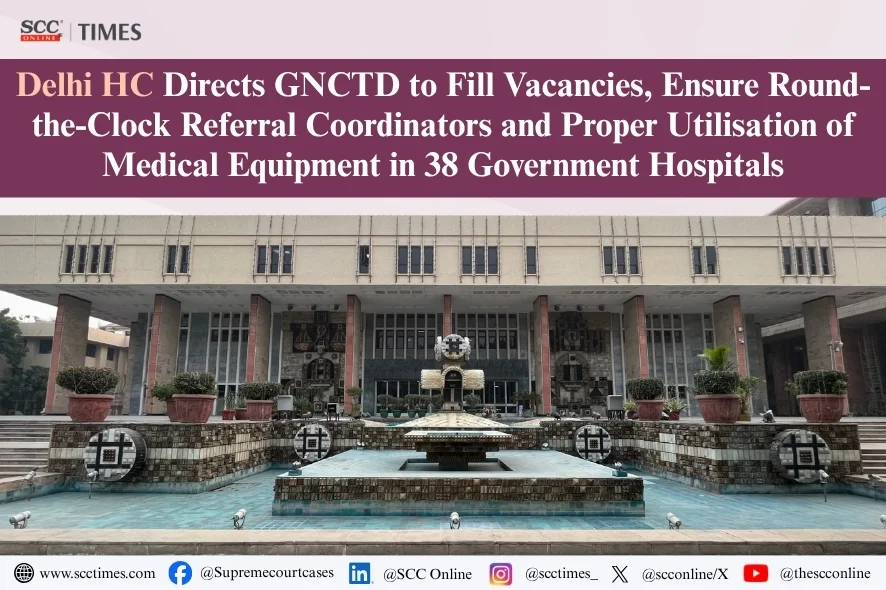
Delhi High Court: In a case concerning the functioning of 38 government hospitals across Delhi, a Division Bench of Prathiba M. Singh* and Manmeet Pritam Singh Arora, JJ., directed the GNCTD to take concrete measures to address deficiencies relating to ICU bed availability, referral coordination, shortage of medical and technical staff, recruitment, and utilisation of medical equipment.
The Court, while considering the functioning of 38 government hospitals across Delhi, examined issues concerning the availability of ICU beds, referral coordination, shortage of medical and technical staff, recruitment of doctors and other personnel, and unused medical equipment. The Court noted that although the government had taken steps pursuant to its earlier directions, several deficiencies continued to persist and the status report did not satisfactorily address the issues relating to recruitment and utilisation of equipment.
With respect to the toll-free number “102”, the Court noted that it had been identified as the dedicated number for assisting patients and their family members regarding the availability of ICU beds across the 38 government hospitals. The operators had been provided access to an ICU dashboard enabling them to furnish information regarding bed availability and hospital specialties. However, the Court noted that there were presently 30 lines and 30 operators, whereas approximately 2200 calls were being received daily, with around 500 call drops. The Court accordingly directed the Head of Operations, CATS, to prepare a month-long data sheet analysing the calls received, call drops and the additional lines and operators required, and to communicate the requirement to the Secretary, Health and Family Welfare, GNCTD.
On the issue of referral coordinators, the Court observed that patients referred from one government hospital to another faced severe difficulty on account of lack of coordination between hospitals, resulting in loss of crucial time. Although referral coordinators had been nominated in 37 of the 38 hospitals, the Court held that, considering that doctors ordinarily work in 8 to 10-hour shifts, at least 3 referral coordinators ought to be available round the clock in each hospital. The Court therefore directed that the list be updated to ensure availability of referral coordinators at all times.
The Court expressed its complete dissatisfaction with the response of the GNCTD concerning the shortage of staff and unused equipment. It observed that government hospitals were facing enormous difficulty in recruiting necessary doctors and other staff and that there was no uniform HR policy of the Delhi Government to deal with such recruitment. The Court held that recruitment would have to be addressed in a centralised manner, rather than through local contractual appointments. It observed that contractual employment could not be the answer to all problems, as it may result in lack of permanency, high attrition, blocked promotional avenues and frustration amongst employees.
The Court further directed the Secretary, Health and Family Welfare, and the Secretary, Services, GNCTD, to hold a fresh meeting with the MS/MD of each of the 38 hospitals and prepare a comprehensive chart indicating the sanctioned posts, filled posts and vacant posts at various levels. A strict timeline was also directed to be prescribed for recruitment. In hospitals where the post of MS/MD/Director was vacant, the Court directed that the regular appointment process be undertaken and, where such process would take time, a senior faculty member or senior doctor be given charge within 15 days of the Joint Meeting. The Court directed that there should not be a single vacant post of MS/MD/Director in any of the 38 government hospitals, including society-run hospitals.
As regards unused medical equipment, the Court noted that varying interpretations of the expression “unused equipment” were being adopted by different hospitals, resulting in inconsistent responses. The Court therefore directed the filing of a further status report specifically concerning MRI, CT Scan, PET Scan and USG machines, identifying the hospitals where such facilities were available and whether adequate regular or contractual manpower existed to operate them. The Court clarified that use of equipment by consultants on a random basis would not constitute its proper utilisation. Any equipment which was not available for patients on a daily basis with proper manpower was to be treated as unused equipment.
The Court consequently directed the authorities concerned to place before it a comprehensive picture regarding staffing, vacancies, hospital administration, referral coordination and utilisation of medical equipment. All MS/MD/Directors of the 38 hospitals were directed to participate in the next proceedings, with the heads of LNJP Hospital, GTB Hospital, DDU Hospital, G.B. Pant Hospital and Sanjay Gandhi Hospital directed to remain physically present along with the Secretary, Health and Family Welfare, GNCTD. The matter was directed to be listed on 10 October 2026.
Also Read: Delhi HC orders HMIS audit after ICU bed denial in Govt hospitals| SCC Times
[Court on its own motion v. Union of India, 2026 SCC OnLine Del 7487, decided on 18-9-2026]
*Judgment authored by: Justice Prathiba M. Singh
Advocates who appeared in this case:
For the Petitioner: Siddharth Aggarwal Sr. Adv., Vishwajeet Singh Bhati, Kumar Utkarsh, Ashok Agarwal, Advocates
For the Respondents: Arunima Dwivedi, CGSC, Amit Tiwari, CGSC, Avnish Ahlawat, SC, GNCTD Services, Sameer Vashisht, Standing Counsel (Civil) GNCTD with Harshita Nathrani, Himanshi Singh, Monalisha Pradhan, Ayushi Srivastava, Arpan Narwal Kushagra Malik, V.S.R. Krishna, Ravinder Agarwal, Manish Kumar Singh & Vasu Agarwal, Nitesh Kumar Singh, Aliza Alam, Mohnish Sehrawat, Rakesh Malhotra, Bharat Malhotra and Gayatri Bhatia, Sagar Saxena, Krishnandu Haldar, Abu Hassan Usmani, Advocates





