


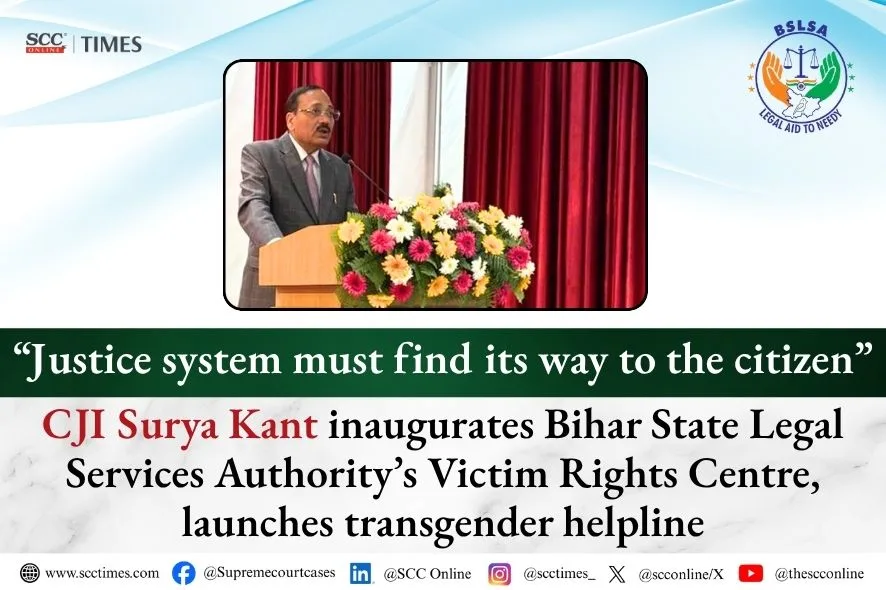
The Bihar State Legal Services Authority (BSLSA), Patna, organised an inaugural ceremony on 26 September, 2026, for the inauguration of a Victim Rights Centre, a Victim Rights Centre Booklet, a Transgender Helpline, and the Flagging Off of Multi-Utility Vehicles.
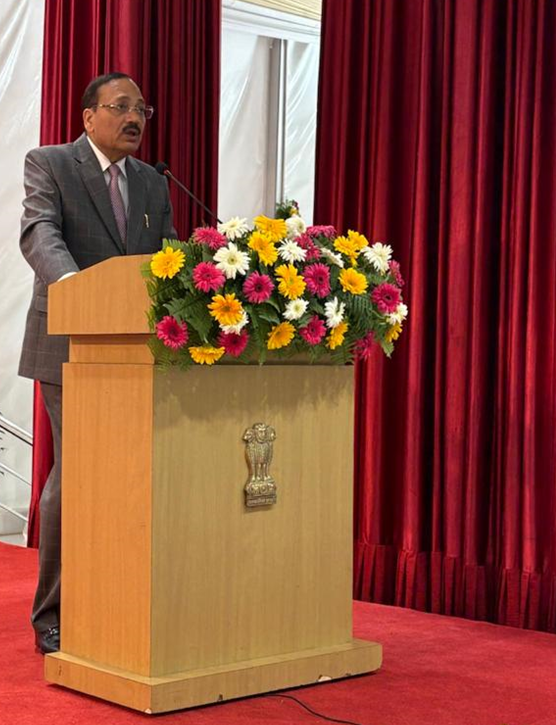
Gracing the occasion, Justice Surya Kant, Chief Justice of India, delivered a special address.
He began his address by posing a crucial question that he believed every justice system must continually ask itself: “When a person needs justice, how close is justice to that person? Is it available only within the walls of a courtroom, or does it reach the person who is vulnerable, unheard, or unable to navigate the system on their own?”
With this question in mind, he highlighted the relevance of the event, which was inaugurating four initiatives that seek to bring justice closer to those who need it most. The Victim Rights Centre, the booklet documenting its work, a helpline for the Transgender community, and a Multi-Utility Vehicle that will take legal assistance beyond the courtroom. These initiatives might serve different needs, but they were all guided by the same conviction that “justice must not wait for the citizen to find it. The justice system must find its way to the citizen.”
Justice Kant remarked that the criminal justice process was built around the accused and the offence. The victim often disappears from the story until the day of testimony after giving their initial statement. What happens to the victim in the months in between is rarely anyone’s direct responsibility. “A victim frequently experiences the process itself as a second injury, arriving already wounded and then made to navigate a system that speaks a language not known to them. That void between entitlement and delivery is where trust in the justice system is won or lost.”
A Single Door for Every Entitlement
Explaining the Victim Rights Centre, he stated that it rests on a simple idea, i.e., a victim of crime should not have to learn the law to receive what the law already promises, like compensation schemes, legal assistance, medical assistance, counselling, protection, rehabilitation. These entitlements are scattered across different statutes, departments and institutions, i.e., they may all exist in law, but they remain beyond the reach of the person who needs them most. Thus, this is precisely the gap that the Centre seeks to address. The law may recognise an entitlement, but recognition alone does not ensure that a victim receives it.
He further explained that the Centre proposes to receive the victim at one point, identify every entitlement that is due to the person, and then pursue each one to conclusion. Each step is assigned a timeline, recorded, and reviewed. It is not merely an information desk, but rather a case management system built around the person. Therefore, the Centre addresses one important barrier by helping a person navigate entitlements that already exist.
However, Justice Kant stated that there was another barrier that arises even earlier, i.e., a person may not even know where to turn, or the justice system may simply not reach them. These initiatives seek to address that wider gap by taking justice closer to people who have too often struggled to access it.
He urged the audience to consider what changes in practice. “A survivor should not have to separately approach the police for protection, the legal services authority for compensation, a hospital for treatment, a counsellor for support and each unaware of what the other is doing. One centre, one file, one point of accountability. That is what coordinated victim support means, and that is what we inaugurate today.”
Regarding the Victim Rights Centre Booklet, he stated that it documents this journey. It records not merely what the Centre intends to do, but how its work is meant to translate into assistance for a victim at each stage of the journey. In that sense, the Booklet was a practical guide to understanding the Centre, its processes, and the manner in which a victim can access its support.
Thus, he hoped that every judicial officer, every legal services functionary, and every person working within the victim support system in Bihar knows what the Centre does, whom it serves, and how a victim can reach it, as an institution cannot serve those who do not know that it exists.
Reaching the Overlooked, and Reaching Further
Justice Kant remarked that the same principle of accessibility must extend to those who have historically found the justice system difficult to approach. He stated that the transgender community has stood at the margins for generations, and though they were recognised in law via the Supreme Court’s judgment in National Legal Services Authority v. Union of India, (2014) 5 SCC 438. “For a person facing harassment or discrimination, the first difficulty may still be knowing where to seek help, or finding legal assistance without fear of public scrutiny. The barrier to justice can arise even before a case is filed.”
Thus, he stated that the Transgender Helpline sought to address the aforesaid barrier. It offers a single point of access to legal aid, counselling and protection, without requiring a person to navigate multiple offices or repeat a painful account over and over again. “Its true measure will lie in how sensitively and consistently we respond when someone reaches out. The strength of a helpline is not merely in answering a call, but in ensuring that the person on the other side is heard and guided towards meaningful assistance. And where people cannot easily reach the system, the system must be prepared to reach them.”
Justice Kant added that the Multi-Utility Vehicle takes this philosophy further. The Vehicle will carry legal awareness, documentation support, and first-point assistance to villages and settlements beyond the immediate reach of the courtroom. In doing so, it reminds us that access to justice is not complete when an institution opens its doors. It is complete when those who need it can actually find their way to those doors.
Conclusion
Justice Kant underscored that these four initiatives shared one common thread. A Centre for Victims, a Booklet that records its journey, a helpline for a community that has long remained at the margins, and a vehicle that carries assistance to those who cannot easily reach it. None of them changes the law, but all of them can change the way the law is experienced by the person standing at its receiving end. That is where the true measure of justice lies.
“A victim who comes before the system is often like a young plant that has survived a storm. It does not need to be told merely that the soil is there. It needs to be sheltered, supported and given the time and care to take root again.”
He added that the legal community’s responsibility was the same. It must ensure that a victim is not left to navigate the aftermath alone, but is accompanied with care from the moment help is sought until the person can stand with dignity once again. He argued that these initiatives must not be measured by the ceremony of their inauguration, but by what happens afterwards, i.e., how effectively a call for help is answered, whether a promised entitlement reaches the person, whether a painful account has to be repeated unnecessarily, and whether assistance reaches the village that has no easy access to a courtroom. These are the moments in which an institution earns the trust of the people it exists to serve.
In conclusion, he congratulated everyone who worked to bring these initiatives to life, and expressed confidence that Patna will show the rest of the country what sustained follow-through looks like.





