2026 SCC Vol. 8 Part 3: Supreme Court rulings on river pollution, mental cruelty, autism and more
Three rulings in SCC Vol. 8 Part 3 cover river pollution, divorce, and stem cell therapy.

Bringing you the Best Analytical Legal News


Three rulings in SCC Vol. 8 Part 3 cover river pollution, divorce, and stem cell therapy.
The August Roundup of Family and Personal Law contains important rulings and judgements from the Courts all over, on Live-In Relationships, marriage, divorce, maintenance rights under Hindu Marriage Act, 1955 and more.
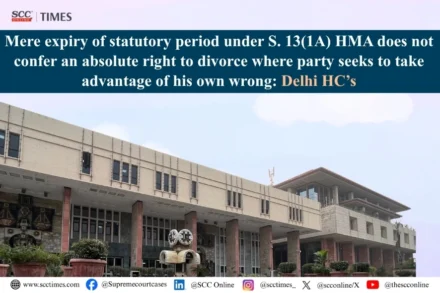
Delhi High Court noted that the conduct of the husband in pursuing a petition under Sections 13(1A) and 13(1)(ib) of the HMA, without making any sincere effort to resume cohabitation and by frustrating the wife’s attempts to execute the decree for restitution of conjugal rights, clearly demonstrated that his sole objective was to secure a decree of dissolution of marriage under the said provisions, without any genuine intention of restoring the matrimonial relationship.
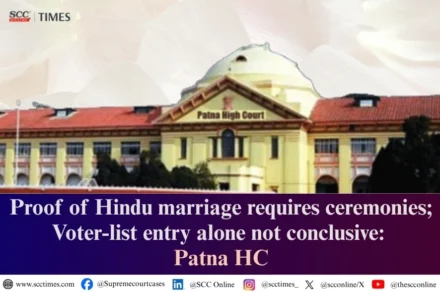
The High Court held that the appellant failed to prove the alleged marriage under Section 7, Hindu Marriage Act, as neither the marriage nor the requisite ceremonies were established, and that voter-list entries and maintenance proceedings could not conclusively prove a valid matrimonial relationship.
Supreme Court enhanced maintenance for a wife undergoing cancer treatment and her 2 minor children, holding that PF and ESPP deductions are benefits accruing to the husband and not permanent charges.
The July Roundup of Family and Personal Law contains important rulings and judgements from the Courts all over, on succession rights, marriage, divorce, inheritance rights under Oraon customary law and more.

Neither a divorce nor a marriage can be conducted through a notarised agreement, the Madhya Pradesh High Court holds, dismissing a family pension claim by a man who could not prove he was ever legally married to a deceased Tribal Affairs Department employee.
The Delhi High Court had held that seeking hotel stay and call record details to prove the charge of adultery would not violate right to privacy.

“An incapacity for a second marriage for a certain period does not have the effect of treating the former marriage as subsisting. This settled position in law would suffice to reject the argument of the husband that the second marriage was void since it was bigamous in nature.”

“The Hindu Marriage Act does not recognise childlessness as a justifiable circumstance for entering into wedlock with a person who is already in the subsisting wedlock with another.”

Section 29(2) of the Hindu Marriage Act, 1955 protects only valid customary divorces, and in the present case the evidence was insufficient in law to prove either the existence of such a custom in the community or the factum of her own divorce.

“The requirement of filing registration certificate is only in cases where the marriage is registered under Section 8 of the Hindu Marriage Act, 1955. Admittedly, in the present case, the marriage which was solemnized in the year 2010 is not registered and therefore, there is no necessity of filing registration certificate.”

“Her behaviour, including instigating the daughter against the father, making unfounded demands during a financially unstable period, and leaving the home with the daughter while abandoning the son, demonstrated a pattern of mental harassment and disregard for the matrimonial bond.”

“The husband cannot compel the wife to share her passwords of the cellphone or bank account and such an act would amount to a violation of privacy and potentially, domestic violence. There should be a balance between marital privacy and the need for transparency and at the same time trust in the relationship.”

“Merely admitting evidence on record is not proof of a fact-in-issue or a relevant fact… Admitting evidence is mere inclusion of evidence in record, to be assessed on a comprehensive set of factors, parameters and aspects, in the discretion of the court.”

“From physical assaults and verbal abuse to repeated acts of financial control and emotional blackmail, the husband was subjected to a state of perpetual distress, where fear and anxiety overshadowed any hope of marital peace.”
“The judicial discretion must be exercised to provide a fair and just maintenance amount, considering the dependent’s actual needs and the payer’s financial capability, even if the claim was initially understated.”
“Remaining unemployed is one thing and sitting idle having qualification and prospect to earn is another thing and if a husband being well qualified sufficient enough to earn sits idle only to shift the burden on the wife should not only be deprecated, but also be discouraged.”
Criminal Procedure Code, 1973 — S. 319 — Summoning of additional accused: Principles of law
“Forcing wife to live with a person who is neither educated nor eager to improve himself certainly amounts to mental cruelty.”