About the Workshop
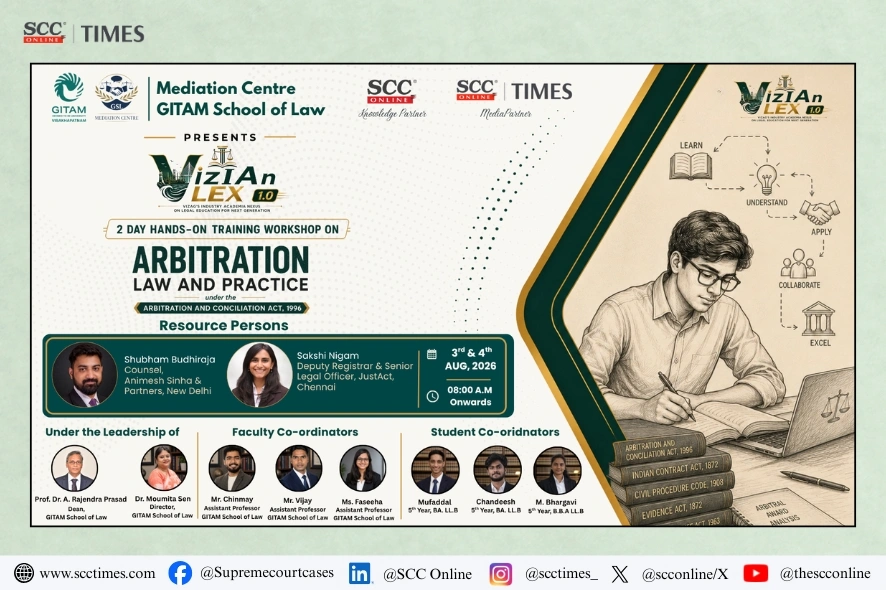
GITAM School of Law, Visakhapatnam, is organising a two-day Skill Development Training Workshop on “Arbitration Law and Practice under the Arbitration and Conciliation Act, 1996.” on 3 and 4 August, 2026.
Designed as a practice-intensive introduction to arbitration in India, the workshop traces how an arbitration matter actually proceeds from the pre-dispute stage to enforcement or challenge of an award, integrating the key amendments to the Arbitration and Conciliation Act, 1996.
Conceived and coordinated by Mr. Chinmay, Assistant Professor at GITAM School of Law, the workshop is being run under his stewardship as the Workshop Coordinator, with a clear emphasis on experiential learning for law students and young practitioners. The initiative is anchored in the broader vision of Dr. Moumita Sen, Director, GITAM School of Law, who is working to foster sustained industry—academia collaboration under the project VizIAnLex, positioning the School as a hub for practice-oriented dispute resolution training.
Objectives
The primary objective of the workshop is to offer a hands-on introduction to arbitration for participants who already understand basic contract law and civil procedure but seek practical exposure to how arbitration matters are handled in real practice. By the end of the two days, participants are expected to be able to identify and draft workable arbitration clauses, map the complete lifecycle of an arbitration under the Act, prepare basic arbitration documents and checklists, and participate confidently in arbitral proceedings as interns or junior associates.
The workshop also aims to situate arbitration within the broader dispute resolution landscape by briefly comparing arbitration, litigation, and mediation or conciliation through a live commercial dispute scenario. This combination of doctrinal grounding and practical workflow mapping is intended to strengthen participants’ capacity to assist in arbitration matters during internships and early practice.
Rationale and relevance
Over the last decade, arbitration has moved to the centre of commercial dispute resolution in India, especially after the 2015, 2019, and 2021 amendments emphasized time limits, reduced court intervention, and refined public policy standards. Law graduates entering practice now encounter arbitration clauses in a significant proportion of commercial contracts, yet many have limited exposure to the granular steps that convert a clause into an effective arbitral proceeding.
The workshop responds to this gap by providing a realistic, statute-anchored walkthrough of arbitral practice, allowing students to engage with Sections 7, 8, 9, 11, 16, 17, 18—19, 24—27, 29A—29B, 31, 34, 35—36 and Part II of the Act through simulations and drafting tasks rather than purely doctrinal lectures. In doing so, it aligns with VizIAnLex’s broader goal of integrating industry standards and professional workflows into classroom training, thereby reinforcing GITAM School of Law’s commitment to producing practice-ready graduates.
Challenges addressed
A recurring challenge in arbitration pedagogy is that students tend to know the statutory framework in isolation, without understanding how pleadings, evidence, and case management decisions unfold over time. They may learn about concepts such as kompetenz-kompetenz or interim measures but remain unsure how and when these tools are actually invoked in a live dispute.
The workshop directly addresses these challenges by working through a single composite case over four sessions, requiring participants to manage client intake, analyse arbitration clauses, draft notices invoking arbitration, negotiate the appointment of arbitrators, frame issues, seek interim relief, and think through post-award strategies. This continuity ensures that technical provisions are always embedded in a narrative file, making the learning experience more coherent and reflective of professional practice.
Pedagogy
The design of the workshop is explicitly experiential: participants work in groups on a composite case file, undertake drafting exercises, engage in role plays, and participate in simulated case management conferences and hearings. Short faculty inputs on statutory provisions and doctrinal nuances are interspersed with exercises, ensuring that academic rigour is maintained even as the sessions stay practice-focused.
Day 1 focuses on moving a live dispute into arbitration—from clause analysis and notice invoking arbitration under Section 21 to client interview and strategy decisions—while Day 2 builds on tribunal constitution, pleadings, interim measures, case management, and hearings. The pedagogy emphasises peer review, structured feedback, and professional skills in oral submissions and witness examination, mirroring workplace expectations.
Resource persons
The resource persons for the workshop are drawn from practitioners and faculty with robust experience in arbitration law and procedure under the Arbitration and Conciliation Act, 1996. Mr. Shubham Budhiraja, Counsel, Animesh Sinha Partners and Ms. Sakshi Nigam, Deputy Registrar and Senior Legal Officer, JustAct, Chennai share the onus of training the students. They are tasked with providing brief doctrinal inputs, moderating drafting exercises, and guiding role plays in client interviewing, tribunal appointment negotiations, case management conferences, and simulated hearings.
Expected outcomes
By the conclusion of the workshop, participants should be able to explain, in practical terms, the structure of the Arbitration and Conciliation Act, 1996 and the implications of its recent amendments. They will have traced a dispute from notice through tribunal constitution, pleadings, evidence, hearings, award, challenge, and enforcement, developing a concrete sense of how arbitration files move in practice.
Participants will also have drafted and reviewed arbitration clauses and notices invoking arbitration, prepared extracts of statements of claim or defence, and drafted prayers for interim relief under Sections 9 and 17. These outputs aim to build confidence in participating in arbitral proceedings as interns or junior associates and to cultivate a disciplined, statute-informed approach to strategy in arbitration matters.
Organizing committee
The workshop is organised by GITAM School of Law under the guidance of Dr. Moumita Sen, Director, GITAM School of Law, Visakhapatnam, who steers the School’s vision of practice-oriented legal education and industry—academia collaboration through initiatives like VizIAnLex. Chinmay, Assistant Professor, serves as the Organising Faculty Workshop Coordinator, responsible for conceptualisation, academic design, and overall coordination of the sessions. The organising committee comprises Mr.Vijay Chittiboyna and Ms. Faseeha Khatoon, faculty members and administrative staff from GITAM School of Law who support logistics, participant management, and documentation, ensuring that the programme reflects the School’s commitment to high-quality, professionally relevant training for law students. Muffadal Tambawala (Student Convenor, GSL Mediation Centre) and Surya Teja (Co-Convenor, GSL Mediation Centre) are working meticulously towards organizing the workshop.