
Speaking at LegalTechTalk 2026, Ms. Nikki Shaver, Chief Executive Officer and Co-Founder of LegalTechnologyHub, examined the convergence of technological, economic and competitive forces reshaping the legal industry. Delivering a keynote titled “The Dilemma Zone: Why Legal’s Inflection Point Demands New Thinking”, Ms. Shaver argued that while law firms continue to report strong financial performance, a series of interconnected developments indicate that the sector is entering a period of significant transformation.

Opening the session, Ms. Shaver observed that the legal industry presently presents a paradox. On one hand, law firms continue to experience revenue growth, increased profits, strong demand and active deal markets. On the other, many industry participants increasingly recognise that fundamental shifts are occurring beneath the surface.
Referring to the pace of external change confronting the profession, Ms. Shaver cited former General Electric Chief Executive Officer Jack Welch’s observation that, “When the rate of change on the outside exceeds the rate of change on the inside, the end is near”, using it to emphasise the urgency with which legal organisations must approach ongoing market developments.
Signal One: Generative AI is reshaping legal work
The first signal identified by Ms. Shaver was the rapid expansion of generative artificial intelligence within the legal sector.

Referring to LegalTechnologyHub’s market mapping of legal AI solutions, she noted that the number of generative AI products operating in the legal market had increased from approximately 400 solutions in March 2025 to more than 1,000 product placements by March 2026. According to Ms. Shaver, the market is also witnessing approximately 100 net new generative AI companies each quarter, even after accounting for consolidation and business closures.
She suggested that the sustained growth of legal AI products indicates a continuing market trend rather than a temporary phenomenon. At the same time, she observed that increasing computing power and accelerating technological development require legal professionals to adapt to an environment characterised by continuous change.
Ms. Shaver also referred to studies conducted by Goldman Sachs and Thomson Reuters, which identified legal services among the sectors expected to experience significant disruption from artificial intelligence. While AI has already delivered measurable gains in efficiency and productivity, she noted that the wider impact on legal business models and economics is still emerging.
As she observed during the session, “We haven’t yet seen the impact on the bottom line. We haven’t yet seen that economic model shift, but it’s coming.”
Signal Two: Capital flows are transforming the legal technology market
The second signal discussed during the keynote concerned the movement of capital into legal technology and its implications for the wider legal ecosystem.

According to figures presented by Ms. Shaver, legal technology attracted approximately USD 4.28 billion in investment during 2025. During the first quarter of 2026 alone, the sector attracted approximately USD 1.42 billion, representing nearly one-third of the previous year’s total funding.
Ms. Shaver noted that increased investment activity is reshaping the market and contributing to the growing visibility of legal technology. She pointed to developments that would previously have been unusual within the sector, including major sports sponsorships and celebrity endorsements.
The keynote also highlighted the growing participation of large technology companies in legal-focused AI initiatives. Ms. Shaver referred to developments involving Anthropic’s Claude for Legal, Microsoft Legal Agent, OpenAI’s increasing focus on legal applications and recent moves by Perplexity within the legal sector.
According to Ms. Shaver, these organisations possess significant advantages in terms of capital, distribution networks and access to specialised talent, factors that could influence the future direction of legal technology and legal services.
The session further addressed the growing role of private capital within legal services. Ms. Shaver referred to developments in the United States involving Managed Services Organisations (MSOs), which have enabled law firms to attract external investment into operational functions. She suggested that increasing interest in such structures reflects broader pressures facing legal organisations.
Signal Three: Client expectations are evolving rapidly
A further theme explored during the keynote was the changing relationship between legal service providers and their clients.

Ms. Shaver presented data indicating that corporate legal departments’ use of artificial intelligence had increased from approximately 24 per cent to 52 per cent over the previous year. She noted that attitudes towards AI have evolved significantly in a relatively short period.
As she explained, “We’ve seen the same clients that used to in 2023 prohibit use of AI now move to a place where they are not just encouraging but expecting that we use AI.”
According to Ms. Shaver, these developments are beginning to place pressure on traditional pricing models and prompting renewed discussions concerning the valuation of legal work. She noted that conversations around pricing structures and the future of the billable hour have become increasingly prominent among law firm leadership.
Signal Four: Talent markets are becoming increasingly competitive
The keynote also examined the changing dynamics of talent within the legal industry.
Ms. Shaver observed that legal professionals today have a considerably wider range of career opportunities than in previous decades, including positions within legal technology companies, AI ventures, legal operations functions and innovation-focused organisations.
She noted that legal organisations increasingly require expertise in areas such as AI development, implementation and change management, bringing them into competition with technology companies and other industries seeking similar skill sets.
The discussion also addressed recent trends in lateral hiring. According to figures presented during the keynote, the Am Law 100 recorded more than 3,000 partner moves during the previous year, while the Am Law 200 experienced more than 4,000 lateral partner transitions, representing a significant increase over previous years.
However, Ms. Shaver also referred to data indicating that approximately 62 per cent of lateral partner hires fail to deliver the anticipated book of business, raising questions about the long-term effectiveness of lateral recruitment as a primary growth strategy.
Signal Five: New competitive forces are emerging
Turning to the competitive landscape, Ms. Shaver noted that legal organisations are increasingly facing competition from multiple directions.

One area of focus was the growing capability of in-house legal teams. Drawing upon discussions with corporate counsel, she observed that many organisations are investing in AI initiatives partly to retain a greater volume of legal work internally. According to Ms. Shaver, this trend has the potential to alter the traditional relationship between corporate legal departments and external law firms.
The keynote also examined the emergence of AI-native law firms. Ms. Shaver noted that more than 20 such firms entered the market during 2025 and that the pace of new entrants has continued during 2026.
She suggested that advances in AI have lowered barriers to entry and enabled new firms to operate using technology-driven business models and workflows from inception.
Particular attention was given to examples of legal technology companies expanding into legal services. Ms. Shaver referred to developments involving Udia Counsel and Norm Law as examples of organisations operating across the traditional boundaries between legal technology and legal services.
Comparing market sizes, Ms. Shaver noted that while the legal technology market is estimated at approximately USD 31 billion, the broader legal services market is valued at approximately USD 1.1 trillion. In that context, she suggested that legal services may increasingly attract interest from technology companies and investors seeking larger market opportunities.
Traditional responses may not be sufficient
Throughout the keynote, Ms. Shaver repeatedly returned to the question of how law firms are responding to change.
She observed that many firms continue to rely on traditional growth strategies, including lateral hiring, mergers and acquisitions, and fee increases. While acknowledging that these approaches have historically produced positive results, she suggested that they may be insufficient in addressing the structural changes currently affecting the legal market.
The keynote highlighted increasing merger activity as another indicator of market pressure. According to Ms. Shaver, law firm mergers increased significantly during the previous year, including among larger firms seeking expanded scale, talent and geographic reach.

Beyond AI Adoption: Building differentiated advantage
In the latter part of the session, Ms. Shaver distinguished between different stages of AI adoption within legal organisations.
She suggested that the adoption of third-party AI tools has become increasingly common across the market and should now be viewed as a baseline capability rather than a source of competitive differentiation.
“Adoption of third-party AI tools is table stakes,” she noted.
According to Ms. Shaver, firms should increasingly focus on AI-enabled workflows and embedded operating systems capable of creating lasting competitive advantages.
She encouraged legal leaders to identify the areas in which their organisations possess distinctive strengths and to integrate AI strategically within those areas to enhance client service, operational effectiveness and market positioning.
The ‘Dilemma Zone’ and the future of legal services
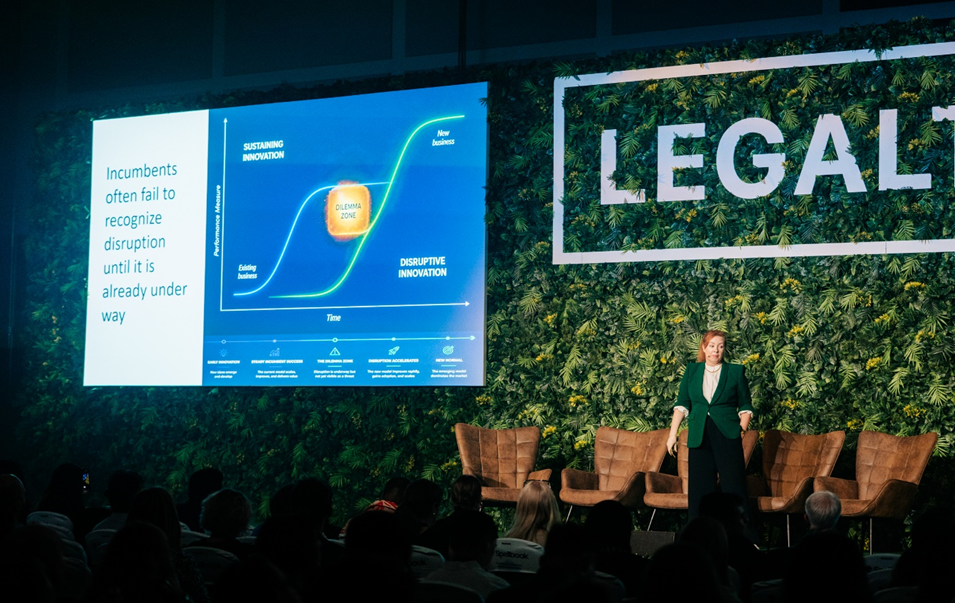
Drawing together the various themes discussed during the keynote, Ms. Shaver referred to Clayton Christensen’s theory of the Innovator’s Dilemma, which describes how established organisations can struggle to recognise disruptive change while existing business models continue to perform successfully.
She suggested that the legal industry currently exhibits many of the characteristics associated with such periods of disruption. While no individual trend appears transformative in isolation, the combined impact of technological advancement, capital investment, changing client expectations, talent mobility and new competitors points towards a legal market undergoing substantial change.
Concluding the session, Ms. Shaver challenged legal leaders to evaluate whether they would build their organisations in the same way if starting afresh today. The question, she suggested, is central to determining how law firms position themselves for the next phase of industry evolution.