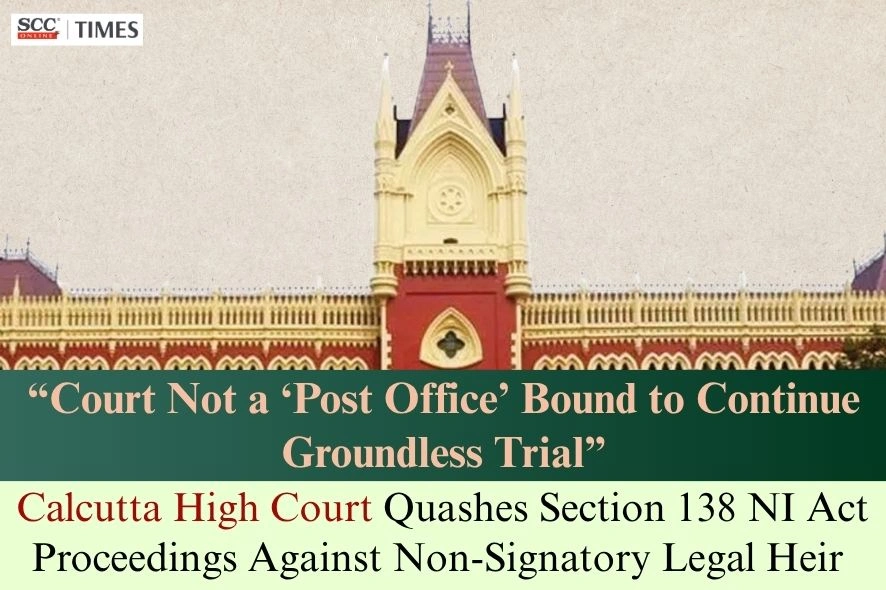
Calcutta High Court: A revisional application was filed by the petitioner under Section 482 read with Section 401, Criminal Procedure Code, 1973 challenging the order dated 4 August 2023, whereby the Magistrate rejected a prayer for discharge, effectively compelling the petitioner, a non-signatory to the cheque, to stand trial for a criminal offense involving a negotiable instrument allegedly committed by a deceased drawer. Uday Kumar, J., quashed Section 138, Negotiable Instruments Act, 1881 (NI Act) proceedings against non-signatory legal heir including the order taking cognizance and all subsequent orders, insofar as the petitioner was concerned.
The Court further annulled the Magistrate’s order dated 4 August 2023, which had rejected the petitioner’s discharge application. Consequently, the petitioner was discharged from all liabilities under the case; his bail bonds and sureties were cancelled, and he was set at liberty.
Also Read: Section 138 of NI Act Explained: Cheque Bounce Notice, Procedure & Landmark Rulings
Background of the Case
The fact of the case relates to a purported business transaction between the complainant (opposite party) and one deceased, the elder brother of the petitioner. It is alleged that the deceased, in his capacity as a ration dealer, secured a loan of Rs 27,00,000 from the opposite party for business exigencies. In purported discharge of the said liability, deceased issued an account payee cheque dated 1 February 2022, drawn on State Bank of India, Gram Salika Branch. However, the legal trajectory of this instrument was irrevocably altered when the drawer expired on 3 February 2022. Notwithstanding the drawer’s demise, which by operation of law revoked the bank’s mandate to pay, the opposite party presented the cheque for encashment on 6 April 2022. Upon its dishonour with the endorsement “funds insufficient,” the complainant attempted to transmute a civil debt into a heritable criminal liability by serving a statutory demand notice dated 13 April 2022, upon the petitioner on the premise of him being a “legal representative” and “business associate”.
Following the petitioner’s refusal to satisfy the demand on the grounds of total lack of personal culpability, the opposite party instituted the impugned complaint under Section 138, NI Act. The petitioner subsequently moved for discharge, asserting that since the cheque was neither signed by him nor drawn on an account maintained by him, the prosecution was void ab initio and an egregious abuse of the process of law. The Court passed an order, impugned hereunder, dated 4 August 2023, the Magistrate rejected the petitioner’s plea observing that in a summons-triable case, there is no specific procedural provision for “discharge” and further held that the applicability of Section 29, NI Act regarding the liability of a legal representative was a “matter of trial”. Aggrieved by this refusal to drop a fundamentally flawed prosecution, the petitioner filed the present revisional application for quashing on the grounds that he is a non-signatory, the criminal liability is non inheritable, and the requisite “concatenation of acts” necessary to complete an offense under Section 138 cannot, in law or facts, be attributed to him.
Analysis and Decision
On the question of whether criminal liability under Section 138 is strictly personal to the drawer or if it can be inherited by a legal representative upon the drawer’s demise, the Court noted that on a literal and strict construction of Section 138, it was clear that the use of the singular, personal pronouns in the provision is not merely a matter of grammar but a clear expression of legislative intent. The penal consequence is inextricably tethered to the physical identity of the individual who performs the act of signing and who maintains the account.
The Court further noted that the cheque in question was issued by the deceased and by operation of law, the moment the drawer ceased to exist, the bank’s mandate to pay out of that account was revoked. When the opposite party presented the cheque nearly 2 months after the drawer’s death, they were presenting an instrument that was already a legal nullity for the purpose of criminal prosecution. The complainant’s attempt to transmute the resulting dishonour into a criminal liability on the petitioner who is the surviving brother, ignores the elementary principle that a “crime” is not an asset or a legacy that can be bequeathed to a surviving heir. Thus, criminal liability under Section 138 is strictly personal and dies with the drawer. It cannot be shifted to, or inherited by, a legal representative, regardless of their purported status as a business associate or heir.
On the question of whether a person who is neither the signatory to the cheque nor the maintainer of the bank account can be prosecuted for its dishonour, even if they are a “business associate” or “co-borrower”, the Court noted that the language of Section 138 creates a specific and impenetrable perimeter of liability. The statute targets the person who draws a cheque on an account “maintained by him”. The Court also stated that the maintenance of the account and the issuance of the instrument are the twin pillars, the sine qua non, for the attraction of Section 138. In the instant case, it is an admitted position that the bank account at State Bank of India, Gram Salika Branch, was maintained solely by the deceased, Tapan Kumar Dey. The petitioner, Gautam Dey, remains a stranger to the banking contract between the deceased and the financial institution.
The Court concluded that in a criminal prosecution under Section 138, who “utilised the funds”, is not of major concern but rather with who “issued the instrument”. The petitioner’s status as a “business associate” does not grant him the legal capacity to authorise payment from his brother’s account. Consequently, he cannot be held criminally liable for the bank’s refusal to honour an instrument he did not sign, drawn on an account he did not maintain. Thus, a non-signatory, who is not the maintainer of the account, cannot be prosecuted under Section 138, regardless of his alleged involvement in the underlying business transaction.
On the question of whether the statutory “concatenation of acts” required to complete an offense under Section 138, specifically the issuance of a valid demand notice and the subsequent failure to pay, can be legally fulfilled when the drawer dies prior to the presentation of the cheque and the issuance of the demand notice, the Court noted that the dishonour of a cheque, by itself, does not constitute an offense under Section 138, NI Act. The offense is a “process-driven” crime that requires the cumulative fulfilment of a series of statutory acts. The opposite party served the notice upon the petitioner treating him as a substitute but the law does not recognise a “substituted service” on a legal heir for the purpose of initiating a criminal prosecution. A dead person cannot receive a notice, nor can they commit the “default” of non-payment within 15 days, which is the final act that triggers the cause of action for a criminal complaint.
Watch: Section 138 NI Act Explained: When Does a Cheque Bounce Become a Criminal Offence?
The Court explained that “concatenation of acts” remained incomplete and was broken the moment the drawer expired. In such event, the service of notice on the petitioner amount to a futile exercise. The petitioner, not being the drawer, was under no statutory obligation to satisfy the notice, and his “failure to pay” cannot be termed a criminal offense. Thus, a valid cause of action under Section 138 cannot arise when the drawer dies before the presentation of the cheque or the issuance of the notice and the service of a statutory notice on a legal heir does not satisfy the requirements of the Act for the purpose of criminal prosecution.
On the last and final question of whether the Magistrate’s refusal to entertain a plea for discharge in a summons-triable case, on purely procedural grounds, constitutes a failure to exercise jurisdiction to prevent an abuse of the process of law, the Court found the approach where in the impugned order dated 4 August 2023, the Magistrate observed that since the case is a “summons trial” regulated by Chapter XX CrPC (now Chapter XXI BNSS), there is no explicit provision for “discharge” once process has been issued and further suggested that the question of liability is entirely a “matter of trial” to be overly technical, legally flawed.
The Court said when an accused appears in response to a summons, the Court has a fundamental duty under Section 251 CrPC to satisfy whether the accusation constitutes a legally recognisable offense. If the complaint, on its face, revealed that the accused is a non-signatory and the drawer was deceased, the Court was not mandated to drag the accused through the protracted ordeal of a full trial. To do so is to ignore the primary purpose of Section 251, which is to ensure that no person is tried for a non-existent offense. Thus, the refusal to discharge the petitioner on purely procedural grounds was a failure to exercise jurisdiction. When a complaint is legally incompetent, the Court must not hesitate to terminate the proceedings at the threshold.
Consequently, the refusal to discharge the petitioner on purely procedural grounds was a failure to exercise jurisdiction. When a complaint is legally incompetent, the Court must not hesitate to terminate the proceedings at the threshold.
[Gautam Dey v. Golam Saharia, CRR 3672 of 2023, decided on 28-4-2026]
Advocates who appeared in this case:
For the Petitioner: Mr. Somnath Adhikary
For the Opposite Party: Mr. Pratip Kumar Chatterjee, Sr. Adv. Ms. Mait
Most Read
Grant of Anticipatory Bail to Accused with 22 FIRs “Very Unfortunate”; Criminal Antecedents Alone Sufficient to Deny Relief: Supreme Court
Decoding the Ministry’s Latest Clarifications: A Thematic Analysis of the Additional FAQs on the Four Labour Codes Answered by Ministry of Labour & Employment
“Court Not a ‘Post Office’ Bound to Continue Groundless Trial”: Calcutta High Court Quashes Section 138 NI Act Proceedings Against Non-Signatory Legal Heir
Bombay High Court Denies Urgent Relief Against Property Auction by Bank under SARFAESI Act

Uttar Pradesh Revises Minimum Wages Following Industrial Unrest in Noida: Effective April 2026