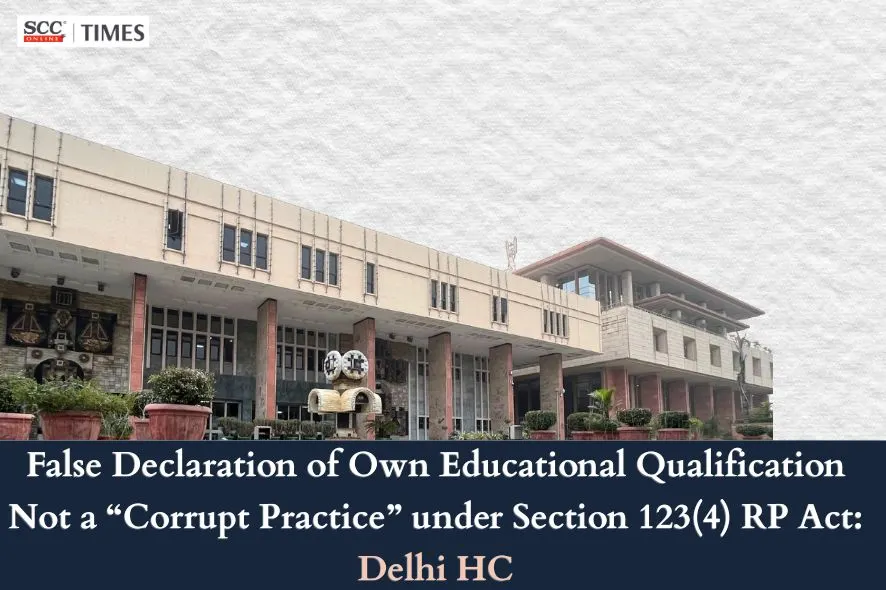
Delhi High Court: In a matter arising from a reference made by the Single Judge while dealing with an election petition filed under Section 80 read with Sections 100(1)(b) and (d), Representation of the People Act, 1951 (the Act), challenging the election of the returned candidate from Assembly Constituency-23, Karol Bagh, on the ground that he had furnished false information in the affidavit (Form 26) submitted along with his nomination paper, the Division Bench of Dinesh Mehta* and Vinod Kumar, JJ., held that allegation of furnishing false declaration of educational qualification by candidate himself/herself did not constitute a corrupt practice within the meaning of Section 123(4) of the Act.
Factual Matrix
In the instant matter, the petitioner instituted the election petition seeking a declaration that the election of Respondent 1 be declared null and void, initiation of prosecution under Section 125-A of the Act and other provisions of the Penal Code, 1860 (IPC) for filing false affidavit, and for disqualification of the respondent for six years under Section 8-A of the Act, based on allegation that the respondent had furnished false and misleading information regarding his educational qualification in the affidavit (Form 26) accompanying his nomination paper for the 2020 elections.
It was specifically pleaded that the Respondent 1 had declared himself to be a Class 10th pass from the National Institute of Open Schooling (NIOS) in the year 2003. However, according to the petitioner, records obtained from the NIOS website showed that although the respondent had enrolled in May 2002, he had not appeared in the examination. The petitioner further asserted that similar false declarations had been made by Respondent 1 in earlier elections held in 2013 and 2015, thereby demonstrating a pattern of misrepresentation.
The petitioner contended that such false declarations were made with a view to mislead the electorate and influence voters, thereby materially affecting the election result. It was averred that had the voters been aware of the true educational qualifications of the respondent, they would not have voted in his favour.
Before, the Single Judge arguments were addressed on whether non-disclosure or false disclosure of educational qualification in Form 26 would attract Section 123, and whether the petition should proceed to trial.
The Single Judge noted that in order to attract Section 123(4), there must be publication of a false statement of fact relating to the personal character or conduct of a candidate, which is reasonably calculated to prejudice that candidate’s election prospects. The learned Single Judge observed that furnishing false information in Form 26 does not, on the face of it, fall within the ambit of Section 123, and that corrupt practice being quasi-criminal in nature must strictly fall within statutory parameters. At the same time, instead of declaring the earlier coordinate Bench judgment in Nand Ram Bagri v. Jai Kishan, 2013 SCC Online Del 1826 as per incuriam, the Single Judge referred the matter for authoritative pronouncement by a larger Bench.
Issues for Determination
The Court confined itself to determining whether the election petition had become infructuous after the subsequent elections and whether the allegations made by the petitioner could fall within the scope of Section 123(4) of the Act.
Analysis
At the outset, the Court noted that for the purpose of deciding whether the petition had become infructuous, it would proceed on the assumption that the petitioner had raised a triable issue. However, the more fundamental question was whether the petition disclosed a cause of action under the relevant statutory provisions.
The Court examined the pleadings and found that the entire edifice of the petitioner’s case rested on Section 123(4), which deals with publication of false statements, and not on Section 123(2), which relates to undue influence. Therefore, the petitioner could not rely upon Section 123(2) or judgments interpreting that provision.
Interpreting Section 123(4), the Court identified four essential ingredients:
1. “There should be a publication by a candidate.
2. Such publication should be false or has been made believing it to be false or believing it not to be true.
3. Such publication should be in relation to personal character or conduct of any candidate.
4. Such a statement should be intended to prejudice the prospects of that candidate’s election.”
Upon a conjoint reading of these elements, the Court held that the provision clearly contemplates a false statement made about another candidate, and not about the candidate himself.
The Court observed that the language of the provision, particularly the expressions “in relation to personal character or conduct of any candidate” and “that candidate’s election”, makes it clear that the mischief sought to be addressed is the making of false statements against rival candidates to prejudice their electoral prospects. A candidate making a statement about his own qualifications cannot be said to be prejudicing his own election prospects.
“The use of expression ‘in relation to personal character or conduct of any candidate’ so also, the expression ‘reasonably calculated to prejudice the prospects’ and expression ‘that candidate’s election’ leaves no room for doubt that the assertion made by the petitioner, even if taken to be at its face value, cannot be brought within the sweep and scope of sub-section (4).”
Applying this interpretation, the Court held that even if the allegations of the petitioner were taken at face value, they would not fall within the ambit of Section 123(4), as they pertain to the respondent’s own educational qualification.
The Court distinguished the decision in Nand Ram Bagri v. Jai Kishan, 2013 SCC Online Del 1826, noting that in that case, the allegations were founded on both Sections 123(2) and (4), whereas in the present case, the petitioner had relied solely on Section 123(4). The Court emphasised that the High Court cannot travel beyond the pleadings or supply a different statutory basis to sustain the petition.
The Court relied on Ajmera Shyam v. Kova Laksmi, 2025 SCC OnLine SC 1723, which drew a distinction between disclosure of criminal antecedents and disclosure of assets or educational qualifications and held that while disclosure of criminal antecedents is critical to maintaining electoral purity, disclosures relating to assets and educational qualifications are supplementary in nature and do not necessarily warrant invalidation of an election unless the defect is substantial.
The Court further held that the requirement of “publication” is not satisfied by mere filing of an affidavit along with nomination papers. Referring to Black’s Law Dictionary, the Court noted that publication involves making something known to the public, whereas a declaration in a nomination form does not, by itself, amount to publication in the contemplated sense.
The Court opined that the allegation against Respondent 1, did not constitute the corrupt practice within the meaning of Section 123(4) of the Act, and since the assertions did not fall within the parameters of corrupt practice, as defined in Section 123, question of disqualification upto 6 years, as given in Section 8-A of the Act did not arise at all.
The Court further opined that while deciding an election petition, the High Court is bound by the letter of law, they cannot traverse beyond the plain language and there is no scope of extended meaning or purposive interpretations.
Decision
The Court held that furnishing false information regarding one’s own educational qualification does not constitute corrupt practice within the meaning of Section 123(4) of the Act. It was further, held that judgment rendered in Nand Ram Bagri (supra) to the extent it holds that wrong mentioning or incorrect statement given in the nomination form is corrupt practice within meaning of Section 123(4) is not good law.
In light of the above findings, the Court held that since the allegations did not fall within the ambit of corrupt practice and the term of the Assembly had already expired, with fresh elections held in 2025, the election petition had become infructuous. It directed the matter to be placed before the Single Judge for passing appropriate orders.
[Yogender Chandolia v. Vishesh Ravi, EL.PET. 10/2020, I.A. 8728/2020 & I.A. 11988/2020, decided on 24-4-2026]
*Judgment by Justice Dinesh Mehta
Advocates who appeared in this case:
Mr. Arvind Kumar Gupta, Mr. C.Prakash, Mr. Abhiesumat Gupta, Ms. Anushree Rawat, Mr. Shrey Tanwar, Ms. Shreja Saini, Mr. Abhishek Rana, Mr. T.Parth, Mr. Rajesh Yadav and Mr. Ankit Verma, Advs., Counsel for the Petitioner
Mr. Anupam Srivastava, Sr. Advocate with Mr. Rishikesh Kumar, Ms. Rohini Prasad, Ms. Ashika Ranjan and Ms. Samriddhi Srivastava, Advs., Counsel for the Respondents