
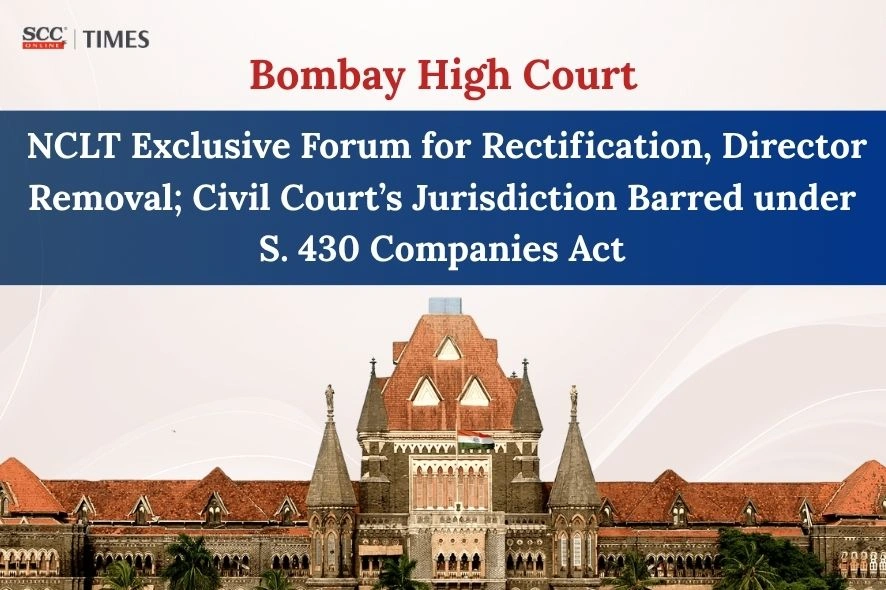
Bombay High Court: In notices of motion seeking injunctions to restrain the defendants from dealing with company properties including the Harileela Property, a Single Judge Bench of R.I. Chagla, J., held that the plaintiffs had failed to establish a prima facie case. The Court observed that the reliefs sought, which included rectification of the register of members and removal of a director, fall within the exclusive jurisdiction of the National Company Law Tribunal (NCLT) under Section 430, Companies Act, 2013 (Companies Act). Finding no merit in the applications, the Court dismissed the notices of motion and directed that there would be no order as to costs.
Background
The dispute concerned properties of a company, including the Harileela Property, which was its principal asset. The Company was originally incorporated with two individuals holding 50 per cent shareholding each and acting as its only Directors.
Following matrimonial disputes and subsequent events, it was the plaintiffs’ case that the shareholding and directorship structure remained unchanged. However, after the demise of one of the shareholders, disputes arose when the defendants claimed control over the Company and its assets.
It was alleged that the 50 per cent shareholding of one shareholder had disappeared without any instrument of transfer and without compliance with statutory requirements. It was further alleged that the director concerned was neither removed nor resigned yet ceased to be reflected as director.
The plaintiffs challenged an alleged board resolution dated 1 August 2013 authorising sale of the Harileela Property, contending that no such meeting took place, no notice or agenda was issued, and the resolution was fabricated. It was further alleged that the property was sold for Rs 3 crores without authority and in suspicious circumstances, and that the purchasers were not bona fide purchasers for value without notice.
The defendants raised a preliminary objection that the jurisdiction of the civil court was barred under Section 430, Companies Act, contending that the matter falls within the jurisdiction of NCLT. However, the plaintiffs contended that the suit seeks declaration and injunction involving fraud and disputed ownership, which require adjudication by a civil court.
Analysis and Decision
The Court emphasised that the Memorandum of Association (MoA) of Panache records Plaintiff 2’s name as a subscriber agreeing to subscribe 1000 shares of Panache, and therefore this does not establish and/or indicate that Plaintiff 2 actually held and/or continues to hold 1000 shares in Panache. The Court highlighted that it would be made clear from Section 36, Companies Act, 1956 (1956 Act), and in particular Section 36(2) of the 1956 Act, which provides that the money payable by any member to the Company under the MoA shall be debt due from him to the Company. Therefore, it was noted that the same does not establish payment and actual vesting of shares but merely creates an obligation on the subscriber to pay the amount and/or consideration against the shares subscribed.
The Court observed that it is settled law that only a share certificate is the prima facie proof of the title of shares, which is borne out from Section 84 of the 1956 Act, providing that a share certificate bearing the seal of a company and specifying the shares is prima facie evidence of the title of shares of a member. The Court referred to Vasudev Ramchandra Shelat v. Pranlal Jayanand Thakar, (1974) 2 SCC 323, wherein it was held that the share certificate is the prima facie evidence of the title of a share as it presupposes transfer of shares. The Court further noted that in the absence of a share certificate and/or marketable and/or transferrable documents in the present case, Plaintiff 2 cannot seek relief, viz. declaration that she is a 50 per cent shareholder in Panache.
The Court emphasised that presuming that Plaintiff 2 and the deceased, by virtue of their shareholding in Panache, can claim that they had shares in the Harileela Property which belonged to Panache, this claim would be contrary to the settled law that a company as a juristic entity is distinct from its shareholders, and it is the Company that owns its assets, not the shareholders. Further, Plaintiff 2, by seeking a declaration that she continues to be a shareholder, in spite of the register of members of Panache showing otherwise, is in effect seeking a rectification of the register of members, since Section 59, Companies Act deals with rectification of a register. The Court noted that it cannot be sought before the Court, as the same falls within the exclusive jurisdiction of the NCLT, in view of the bar by virtue of Section 430, Companies Act on a civil court granting reliefs which can only be granted by the NCLT.
The Court observed that Section 430, Companies Act provides that no civil court shall have jurisdiction to entertain any suit or proceeding in respect of any matter which the Tribunal or the Appellate Tribunal is empowered to determine by or under the Companies Act or any other law for the time being in force. Further, no injunction shall be granted by any court or other authority in respect of any action taken or to be taken in pursuance of any power conferred by or under the Companies Act or any other law for the time being in force, by the Tribunal or the Appellate Tribunal.
The Court referred to Shashi Prakash Khemka v. NEPC Micon, (2019) 18 SCC 569, where it was observed that in matters in respect of which the power has been conferred on the NCLT, the jurisdiction of the civil court is completely barred. Further, the Supreme Court has held in Shashi Prakash Khemka (supra) that relegating the parties to a civil suit would not be the appropriate remedy, especially considering the manner in which Section 430, Companies Act is widely worded.
The Court observed that there would also be a bar to the plaintiffs’ challenge to the appointment of Defendant 3 as Director of Panache in view of Section 430, Companies Act. It has been the contention of the plaintiffs that Section 430, Companies Act is not applicable in the present case, as the plaintiffs have allegedly shown the fraudulent manner in which the shares of Plaintiff 2 were illegally transferred as well as the fraud in the appointment of Defendant 3 as a Director of Panache.
The Court emphasised that in the present case, the issue of whether Plaintiff 2 had a 50 per cent shareholding and was a Director of Panache are issues which are required to be determined by the NCLT, particularly considering the bar under Section 430, Companies Act. Further, the Court noted that this is not a case as in the case relied upon by the plaintiffs, viz. State (UT of Chandigarh) v. Esys Information Technologies Pte. Ltd., (2016) 12 SCC 582, where the Supreme Court had directed lifting of the corporate veil as the promoters of the Company had failed to comply with the directions of the Court, because lifting of the corporate veil is not as a matter of course but an exception.
The Court observed that the plaintiffs are seeking ownership of the Harileela Property, which admittedly belonged to Panache. The Court found merit in the submissions of Defendants 4 to 6 that Defendant 4 is a bona fide purchaser with full and adequate consideration for the Harileela Property. It was also noted that Defendants 4 to 6 have prima facie been able to establish that the Harileela Property, which was purchased for a sum of Rs 3 crores, is in excess of the market value for the said property, which is borne out from the valuation reports. Further, Defendants 4 to 6 have also been able to prima facie establish that they had undertaken necessary due diligence and took all necessary steps as are taken by a bona fide purchaser intending to purchase the Harileela Property.
The Court emphasised that it is settled law that a mere communication addressed by any person directing another person to do an act cannot by itself operate as an injunction, and the communication in the facts and circumstances of the case would have no value considering the prima facie view taken, viz. that Plaintiff 1’s predecessor, viz. the deceased, had no right, title or interest in the Harileela Property as the Harileela Property belonged to Panache. The Court also highlighted that Plaintiff 1, who had addressed the communication at the relevant time, had made no efforts to approach this Court to secure an injunction in his favour.
The Court further relied upon Akella Lalitha v. Konda Hanumantha Rao, 2022 SCC OnLine SC 928, where it has been held that if reliefs are not found in pleadings, the same cannot be granted. The Court noted that the plaintiffs have not pleaded for appointment of a Court Receiver, and therefore the reliefs to the same cannot be granted. The Court observed that when an injunction is granted and status quo has been maintained, no relief can be granted to appoint a Court Receiver, especially when it is not even pleaded. Thus, the plaintiffs have failed to demonstrate any emergency, danger, or loss demanding immediate action for appointment of a Court Receiver.
The Court emphasised that considering the reliefs sought for, which include rectification of the register and the removal of Defendant 3 as a Director, these cannot be granted by a civil court in view of the bar under Section 430, Companies Act, and such bar is not excluded in the present case where the plaintiffs have pleaded fraud and forgery, which according to them is an open and shut case of fraud.
The Court found no merit in the notices of motion or the relief sought therein. Consequently, the notices of motion were dismissed, with no order as to costs.
[Satvik Rajiv Samani v. Shardaben Prabhudas Samani, 2026 SCC OnLine Bom 2457, decided on 6-4-2026]
Advocates who appeared in this case:
For the Plaintiffs: Archit Jaykar with Hetal Jobanputra and Dhwani Parekh i/b. Jayakar & Partners
For the Defendants: Shanay Shah with Hamza Lakhani i/b. Suraj Shukla, Aseem Naphade with S.L. Shah i/b. Shal Legal, Nausher Kohli with Aditya Raut, Shyamdhar Upadhyay i/b. Desai Desai Carrimjee & Mulla, Divyang Shukla /b. L.J. Law