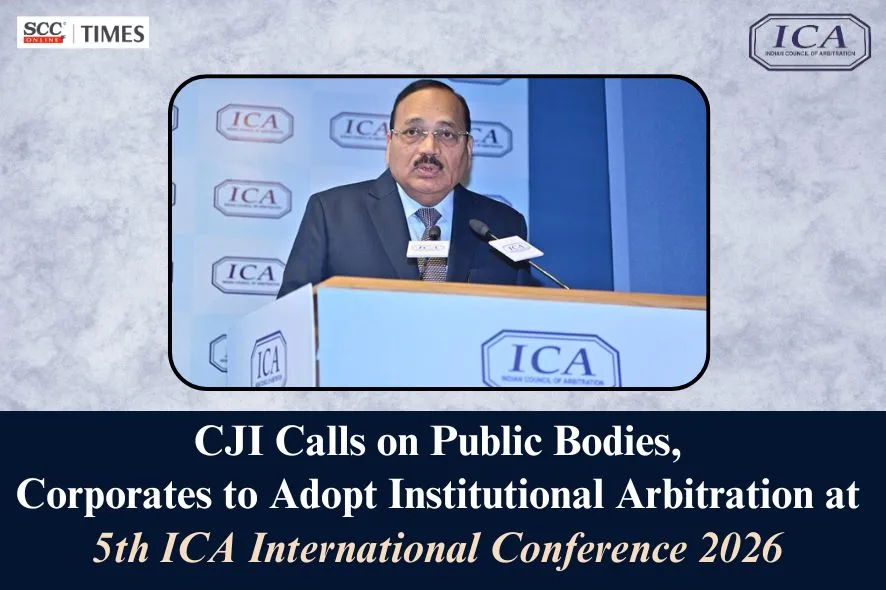
Chief Justice of India, Justice Surya Kant, delivered an inaugural address at Day 1 of the 5th ICA International Conference, 2026, on “Arbitration in the Era of Globalization- Legal Technology, Economic Development & Cross-Border Disputes”.
At the outset, CJI Kant expressed regard for the dignitaries present and the opportunity to inaugurate the 5th edition of the ICA International Conference on Architecture and the Era of Globalization. In the backdrop of globalization and rapid change in commerce, he underscored how contracts were being negotiated across continents, and disputes were international. Thus, the conference was particularly relevant.
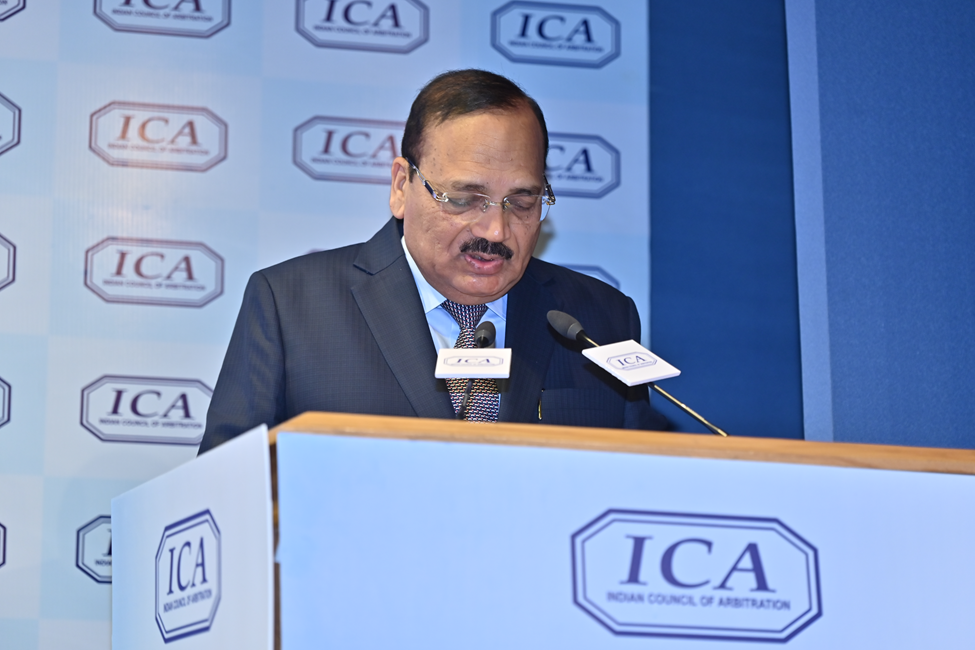
Regarding the arbitration landscape of India, he reflected on India’s efforts to undertake development and emphasized the importance of expanding and evolving, rather than just reforming. He stated that the way forward was strengthening regular dialogue between stakeholders, consultancy mechanisms, periodic procedural reviews, and institutional feedback loops, as these engagements helped arbitration to remain efficient, adaptable, and aligned with the expectations of contemporary commerce.
However, Justice Kant stated that mediation and conciliation had not evolved the same way as arbitration; thus, their utilization as dispute resolution pathways appears disjointed rather than complementary. This led to a lack of trust in these systems by litigators, especially by commercial actors who prefer predictable yet flexible dispute resolution systems. He suggested that the solution to this challenge was to consciously build an integrated Alternative Dispute Resolution (ADR) mechanism in which mediation and arbitration operate as mutually reinforcing instruments rather than competing alternatives.
On the aspect of increasing involvement of technology, Justice Kant mentioned how arbitration was being reshaped by technology, virtual hearings, digital case management platforms, and secure electronic transmission of documents. However, technological progress has brought in new responsibilities like confidentiality and independent judgment concerns raised by the increasing use of artificial intelligence in decision support tools.
“Arbitration derives its legitimacy not only from efficiency, but from the confidence that decisions are made as a product of impartial human expertise.”
In his opinion, the solution lay not in shunning technology, but rather in regulating its use through procedural frameworks. He stated that Arbitral Tribunals must retain autonomy over the way such tools are incorporated into proceedings so that protocols governing cybersecurity and confidentiality keep pace with technological adoption.
Moving forward, he spoke about the anti-arbitration injunction. He emphasized that arbitration depended fundamentally on the assurance that parties’ agreements will be respected and that tribunals will be permitted to determine their own jurisdiction and procedure. Excessive judicial intervention, therefore, risked unsettling this assurance and weakening faith in arbitration as a reliable method of dispute resolution. Thus, he opined that the grant of anti-arbitration injunctions must remain confined to exceptional circumstances.
“Judicial oversight should not go beyond an essential safeguard within any mature arbitration framework. The real obstacle lies in maintaining a careful equilibrium between autonomy and accountability. Such restraint preserves the independence of tribunals while enabling courts to remain guardians of procedural fairness.”
Lastly, he delved into the growing importance of institutional arbitration as a pillar of stability in cross-border commerce. He stated that while ad-hoc arbitration has historically played an important role in India’s arbitration landscape, complex international disputes increasingly require a structured procedural environment. Predictable timelines, transparent cost breakdowns, and neutrality in appointments are the basic features of arbitration, which institutional arbitration can address.
“Institutional arbitration in India must continue to expand its reach, strengthen professional capacity, and deepen engagement with global best practices.” He added that “Encouraging parties, particularly public sector bodies and large commercial entities, to adopt institutional rules more frequently, will play an important role in this transition”.
Justice Kant further remarked that “Institutional Arbitration can contribute significantly to the development of specialized arbitration capacity, both at the Bar and within Arbitral Panels. Expanding such capacity and infrastructure across the country will enhance India’s position as a global hub for arbitration.”
He added that a thread ran through the themes of the conference, which addressed different dimensions of the same objective, i.e., strengthening arbitration as a fair, efficient, independent, and dependable mechanism for resolving disputes in a globalized economy.
“The credibility of India’s dispute resolution mechanisms will increasingly influence how investors assess the country as a reliable destination for sustained investment.” He added that, “Globalization ultimately depends not only upon the movement of capital, but upon the stability of expectations. Arbitration provides that stability. It reassures investors, supports commercial partnerships, and ensures that disagreement does not become disruption.”
In conclusion, Justice Kant congratulated the ICA for organizing this conference, which will purposefully contribute to strengthening India’s arbitration ecosystem and advance its role within the evolving architecture of global dispute resolution.