
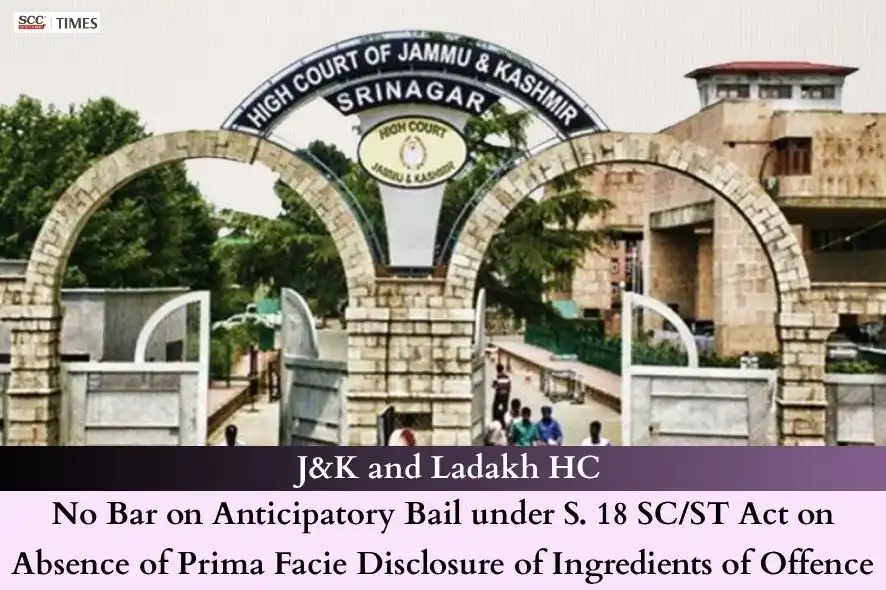
Jammu & Kashmir and Ladakh High Court: In a case seeking anticipatory bail in relation to a caste-based abuse in a public setting, the issue was whether the allegations contained in the FIR prima facie disclosed the essential ingredients of offences under Sections 3(1)(r) and 3(1)(s), Scheduled Castes and Scheduled Tribes (Prevention of Atrocities) Act, 1989 (SC/ST Act) so as to exclude the remedy of pre-arrest bail. A Single Judge Bench of Rajesh Sekhri, J., held that the allegations contained in the FIR did not disclose the necessary ingredients of the alleged offences. Consequently, the statutory bar under Sections 18 and 18-A, SC/ST Act was held to be inapplicable, and the Court allowed the petition, granting anticipatory bail subject to conditions.
Background
On 8 January 2026, during the inauguration of a road, it was alleged that the petitioner, a member of District Development Council, along with her sons, assaulted the complainant and others without provocation, causing injuries and disturbing public order. It was specifically alleged that during the occurrence, a caste-based derogatory slur “chinal” was used publicly, knowing that the complainant belonged to the “Megh” community, a Scheduled Caste category. Based on the complaint, an FIR came to be registered for offences under Sections 126(2), 115(2), 351(2), 352, Nagarik Sanhita, 2023 (BNS) read with Sections 3(1)(r) and 3(1)(s), SC/ST Act.
The investigating agency recorded statements of eyewitnesses, including the Lumbardar and Chowkidar, who confirmed that the term “chinal” was locally understood as a caste-based abusive expression linked to the Megh community. Electronic evidence in the form of videos and photographs was also collected, and caste certificates confirmed the caste status of both the complainant and the accused, being “Megh” and “Jaral” category. The petitioner’s son, who was arrested on 26 January 2026, was released on bail by the trial court but the petitioner’s bail plea was rejected.
The petitioner contended that the internet meaning of the term “chinal” suggested that it was a gender-specific word and referred to the women who were harlots, whereas the complainant was a male, and also in the local language, the term was derived from the word “China” which meant religious symbols and divine weapons and “chinal” was a person who carried and took care of such china. Further, in Doda District, such chinals were worshipped before the commencement of a religious activity. She also submitted that during the event, she was forcibly restrained by the complainant from inaugurating the road and manhandled, after which he had also lodged the complaint with an ill-intent to satisfy political vendetta. It was urged that since the FIR did not disclose a prima facie offence under the SC/ST Act, the statutory bar against anticipatory bail mandated by Sections 18 and 18-A(1), SC/ST Act was not attracted.
On the other hand, the respondents opposed the petition, contending that the utterance of a caste-based slur in public view was supported by witness statements and electronic evidence.
Analysis and Decision
The Court relied on Shajan Skaria v. State of Kerala, 2024 SCC OnLine SC 2249, wherein it was held that the offence under Section 3(1)(r), SC/ST Act cannot stand merely because the complainant belongs to a Scheduled Caste or a Scheduled Tribe, unless there is a clear intention to humiliate the victim on account of caste identity. The Supreme Court highlighted that where it is apparent from the face of the FIR or the complaint that no ingredient prima facie constituting an offence under SC/ST Act is made out, anticipatory bail can be granted. The Court also referred to Keshaw Mahto v. State of Bihar1 wherein the Supreme Court observed that for an offence under Section 3(1)(s), SC/ST Act it is necessary that abuse must be by caste name in public view and the allegations must reveal that such abuses were laced with caste name or caste name itself was hurled as an abuse.
The Court clarified that the threshold for determining the applicability of Sections 18 and 18-A, SC/ST Act is whether the allegations in the FIR or complaint prima facie disclose the essential ingredients of the alleged offence. The Court observed that unless the essential ingredients are not disclosed, the bar contained in the abovementioned sections would not apply and courts could grant pre-arrest bail. The Court opined that courts in exercise of criminal jurisdiction to consider a bail plea cannot embark upon a “mini trial” to resolve factual disputes, and therefore, whether the word “chinal” was caste-based, gender-specific, or a religious symbol could only be decided during a full-dressed trial and could not be gone into in exercise of the Court’s criminal jurisdiction to consider a bail plea.
The Court noted that the petitioner’s counsel had argued that the Constitution (Jammu and Kashmir) Scheduled Castes Order, 1956, published on 31 October 2019 (SC Order of 2019) provided a list of 13 Scheduled Castes, and since “chinal” did not figure in the said list, it could not be termed a caste name, and as such no offence under SC/ST Act was made out. However, the Court observed that the slur was linked to the Megh community which was mentioned in the list of SC Order of 2019 and hence, the petitioner’s argument was misconceived.
The Court observed that an abuse by a person not being a member of a Scheduled Caste or a Scheduled Tribe, directed against a member of such community “by caste name” in any place within public view, is sufficient to constitute an offence within the meaning of Section 3(1)(s), SC/ST Act and it is immaterial whether such abuse consists of a single word or more than one word. The Court opined that the insult must be intentionally targeted at the victim because he belongs to a Scheduled Caste or a Scheduled Tribe rather than just a general abuse in a sudden fight. Therefore, even a single caste-based abuse would be sufficient to make out an offence under SC/ST Act, if it is linked to victim’s caste and intended to humiliate him in public view.
Upon examining the video recordings and an alleged press conference of the petitioner relied upon by the prosecution, the Court noted that although in the video the petitioner was seen assaulting someone, nothing incriminating was discernible which could prima facie establish the utterance of a caste-based slur, and that even the alleged admission in the press conference did not contain any acknowledgment of caste-based abuse. Thus, the Court concluded that the electronic evidence did not support the allegations under Section 3(1)(r) or Section 3(1)(s), SC/ST Act even though the rest of the offences under penal laws might be constituted.
Accordingly, the Court, while allowing the petition, directed that the petitioner, in the event of arrest, be released on bail on furnishing a surety bond in the amount of Rs 25,000 and a bond of personal recognition of the like amount.
[Santosha Devi v. State (UT of J&K), 2026 SCC OnLine J&K 219, decided on 2-4-2026]
Advocates who appeared in this case:
For the Petitioner: M/s J. P. Gandhi and Nipun Gandhi, Advocates.
For the Respondents: Monika Kohli, Sr. AAG.
1. SLP (Crl.) No. 12144 of 2025, decided on 12-1-2026.