Disclaimer: This has been reported after the availability of the order of the Court and not on media reports so as to give an accurate report to our readers.
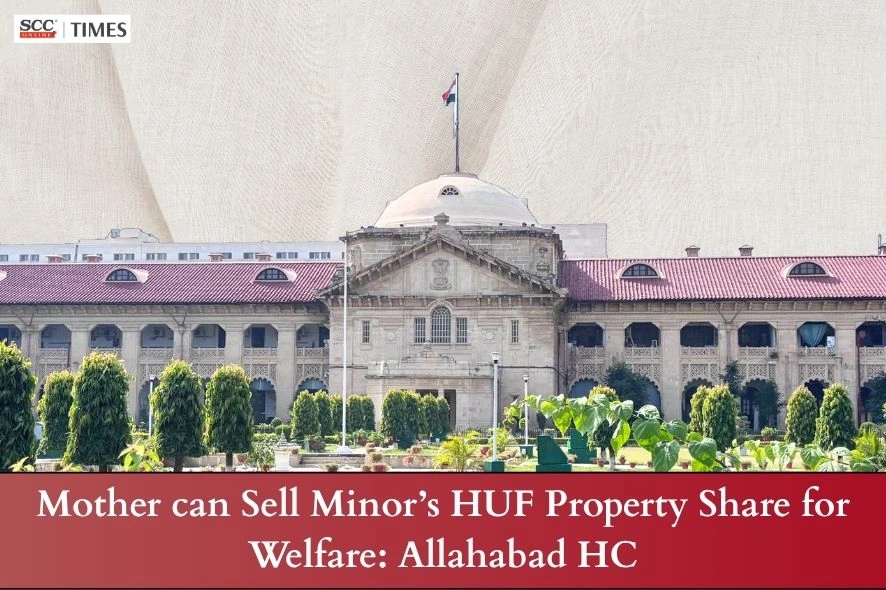
Allahabad High Court: In an appeal filed by a mother who was denied permission to sell her minor daughter’s share in the Hindu Undivided Family (HUF) property for her higher education, the Single Bench of Rohit Ranjan Agarwal, J., allowed the appeal, holding that the appellant being the natural guardian under Section 6, Hindu Minority and Guardianship Act, 1956 (HMGA) can act as a manager of the joint family property and sell the share of the minor girl for her welfare.
Background
The appellant, widow of the deceased and mother of a minor girl, applied before the Court of Additional District and Sessions Judge, Muzaffar Nagar, to declare her as a guardian of her minor daughter and permit her to sell the property of the daughter. The grandmother of the minor girl, the respondent, did not object to either of the prayers. However, the District Court appointed the appellant as guardian, but did not grant permission to sell the land. Hence, the present appeal.
Analysis
At the outset, the Court took a cursory glance at Sections 4, 7, 8, 10, and 29, Guardians and Wards Act, 1890 (1890 Act), as well as Sections 2, 6, 8, and 12 HGMA. Upon reading these provisions, the Court stated that evidently the 1890 Act does not define “natural guardian”, rather it only defines “guardian”, which is a person taking care of the minor or his/her property or both.
The Court noted that under the 1890 Act, the application for the appointment of a guardian was to be filed under Section 8, read with Section 10, and the Court, upon being satisfied, would pass an order appointing a guardian of a minor or property or of both. Section 29 limited the power of an appointed guardian regarding the property of a ward as far as mortgage, charge, transfer by sale, gift, exchange, or otherwise was concerned, and the guardian could only proceed after the permission of the Court. Thereafter, the HMGA was enacted, which has a slight departure from the 1890 Act as it places a guardian under different headings, such as a natural guardian, a guardian appointed by will, a guardian appointed or declared by a court, and a person empowered to act as a guardian by or under any enactment. Simultaneously, the legislature also defined a natural guardian of a Hindu minor, i.e. in case of a boy or an unmarried girl, the natural guardian is the father and after him, the mother.
The Court further noted that Section 8(2) curtails certain powers of a natural guardian and provides that, without prior permission of the Court, no mortgage or charge can be created or property be transferred by sale, gift, exchange, or otherwise. Similarly, the lease of any part of property for a term exceeding five years or for a term exceeding more than a year beyond the date on which the minor will attain majority can only be done with prior permission of the Court. This provision is pari materia to Section 29 of the 1890 Act.
The Court added that sub-section (3) further states that any disposal of immovable property by a natural guardian, in contravention of sub-sections (1) and (2), is voidable at the instance of the minor or any person claiming under him. Furthermore, Section 8(5) provides that provisions of the 1890 Act shall apply on an application filed under sub-section (2) as far as permission of the Court is concerned. The Court also reiterated the harmonious interpretation required for both statutes while dealing with applications moved under either of them.
The Court noted that the appellant had filed the application under Section 8, read with Section 10 of the 1890 Act, seeking permission to sell the 1/4th share of HUF property for the minor’s higher education, who recently appeared in Class XII examination and wanted to pursue her career further.
Noting that the application was moved by the mother of a Hindu minor after the death of her husband, being a natural guardian, the Court stated that, considering Section 6, the case has to be considered under both acts as they are beneficial legislations enacted to protect the interest of a minor and his property.
Regarding Section 12 HMGA, which provides that a guardian shall not be appointed for minor’s undivided interest in HUF property as it is under the management of an adult family member, the Court noted that in the present case, the father of the minor died, and the mother, who is the adult member, was acting as a manager of joint family property. She was also the natural guardian as per Section 6 HMGA.
The Court noted that while an appointed guardian had to take prior permission from the Court to deal with the minor’s property, in the present case, the Hindu minor’s property was an interest in the HUF property protected by the management of an adult family member, i.e. her mother. Thus, the Court held that the present case would not fall within the parameters of Section 29 of the 1890 Act or Section 8(2) HMGA; rather, as per the property’s description, it would be covered within the ambit of Section 12 HMGA.
In this regard, the Court referred to Pooja v. State of Maharashtra, 2025 SCC OnLine Bom 388, wherein, while relying upon various judgments of the Supreme Court, the Bombay High Court held that the restriction imposed by Section 8 cannot be applied to fluctuating interests of minors in an undivided share in HUF property.
The Court explained that Sections 8 and 12 HMGA cannot be read in isolation. More so, if an application has been made under the 1890 Act regarding a Hindu minor, provisions of HMGA have to be considered during the appointment of a guardian, as Sections 2 and 8(5) clearly spell out that the 1890 Act is supplemental to HMGA.
Thus, the Court held that the appellant, being the natural guardian under Section 6 HMGA, can act as a manager of the joint family property and sell the share of the minor girl for her welfare.
Accordingly, the Court set aside the District Court’s judgment as being unsustainable in the eye of the law.
[Doli v. Shakuntla Devi, 2026 SCC OnLine All 1156, decided on 23-3-2026]
Advocates who appeared in this case:
For the petitioner: Karuna Srivastava, Parth Goswami, Sanjay Goswami, Santosh Kumar Srivastava
For the respondent: Rati Bhan Singh