
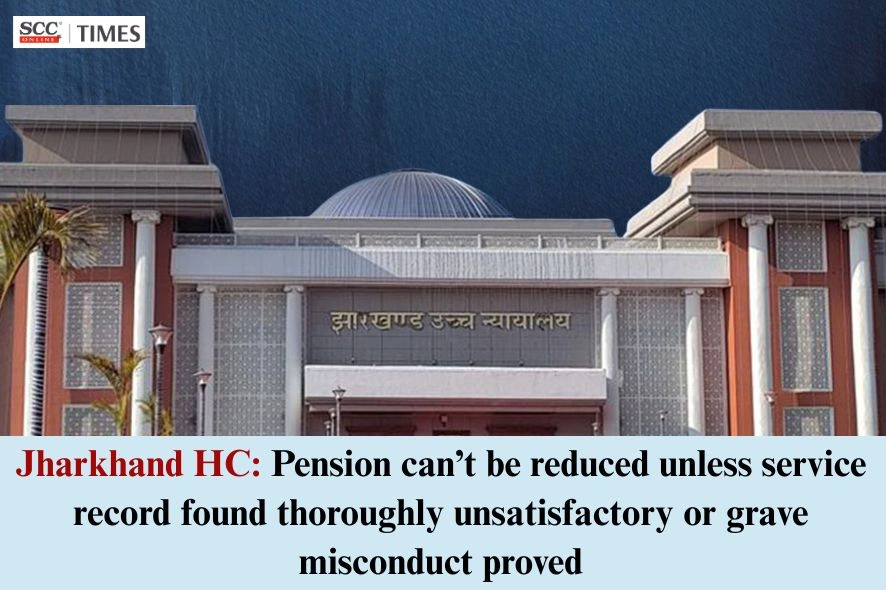
Jharkhand High Court: In a letters patent appeal challenging the quashing of a punishment order deducting 15 per cent pension for five years, the Division Bench of M.S. Sonak, C.J., and Rajesh Shankar*, J., held that the deduction was unsustainable since the mandatory requirements under Rules 43(b) and 139(c), Jharkhand Pension Rules, 2000 (Pension Rules) were not satisfied. The Court emphasised that mere allegation of irregularity cannot justify reduction of pension, and that grave misconduct must be proved in a properly instituted departmental or judicial proceeding.
Background
The respondent joined service as a Junior Engineer in 1979 and was later allocated to the Water Resources Department of Jharkhand. Complaints were lodged alleging financial irregularities in Micro Lift Irrigation Schemes during 2003-2004. Departmental enquiries revealed that expenditure failed to achieve expected results.
In 2015, a show-cause notice was issued, to which the respondent replied, and he retired in 2016. A second show-cause notice under Rule 139 was issued in 2017, followed by an order imposing a 15 per cent pension deduction for five years. The respondent challenged this order, however the Single Judge quashed it.
The appellants argued that a departmental proceeding had been initiated under Rule 55, Civil Services (Classification Control and Appeal) Rules, 1930 before retirement, and that the punishment was justified based on financial embezzlement. They contended that the service was not thoroughly satisfactory.
The respondent submitted that no proper departmental proceeding was initiated, no charge-sheet was served, and the punishment was imposed mechanically without proving grave misconduct.
Analysis and Decision
The Court emphasised that Rule 43(b), Pension Rules empowers the State Government to withhold or withdraw pension or any part of it when the pensioner is found to be guilty of grave misconduct either in a departmental proceeding or a judicial proceeding. The Court also highlighted that the State Government has the right to recover from the pension of the pensioner concerned the whole or part of any pecuniary loss caused to the Government, if such loss is caused to the Government by misconduct or negligence during his service tenure, including the service rendered by him on re-employment after retirement. Further, it was observed that Rule 139(c), Pension Rules empowers the State Government to revise an order relating to pension passed by the subordinate authorities under their control, if they are satisfied that the ser]vice of the pensioner was not thoroughly satisfactory or that there was proof of grave misconduct on his part while in service.
However, the Court noted that before exercising such power, the pensioner should be given a reasonable opportunity of showing cause against the action proposed to be taken with regard to his pension, and a period of limitation for exercising such power is fixed as three years from the date of the order sanctioning the pension. The Court observed that under the two conditions the State Government is empowered to reduce the pension of a pensioner: (i) if the service of the pensioner was not thoroughly satisfactory, or (ii) if there is proof of grave misconduct on his part while in service.
The Court highlighted that the term “thoroughly satisfactory” under the first condition makes it mandatory that before passing the order of deduction of pension of a pensioner, the State Government should take into consideration the entire service record of the pensioner and not a particular instance of committing irregularity. The Court emphasised that, so far as the order of deduction of pension on the ground of grave misconduct is concerned, the State Government has to satisfy itself that in a departmental or judicial proceeding it has been proved that the pensioner is guilty of grave misconduct.
The Court further noted that it is evident from the record that for the allegation of irregularities committed, neither a full-fledged departmental proceeding was initiated by issuing a memo of charge to him nor any criminal proceeding was set in motion. Moreover, neither proper inquiry for the alleged irregularities was conducted by appointing an inquiry officer nor was due opportunity of hearing given to him in a full-fledged enquiry proceeding.
The Court remarked that mere allegation of irregularities is not sufficient to exercise the power under Rule 139(c), Pension Rules, rather, the same has to be proved in a departmental proceeding or criminal proceeding by giving due opportunity of hearing to the person concerned, since it is a settled principle of law that when a statute or law prescribes a specific procedure for an action, that procedure must be followed strictly, rendering other methods invalid.
The Court further noted that it has specifically been provided under Rule 43(b), Pension Rules that the order of withholding or withdrawing pension of a pensioner has to be passed by an authority in accordance with the procedure applicable to proceedings on which an order of dismissal from service may be made, and the same condition is also applicable for deduction of pension in exercise of power conferred under Rule 139(c), Pension Rules.
Finally, the Court concluded that the condition precedent for exercising power under Rule 139(c), Pension Rules was not fulfilled. Accordingly, it was held that the order of deduction of pension was rightly quashed by the Single Judge, and the appeal was dismissed along with all pending applications.
[State of Jharkhand v. Brajeshwar Singh, 2026 SCC OnLine Jhar 412, decided on 19-3-2026]
*Judgment authored by: Justice Rajesh Shankar
Advocates who appeared in this case:
For the Appellants: Anish Kr. Mishra
For the Respondent: Manoj Prasad, Jyoti Kumari