
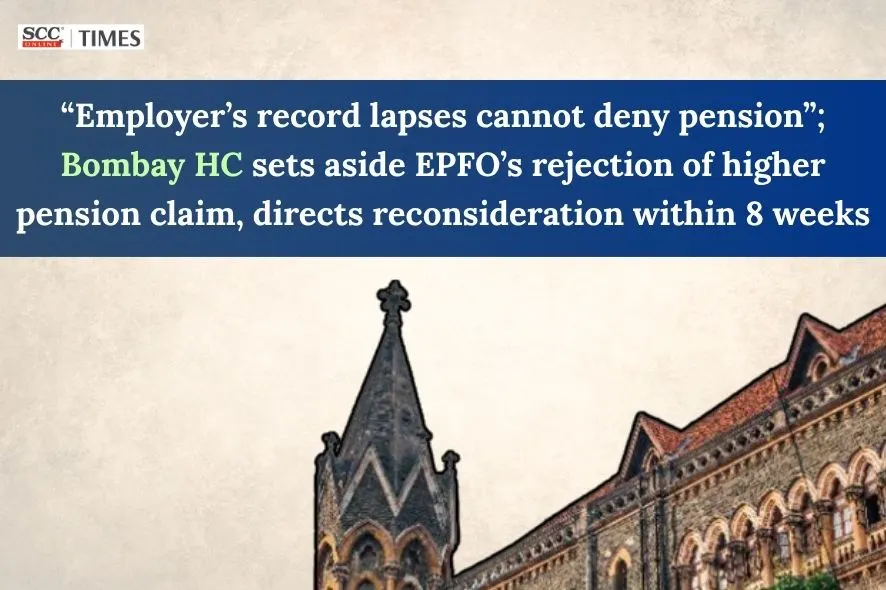
Bombay High Court: In a writ petition under Article 226 of the Constitution challenging the rejection of an application for pension on higher wages, a Single Judge Bench of Amit Borkar, J., held that the denial was unjustified since it was based only on non-production of employer-side records like Form 6A and challans. The Court emphasised that these statutory records are within the custody of the employer and cannot be expected from the employee, who had already furnished Form 3A, Employees Provident Fund (EPF) account statements, and the joint option form. Observing that technical deficiencies on the part of the employer should not defeat a legitimate claim, the Court set aside the impugned order and directed the Employees’ Provident Fund Organisation (EPFO) to reconsider the application within 8 weeks.
Background
The petitioner had served for nearly 37 years as a permanent employee, contributing regularly to the provident fund. He exercised his option under the Employees’ Pension Scheme, 1995 (Scheme), and later submitted an online application seeking pension on higher wages.
The grievance arose when the EPFO rejected his application citing absence of Form 6A and monthly challans, which were required for verification of contributions. The petitioner contended that the statutory obligation to maintain and produce such records lay with the employer, and that he had already submitted Form 3A, EPF account statements, and the joint option form. He argued that denial of pension on grounds beyond his control infringed his right to livelihood and dignity.
The employer admitted that Form 3A and wage details had been furnished but explained that certain records were unavailable due to transition to online systems. However, the EPFO maintained that without Form 6A and challans, verification was impossible.
Analysis and Decision
The Court emphasised that Form 6A is a statutory record which is required to be maintained and submitted by the employer since it remains within the control and custody of the establishment. The Court highlighted that an employee has neither access to such record in the ordinary course nor any authority to maintain or preserve it. Thus, expecting the petitioner to produce such a document is not in consonance with the scheme of the statute.
The Court further noted that Form 3A contains year-wise contribution details as it reflects wages and contributions, whereas Form 6A is largely a consolidated version prepared by the employer for submission. Therefore, when Form 3A and account statements are available, the essential data is already on record.
The Court observed that records could not be produced due to the transition to the online system, and this position shows that the deficiency is not because the petitioner failed to act, but because the employer did not have complete records in one place. The Court also noted that the petitioner had filed additional supporting material along with his application, which included the certified joint option form and EPF account details. The Court further highlighted that these documents are not insignificant as they are part of the official record system itself, reflecting that the petitioner was a contributing member by showing continuity of employment and deduction.
The Court also emphasised that the burden cannot be placed upon the employee since the employee’s role is limited as he works, earns wages, and contribution is deducted, not maintaining statutory returns. The Court observed that the responsibility lies with the employer, and if the employer has failed in maintaining records or producing them, then the consequence cannot be shifted upon the employee. The Court noted that it would result in denial of benefit to a person who has no control over such records, and such an approach would be unjust since pension is not a matter of favour, but a benefit earned through long years of service.
Similarly, the Court observed that the issue regarding non-availability of challans cannot be treated as decisive, since in a long service career it is not unusual that some records are not readily traceable, and that by itself cannot result in denial of pension. The Court emphasised that if there was any doubt, the authority could have called for clarification or directed the employer to reconcile records, or it could have also taken steps to verify from its own system. However, the rejection shows that the authority has not exercised its power in a fair manner.
The Court noted that technical deficiencies on the part of the employer or record-keeping authority should not defeat a legitimate claim of an employee, as pension schemes are welfare measures intended to provide financial support after retirement. Therefore, they must be applied in a manner that advances the object and not defeats it. The Court also remarked that a person who has worked for several decades and contributed regularly cannot be denied benefit because of gaps in official records.
The Court held that the impugned order dated 28 March 2025 was unsustainable and directed the EPFO to reconsider the claim on the basis of all available records, including Form 3A, EPF account statements, the joint option application, and the employer’s clarification. The Court further ordered that the claim should not be rejected solely on the ground of non-production of Form 6A or challans.
Finally, the Court allowed the petition by directing that the exercise was to be completed within 8 weeks, with consequential benefits to follow if entitlement was established.
[Kiran Rajaram Jadhav v. EPFO, Writ Petition No. 632 of 2026, decided on 26-3-2026]
Advocates who appeared in this case :
For the Petitioner: Satyam Surana
For the Respondents: Payoja Gandhi, N.R. Patankar with Prabhakar M. Jadhav i/b Tanaya Patankar