
Disclaimer: This has been reported after the availability of the order of the Court and not on media reports so as to give an accurate report to our readers.
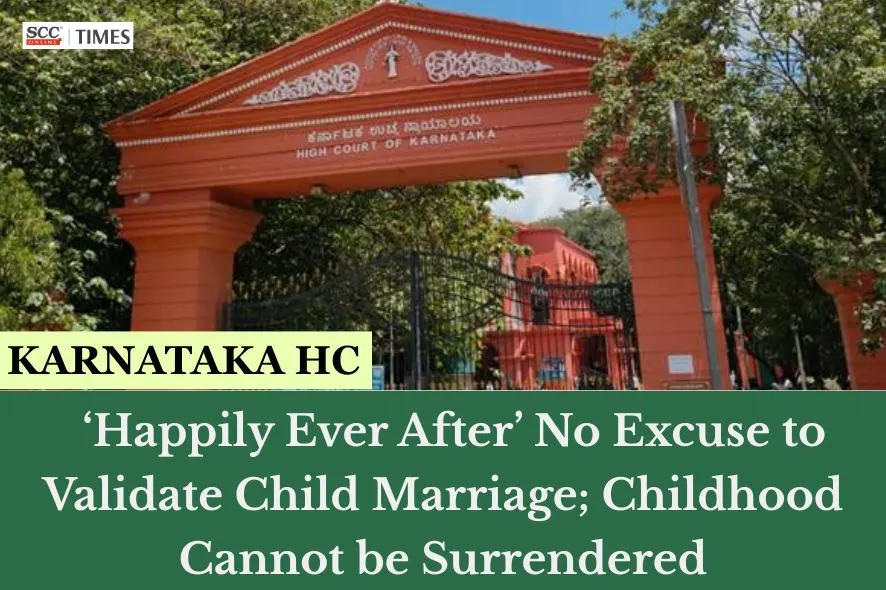
Karnataka High Court: In a criminal petition filed under Section 528, Nagarik Suraksha Sanhita, 2023 (BNSS) assailing the proceedings relating to offences punishable under Sections 9, 10 and 11, Prohibition of Child Marriage Act, 2006 (PCMA), the Single Judge Bench of M. Nagaprasanna, J., held that the submission that the couple was living in harmony, does not efface the illegality committed at the time of solemnisation; Court cannot extend a protective arm towards those involved in child marriage, whether they are contracting parties or someone indirectly involved like the priest of temple or management of the venue where the child marriage took place.
Background
The present matter arose from a suo motu complaint by the State through the Child Development Project Officer. Investigation revealed that Petitioner 1 had performed a marriage with a minor, who was daughter of Petitioners 4 and 5. The charge-sheet was filed and the Court concerned took cognizance of the offence and registered a criminal case against the petitioners.
During the pendency of the proceedings, the petitioner preferred this petition assailing the said criminal proceedings and sought quashing. The petitioners admitted solemnisation of marriage with a minor and pleaded quashing on grounds that they were ignorant of the law and that the parties were living happily now.
Issue
Whether proceedings should be permitted to be obliterated, on the score that the accused were ignorant of law and the accused and the minor are living happily.
Analysis and Decision
At the outset, the Court noted that the petitioners did not dispute the fact that the marriage of the minor girl took place. The Court stated that under Sections 2B and 2F, a child marriage is a marriage wherein either of the persons is a minor as per the Majority Act, 1875. The Court stated that in the present case, it stands admitted that the girl was a minor at the time of marriage, and the statutory definition leaves no room for interpretative elasticity; therefore, the present marriage was a child marriage.
The Court, on these admitted facts, answered the issue related to quashing of proceedings with “an unequivocal and an emphatic” negative. The Court stated that the offence that is alleged is the one punishable under Sections 9, 10 and 11 of the Act, that form the statutory bulwark against the solemnisation and perpetuation of child marriage. The Court stated that they are not merely penal provisions, they are legislative declarations that childhood shall not be prematurely surrendered at the altar of matrimony. The Court noted that Section 9 does not condition culpability upon intention beyond the knowledge of age, and imposes strict responsibility on an adult male who marries a child.
The Court noted that Section 10 widens the net of culpability, and does not confine responsibility to the contracting adult, but makes everyone equally liable, i.e., whoever performs, conducts, directs or abets a child marriage, within the sweep of this provision. The Court stated that the only statutory escape is a demonstrable and reasonable belief that the marriage was not a child marriage, a defence which will have to be established by evidence and not presumed by sympathy, as attempted in the present case.
The Court noted that Section 11 is the vigilant sentinel of the statute, that penalises those who promote, permit or negligently fail to prevent the solemnisation of child marriage; the reach of this provision is intentionally expansive and operates as a “catch-all” safeguard. The Court stated that the provision recognises that child marriage is seldom the act of a single individual, it is often enabled by collective participation. The Court noted that Section 11(2) imposes a reverse burden on the persons having charge of the child, in case of contraction of child marriage, by introducing a legal presumption that they have negligently failed to prevent the marriage. The Court relied on the judgment of Society for Enlightenment and Voluntary Action v. Union of India, 2024 SCC OnLine SC 2922, wherein the Supreme Court held that any person involved in the said marriage, who does not stop the conduct of such marriage, will become open to prosecution under Section 11 PCMA.
“What is presented as a familial consent, is in truth a surrender of childhood.”
The Court held that the collective reading of these provisions of PCMA reflects the legislative intent which takes out the child marriage from private sphere of the familial engagement and put it out in social sphere as a wrong against the society by and large, and demands accountability at every level of participation. The Court held that PCMA is more than a punitive measure, rather a declaration of rights of children, which outweigh the convenience of customs.
The Court referred the judgment of Kerala High Court in Moidutty Musliyar v. Sub Inspector, 2024 SCC OnLine Ker 4188, on identical facts, wherein the Court held that child marriage denies the child its absolute rights including the right to education, health and protection from exploitation, and exposes the young girl to several other problems. The Court agreeing with the Kerala High Court’s decision to refuse quashing of proceedings even on the submission of the religion permitting such marriage, held that the petitioners must face trial for the offences under the provisions of PCMA. The Court held that ignorance of law is no excuse and the defence could not be considered under Section 528 BNSS.
“The formative years for learning, self-discovery and intellectual blossoming are permanently burdened with adult responsibilities.”
The Court commented on the increasing influx of stream of litigation arising either under the provisions of the Protection of Children from Sexual Offences Act, 2012, or under PCMA. The Court noted the disturbing pattern that emerged from these cases, i.e., parents of both sides, acting in concert and often under the mistaken cloak of social propriety, solemnise marriages of girls before they attain the age of 18 years. The Court stated that the Supreme Court poignantly looked at child marriage from the perspective of denial of basic human rights, that “curtails education, imperils health and exposes child to exploitation — emotional, social and economic”.
“A girl married before 18 does not merely enter matrimony, she exits opportunity. The promise of education fades into abstraction. The dream of academic or professional advancement remains precisely that, a dream.”
The Court stated that the submission that the couple was living in harmony, does not efface the illegality committed at the time of solemnisation. The Court held that the criminal liability is measured at the moment of commission, not neutralised by the subsequent domestic peace; to accept otherwise would be to convert penal law into a matter of retrospective validation through sentiment. The Court held that if such conduct were to receive judicial approval, the eradication of child marriage would remain an elusive aspiration, and therefore, no protection could be provided to those who are involved in child marriage.
The Court stated that the responsibility does not rest solely on contracting parties; rather, where a marriage was solemnised in a temple, the management of a temple and the officiating priest who performed the ceremony may fall within the sweep of liability under PCMA, and even where the marriage is conducted in a marriage hall, or other venue, its management and facilitators cannot escape liabilities.
Hence, the petition was rejected for having no merit.
[Manjunatha N. v. State of Karnataka, Criminal Petition No. 1605 of 2026, decided on 10-3-2026]
Advocates who appeared in this case:
For the petitioners: U. Sadakath, Advocate
For the respondent: B. N. Jagadeesha, Additional SPP
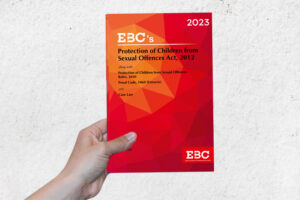
Buy Protection of Children from Sexual Offences Act, 2012 HERE