
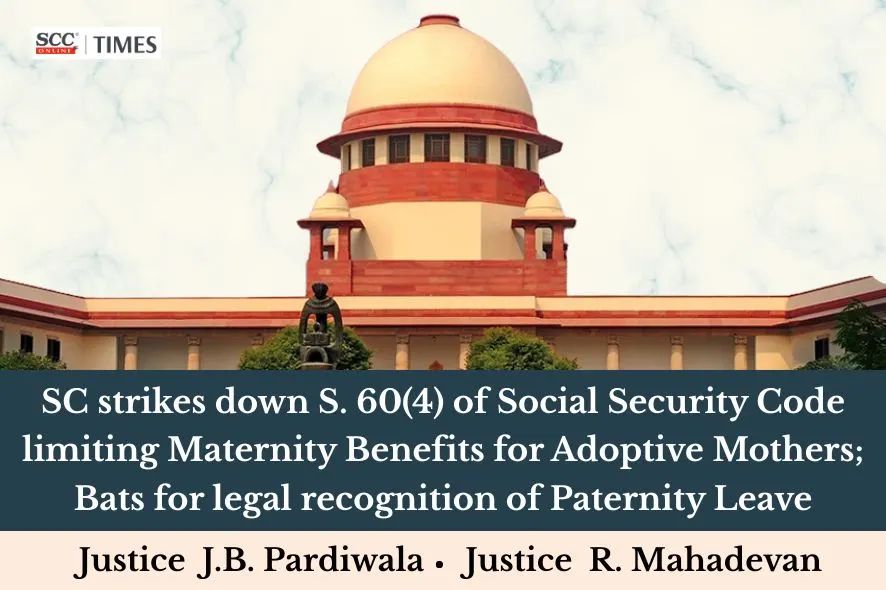
Supreme Court: In a significant verdict firmly affirming adoptive mothers’ entitlement to receive maternity benefits, the Division Bench of J.B. Pardiwala* and R. Mahadevan, JJ., held that Section 60(4), Social Security Code, 2020 (2020 Code) insofar it puts 3 months age limit on the age of the adoptive child, for adoptive mothers to avail maternity benefit under the 2020 Code is violative of Articles 14, and 21 of the Constitution.
While deliberating over the constitutional validity of Section 60(4) of the 2020 Code, the Court explained that distinction drawn by Section 60(4) does not have a rational nexus with the object of the 2020 Code. The object of maternity benefit is not associated with the process of childbirth but with the process of motherhood. The purpose of maternity protection does not vary with the manner in which the child is brought into the life of the beneficiary mother.
Acknowledging the importance of fathers in a child’s upbringing, the Court urged the government to come up with a provision recognizing paternity leave as a social security benefit.
Background: Statutory Framework and Facts
Erstwhile Section 5(4) of Maternity Benefit Act, 1961 (1961 Act) entitled mothers who legally adopt a child below the age of 3 months the maternity benefit for a period of 12 weeks from the date on which the child is handed over to the adoptive mother. In 2020, the legislature enacted the Social Security Code, 2020 which amended and consolidated all the laws relating to social security including that of the Act, 1961. Section 60(4) of the 2020 Code is pari materia to Section 5(4) of the Act, 1961.
The petitioner, an adoptive mother of two children, filed this writ petition contending that the impugned provision is violative of Articles 14, 19(1)(g) and 21 of the Constitution.
Issues for Consideration
-
Whether the age limit of 3 months stipulated under Section 60(4), 2020 Code, could be said to be in violation of the Article 14 of the Constitution being discriminatory towards women who adopt a child aged three months or above?
-
Whether the age limit of 3 months stipulated under Section 60(4), 2020 Code, could be said to be in violation of the right to reproductive autonomy of an adoptive mother and the right of the adopted child to holistic care and development under Article 21 of the Constitution?
Court’s Assessment
Perusing the matter, the Court firstly explained that how maternity protection has been established as a basic human right. The Court stated that protection of maternity leave is a basic human right, as it recognizes conditions that are necessary for the full development of human personality and realization of equality. It embodies an essential component required to promote equality at workplace and safeguards maternal and child health. “The concept of maternity benefit acknowledges the ability of a woman to exercise her reproductive choices without fear of losing her employment, more particularly, the economic security. Thus, it ensures that motherhood does not become a factor for exclusion at workplace”. Right of maternity protection recognizes the biological as well as caregiving realities associated with motherhood and seeks to correct structural inequalities that women face in employment. It represents the State’s commitment to uphold human dignity, equal treatment at work, and broader ideals of social justice.
Touching upon the statutory framework and relevant case laws, the Court observed that the commonly drawn distinction between a mother who begets a child through surrogacy or adoption and a mother who naturally gives birth to a child, perceives motherhood through the narrow lens of biology and fails to take into account the bond that develops between a mother and her child outside the womb, which is as crucial and intimate, as the bond that is formed inside the womb. Furthermore, this distinction makes motherhood contingent upon biological requirements and is a direct affront to the desire and intention of a woman to experience motherhood and bring up a child.
“We have no hesitation in saying that an adoptive mother like the petitioner would have the same rights and obligations towards the child as the natural mother”.
Acknowledging the distinction created by the legislature biological mothers and adoptive mothers, the Court elaborated the 3 components comprising maternity leave – (a) time necessary for physical recovery following the birth of a child; (b) time required to nurture and develop the emotional bond between the mother and the child; and (c) time necessary to attend to the physical and emotional needs of the child and to facilitate the process by which the child gradually integrates into the family.
In case of adoption or surrogacy, while the first component is absent, the second and third component are present and significant. The legislative recognition of maternity leave for adoptive and commissioning mothers under Section 60(4) is itself an acknowledgment of the importance of these components.
Thereafter, testing the constitutional validity of the impugned provision, the Court emphasised that the distinction created by Section 60(4) between a woman legally adopting a child below the age of three months and those who adopt a child aged three months or above must have a rational nexus with the intention and object of the 2020 Code. The Court pointed out that the need for economic security, institutional support, and protection of dignity does not diminish merely on account of the age of the child at the time of adoption. The necessity of nurturing, care, and family integration remains equally relevant and pressing irrespective of whether the adopted child is below or above the age of three months.
Considering the object of the 2020 Code, women who adopt a child aged three months or above are similarly situated to women who adopt a child below the age of three months, insofar as their roles, responsibilities, and caregiving obligations are concerned. The essential attributes, capacities, and commitments of adoptive mothers do not undergo any material change merely on account of the age of the child at the time of adoption and the immediate period following the adoption.
Hence, the Court opined that distinction drawn by Section 60(4), does not have a rational nexus with the underlying beneficial object of the statute. It was stated that an age limit fails to account for the diverse realities of adoption. The needs of children and adoptive families are neither uniform nor reducible to an understanding of adoption in a typical familial structure.
“A provision that fails to accommodate these realities undermines the objective of the legislation and is prone to constitutional attacks”.
The Court also highlighted that confining the benefit of maternity leave where a child is adopted at a prescribed age would operate to the detriment of children with disabilities. Furthermore, in the absence of adequate maternity benefit, a single adoptive mother may be compelled to choose between her employment and the immediate needs of the adopted child.
While women adopting children younger than three months are entitled to maternity benefit for a period of 12 weeks, women adopting children even a day older than three months are not entitled to maternity benefit to any extent. This approach adopted by the legislature while enacting the impugned provision does not reflect the real-world requirement of care and nurturing, which does not come to a sudden halt upon the attainment of a certain mathematical number, but gradually tapers with the proper integration of the child with the new environment, especially the parents.
The Court thus held that Section 60(4), to the extent that it prescribes an age limit of three months, is discriminatory because-
(a) it does not disclose a reasonable distinction between women who adopt a child below the age of three months and those who adopt a child aged three months or above;
(b) the particular differentiation, which is sought to be made, has no nexus with the object sought to be achieved
(c) the classification suffers from under-inclusiveness.
The impugned provision in effect operates unequally upon adoptive mothers who are similarly situated, resulting in discrimination without reasonable justification, thereby violating Article 14 of the Constitution.
Delving into testing the impugned provision on the touchstone of Article 21 of the Constitution, the Court pointed out that the right of reproductive autonomy is not confined to the biological act of giving birth. Adoption is an equal exercise of the right to reproductive and decisional autonomy under Article 21 of the Constitution.
The Court further highlighted that in matters affecting a child, paramount consideration must be given to best interests of the child. This consideration does not conclude with the completion of the formalities of adoption or the handing over of the custody, rather it continues throughout the period the child remains a child, more particularly, the period during which the child integrates into the adoptive family. The true fulfilment of the child’s welfare lies in enabling the child to meaningfully adjust, bond, and flourish within the family environment.
Finally, the Court pointed out that impugned provision the provision is incapable of practical implementation, as it cannot fully achieve the purpose for which it has been enacted. With regard to the time required to declare a child legally free for adoption, by the time such declaration is made, the child is unlikely to be of less than three months old. Thus, the age limit renders the provision illusory and devoid of practical application.
Highlighting the importance and need for paternity leave, the Court stated that society has historically attributed caregiving and nurturing responsibilities almost exclusively to mothers. While the role of a mother is undeniably central to a child’s emotional, physical, and psychological development, it would be incomplete and unjust to overlook the equally significant role of a father. The Court pointed out that presence of both parents during the early development of a child is indispensable. “What a father offers to a child in those nascent days cannot be scheduled for a convenient time or compensated for later”. Proximity is not identical to presence. It is not unknown that fathers have traditionally been perceived as providers, with their responsibilities revolving around financial stability. Consequently, as financial care does not resemble the visible, everyday nurturing, it has often been undervalued as a basis for recognizing the need for leave.
The Court also pointed out that absence of paternity leave produces two consequences– it reinforces gendered roles in parenting; secondly even where a father is willing and desirous of contributing, he is left without a meaningful opportunity to do so. Therefore, a provision for paternity leave serves an important purpose by enabling fathers to participate meaningfully in the early stages of a child’s life and development. It helps in dismantling gendered roles, encourages fathers to take an active role in childcare, fosters a balanced understanding of parenting, and promotes gender equality within family and workplace.
The Court pointed out that at present, Sections 43-A and 43-AA of the CCS (Leave) Rules, respectively, grant a male government servant 15 days of paternity leave for the birth of the child or for adoption. This provision reflects that the concept of paternity leave is not alien, but less recognized.
Therefore, the Court urged the Centre to come up with a provision recognizing paternity leave as a social security benefit. The Court emphasised that the duration of such leave must be determined in a manner that is responsive to the needs of both the parent and the child.
[Hamsaanandini Nanduri v. Union of India, 2026 SCC OnLine SC 402, decided on 17-3-2026]
*Judgement by Justice J.B. Pardiwala
Advocates who appeared in this case :
For Petitioner(s): Ms. Bani Dikshit, Adv. Mr. Mukesh Kumar Singh, Adv. Mr. Kishan Kumar, Adv. Mr. Uddhav Khanna, Adv. Mr. Dhruva Vig, Adv. Mr. Narendra Kumar Goyal, Adv. Mr. Santanu Jugtawat, Adv. Mr. Kadam Hans, Adv. Mr. Komal Singh, Adv. Mr. Subodh, Adv. Mr. Ikshit Singhal, Adv. Mr. Harsh Chaturvedi, Adv. For M/s.Mukesh Kumar Singh And Co., AOR
For Respondent(s): Mr. K.M. Nataraj, A.S.G. (Not present) Mr. Shailesh Madiyal, Adv. (Not present) Mr. Sandeep Kumar Mahapatra, Adv. Mr. Vatsal Joshi, Adv. Mr. Praneet Pranav, Adv. Mr. Amrish Kumar, AOR