
Disclaimer: This has been reported after the availability of the order of the Court and not on media reports so as to give an accurate report to our readers.
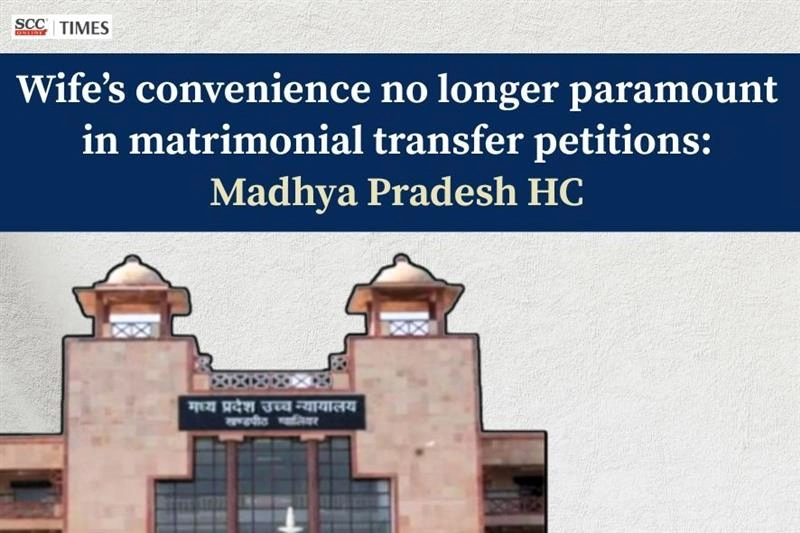
Madhya Pradesh High Court: In a matrimonial transfer petition filed by a wife seeking transfer of case filed before Family Court of her husband’s jurisdiction, the Single Judge Bench of Deepak Khot, J., dismissed the petition, holding that the convenience of wife/lady was no longer the paramount consideration for deciding the transfer applications and alternatives to transfer proceedings have been provided, like through video conferencing.
Background
The parties got married in 2024, but soon after, a matrimonial dispute arose between them, which led to the husband filing an application under Section 9, Hindu Marriage Act, 1955 (HMA) before the Family Court, Narsinghpur. The wife, a resident of Harda, also filed a maintenance application under Section 125, Criminal Procedure Code, 1973(CrPC), before the Family Court of Harda.
The wife filed the present petition under Section 24, Civil Procedure Code, 1908 (CPC), seeking transfer of the case filed before the Family Court, Narsinghpur, to the competent court in Harda. She contended that she was subjected to cruelty and assault in the matrimonial home, due to which she filed two FIRs. She also contended that she faced difficulty in travelling to Narsinghpur to attend the proceedings due to continuous threats and fear. Furthermore, she did not have any income and would have to travel 300 km alone.
Analysis
At the outset, the Court referred to Anindita Das v. Srijit Das, (2006) 9 SCC 197, wherein the Supreme Court held that at one stage the Court was showing leniency to ladies, but since then it has been found that a large number of transfer petitions are filed by women taking advantage of the leniency shown by this Court. Similarly, in Sujata v. Abhishek Kulhade, 2019 SCC OnLine MP 6795, it was reiterated that convenience and the distance alone are not the criteria for showing leniency in favour of the applicant wife. The Court also referred to several other cases where the Court refused transfer of the case after their plea for travel and lodging expenses was agreed to be borne by the husbands.
Considering such precedents, the Court stated that it was clear that now the convenience of the wife/lady is not the paramount consideration for deciding the transfer applications and alternatives to transfer proceedings have been provided, like through video conferencing. If the matter is to be proved by the witnesses of the place where the matter is being prosecuted, then the other side can be suitably adjusted by making payment of commute.
On the merits, noting that since both FIRs and Section 9 applications had been filed in Narsinghpur, the Court held that the wife shall appear before the Family Court, Narsinghpur, via video conferencing. The Court directed that she shall attend the said Court for her examination on the date fixed by the Court below, for which the expenses would be borne by the husband.
The Court further directed that the Family Court, Narsinghpur, fix the date for examination of the wife and, accordingly, direct the husband to make payment of the expenses of travel, lodging, and boarding. For further dates and adjudication, the wife was at liberty to appear before the Family Court through video conferencing, along with a counsel who shall appear in person.
[Ekta Vaish v. Deepak Kuchbandiya, 2026 SCC OnLine MP 1352, decided on 18-2-2026]
Advocates who appeared in this case:
For the applicant: Samar Singh Rajpu
Buy Code of Criminal Procedure, 1973 HERE