
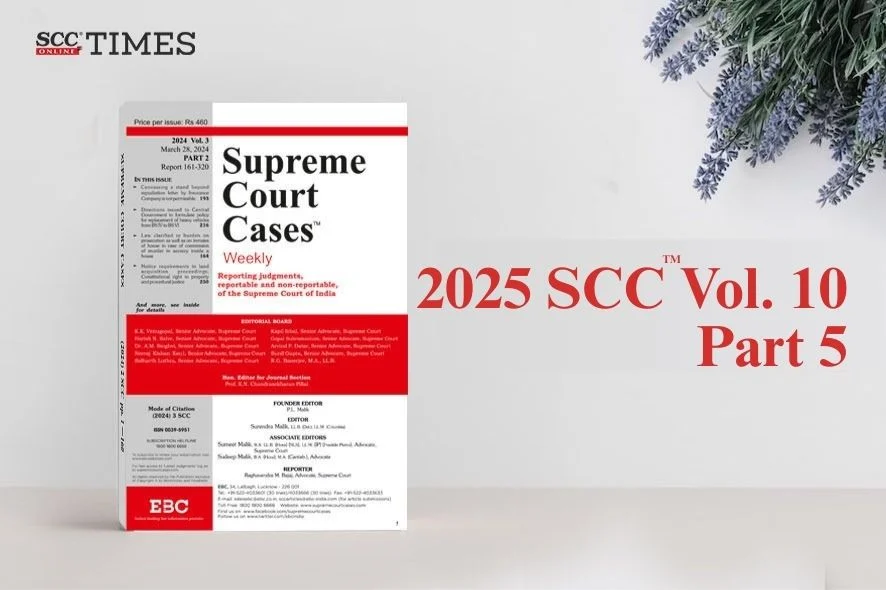
This volume of the Supreme Court Cases (SCC), Part 5 of Volume 10, embodies landmark cases decided by the Supreme Court on role and duties of Advocates-on-Record, assessable value of imported goods, role of lawyers as mediators, and more.
Advocates — Advocates-on-Record — Role and duties: Role and duties of Advocates-on-Record, explained. Emphasised that an Advocates-on-Record cannot merely lend their names to petition/appeals filed by other advocates since that would result in frustrating very purpose for setting up institution of Advocate-on-Record, [Jitender v. State (NCT of Delhi), (2025) 10 SCC 705]
Advocates Act, 1961 — S. 16(2) — Regime/System of designation of Senior Advocates: Guidelines/Norms regarding regime/system of designation of Senior Advocates laid down by Supreme Court in Indira Jaising (1), (2017) 9 SCC 766 and Indira Jaising (2), (2023) 8 SCC 1, modified and directions issued accordingly, [Jitender v. State (NCT of Delhi), (2025) 10 SCC 651]
Arbitration and Conciliation Act, 1996 — Ss. 29(4) and (5) — Application for extension of time period for passing an arbitral award after expiry of twelve-month or extended six-month period — Maintainability of: The expression “either prior to or after the expiry of the period so specified” is unambiguous and it can be deduced by the language that the court can extend the time where an application is filed after the expiry of the period under sub-section (1) or the extended period in terms of subsection (3). Thus, the court has the power to extend the period for making an award at any time before or after the mandated period. Further, the extension of time is to be granted by the court only for “sufficient cause” and on such terms and conditions as may be imposed by the court, [Rohan Builders (India) (P) Ltd. v. Berger Paints (India) Ltd., (2025) 10 SCC 802]
Arbitration and Conciliation Act, 1996 — Ss. 34 & 37 and S. 16: Award passed under the 1996 Act cannot be annulled on the ground of lack of jurisdiction of Arbitral Tribunal where no plea of applicability of the M.P. Act is raised before Arbitral Tribunal. Law clarified relating to when plea of lack of jurisdiction of Arbitral Tribunal can/cannot be raised and its consequences, [Gayatri Project Ltd. v. M.P. Road Development Corpn. Ltd., (2025) 10 SCC 750]
Civil Procedure Code, 1908 — Or. 23 Rr. 2 and 1 and S. 11: Liberty granted to file a fresh suit by court would not revive cause of action and save limitation, so as to enable raking up all grounds earlier raised. No cause of action can be claimed on liberty reserved to file fresh suit, which is only on just exceptions including limitation, which in any event has to go by period prescribed in statute of limitation, [Arifa v. Abhiman Apartment Coop. Housing Society Ltd., (2025) 10 SCC 700]
Constitution of India — Art. 226 — Review/Recall — Recall — Scope: Party cannot challenge order passed on concession or compromise unless fraud or deception is involved, [Sports Authority of India v. Kulbir Singh Rana, (2025) 10 SCC 819]
Customs — Valuation — Assessable value of imported goods: Engineering and technical service fees/agency commission/charges paid by buyer to local agent of overseas supplier, as condition of sale, included in computing assessable value of imported goods, [Coal (India) Ltd. v. Commr. of Customs, (2025) 10 SCC 737]
Legal Aid and ADR — Mediation — Role of lawyers: Supreme Court emphasized that it is “inevitable” for lawyers to transition into role of mediators, which demands a shift in approach from adversarial litigation to constructive problem-solving. Essence of dispute resolution lies in selfless endeavour which is at core of harmonious living. If lawyers are to double-up and evolve as mediators, a development which is inevitable, they must cultivate a distinct set of skills and adopt a new attitude towards dispute resolution, one that diverges from adversarial litigation. Acquisition of these skills and mindset begins with revisiting certain traditional techniques and practices developed for argumentation, [Raksha Devi v. Parkash Chand, (2025) 10 SCC 697]
Penal Code, 1860 — S. 387 — Extortion: Actual delivery of property, referred to in S. 383, not necessary under S. 387. Threat putting a person in fear of death or grievous hurt for purpose of extortion, sufficient to constitute offence under it. Satisfaction of all ingredients of S. 383 not needed. Section deals with the process, a stage before committing extortion, as distinguished from Ss. 385, 387 and 389, [Balaji Traders v. State of U.P., (2025) 10 SCC 638]