








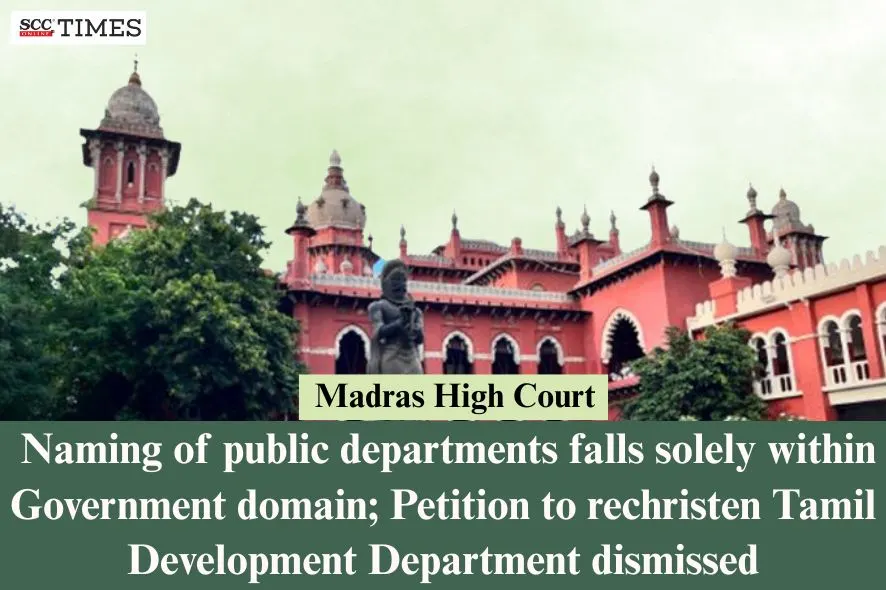
Madras High Court: While deciding a writ petition under Article 226 of the Constitution, wherein the petitioner sought rechristening of “Tamil Valarchi Thurai” as “Tamil Membattu Thurai” and quashing of the impugned order dated 14122022 on the ground that the word “valarchi,” meaning growth or enrichment, could not be equated with “development,” the Division Bench of Manindra Mohan Shrivastava*, CJ., and G. Arul Murugan, J., dismissed the petition and held that the naming and renaming of government departments is purely within the domain of the Government and cannot be undertaken by the High Court. The Court further noted that the issue was not of such gravitas that its non-consideration would impair society at large.
Background:
The petitioner earlier made a representation to the authorities requesting that the word “valarchi” be replaced with “membattu.” It was asserted that Tamil scholars have iterated that the word “development” cannot be equated with “valarchi.” The affidavit highlighted that “valarchi” means growth, increase, enrichment, while “development” connotes upliftment, betterment, higher state.
The authorities rejected the request through proceedings dated 14-12-2022. After this rejection, the petitioner approached the Court. It was argued that the impugned order showed a lack of proper consideration and was administratively arbitrary. The respondents, however, defended the order, stating that the actions of the authorities were completely fair, without any bad intention or arbitrariness.
Analysis and Decision:
The Court emphasised that all issues raised by the petitioner were already considered by the respondent authorities, and the impugned order was passed after due consideration. However, the Court observed that although a vague assertion was made that the impugned order suffered from nonapplication of mind and administrative arbitrariness, no whit of material was placed on record to bolster the said plea.
The Court highlighted that naming and re-naming of government departments is purely within the domain of the Government, and such a task cannot be undertaken by the High Court exercising writ jurisdiction, since the courts lack the expertise in this regard, and it is purely within governmental fiefdom. The Court also noted that the proceedings challenged were issued way back in 2022, but the petition was filed nearly three years later, showing an absence of compelling urgency.
The Court emphasised that the issue involved was not of such gravitas that non-consideration would impair society at large. The Court stressed that a public interest litigation should espouse a cause to protect society and avoid deliberate peril arising out of governmental non-concern for social good and benefit.
The Court observed that the present case did not warrant exercise of writ jurisdiction, as the cause espoused was purely an administrative act to be considered by experts in the field, and this Court lacked expertise in that regard. Accordingly, the petition was dismissed, sans costs, and the connected miscellaneous petitions were closed.
[Muthu Subramaniam v. State of T.N., 2025 SCC OnLine Mad 11083, decide on 14-11-2025]
*Judgment authored by: Chief Justice Manindra Mohan Shrivastava
Advocates who appeared in this case:
For the Petitioner: N. Umapathi
For the Respondents: Suresh Kumar, Additional Advocate General, assisted by M. Habeeb Rahman, Government Advocate
Buy Constitution of India HERE










0 replies