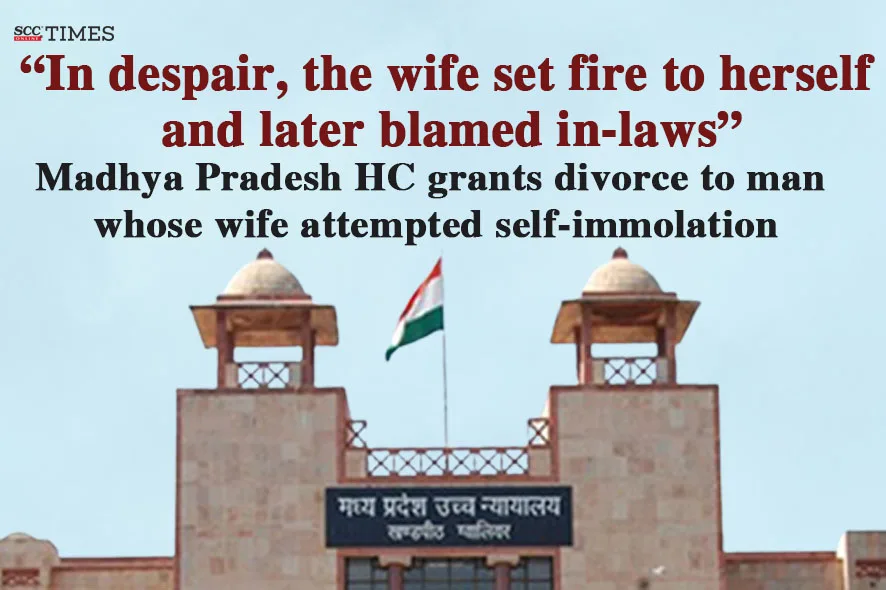
Madhya Pradesh High Court: In an appeal filed against the Trial Court’s judgment wherein the appellant- husband’s divorce plea was dismissed, the Division Bench of Vishal Dhagat and Anuradha Shukla*, JJ., allowed the appeal, holding that the dreadful act of self-immolation was sufficient to hold that the respondent-wife committed mental cruelty against the husband and the Trial Court erred in not appreciating the evident facts and even more so, in replacing them with its own perceived notions.
Background
The parties got married in 2003 according to the Hindu rites and rituals and gave birth to a girl child. Thereafter, the wife sustained burn injuries in an incident. Due to disputes, they started living separately in 2005.
The husband filed a divorce petition claiming that the wife’s behaviour became unpleasant just after a month of marriage. He argued that she disliked her husband, used to ill-treat and threaten him. Allegedly, she attempted to self-immolate at her matrimonial house and was rescued by her husband and in-laws. She sustained burn injuries and was admitted to the hospital. Thus, he filed the divorce petition on the grounds of cruelty.
The wife, on the other hand, alleged that since the marriage, she had been harassed by the husband and his family members. She also stated that the allegation of self-immolation was false, as after the birth of their girl child, the husband and in-laws became hostile and cruel. The husband, his mother, brother, and brother’s wife jointly poured kerosene on her and set her on fire. She was rescued by neighbours and taken to the hospital. Though she was very keen to lodge an FIR against her in-laws, on the advice of reputed members of society, she decided against it. She contended that due to physical changes in her appearance from the burn injuries, her husband wanted to wriggle out of the relationship.
After considering the merits of the case, the Trial Court dismissed the petition. Thus, the husband filed the present appeal.
Analysis
At the outset, the Court considered desertion as the first ground for divorce. The Court noted that the divorce petition was filed on 13-03-2006, three years after the solemnization of the marriage on 29-04-2003, and in those three years, the parties occasionally lived together. There was no continuous separation for two years or more. The Court further noted that the petition revealed that the parties last lived together in June 2005. Thus, in the absence of the required two-year period of continuous separation, the Court held that the ground of desertion was not available to the husband.
Regarding the ground of cruelty, the Court noted that though the wife claimed that the fire was put out by neighbours, no such neighbour was examined to corroborate her contention. Any such neighbour would have been a relevant witness to establish that it was not a case of self-immolation, but a criminal act committed by the in-laws. There was no explanation as to why the wife did not examine such an important witness.
The Court noted that, additionally, no FIR was lodged by her against the in-laws. The Court stated that her explanation that she was advised by the respected members of society to abstain from lodging an FIR would have been of some value if the relationship between the parties had normalized thereafter. However, from the evidence, it was clear that things became worse after the incident, as the wife went to her parental house along with the child and did not return to her matrimonial home.
Regarding the contention that the husband did not want to cohabit due to the physical changes consequential to the burning incident, the Court stated that the same appeared to be far from truth because if the intervention of respected members of society was the reason for not initiating criminal proceedings regarding the burning incident, then the wife had a formidable right to approach those same people and solicit their intervention to convince the husband for cohabitation and restitution of their marriage ties. The wife and her brother’s statements did not give any indication that the indulgence of those persons was ever sought by them on this objective. Additionally, the said persons were not produced as witnesses before the Trial Court.
The Court further noted that the Trial Court placed heavy reliance on the reconciliation proceedings/ Court-assisted mediation in its judgment. Noting this, the Court remarked that the objectionable part of the mediation proceeding was recording the conduct of the parties and the result of the proceeding in an order (‘mediation order’). This caused embarrassment to the solemn obligation of confidentiality in a mediation process. In this regard, the Court placed reliance on Moti Ram v. Ashok Kumar (2011) 1 SCC 466, wherein it was held that mediation proceedings are strictly confidential and the mediator should send the settlement agreement signed by the parties to the Court only when mediation is successful and should not mention what transpired during the mediation proceedings. The Supreme Court further observed that any disclosure of the events happening during the course of mediation proceedings destroys the confidentiality of the process.
Given this legal context, the Court held that confidence reposed by the parties while engaging in conversation with the presiding Judge in an attempt to settle their dispute was failed by the Trial Court when it wrote down the behaviour and the outcome of the conversation in the mediation order.
“The question arises, what is the remedy if in a Court-assisted mediation, the confidentiality of the mediation process is compromised? The answer may be difficult, but it can certainly not be that the evidence available on record would be ignored and priority would be given to whatever was expressed in the order sheet of the Trial Court after mediation.”
Thus, the Court stated that the observations made by the Trial Court in its mediation order were inappropriate and the findings were to be strictly within the ambit of the facts and evidence available on record.
Accordingly, the Court held that the Trial Court was incorrect in supplementing/replacing the facts and the evidence of the case with its perceived notion based on the mediation proceeding.
The Court noted that there was no evidence available on record which would suggest that the husband had expressed his feeling of loathing or disdain regarding the wife’s appearance post the fire episode. She herself was silent as to when and how the husband expressed any such feeling for her. Therefore, the Court held that whatever was stated by the Trial Court in the impugned judgment regarding the abhorrence entertained by the husband against his wife was based on assumptions and misplaced perception and not on the proven facts. Accordingly, the Court did not concur with it.
Overall, the Court stated that the wife suffered a painful incident sustaining burn injury for which she held the in-laws responsible, but neither did she produce any reliable evidence or witnesses on this point, nor did she initiate any criminal proceedings against the wrongdoers. On the other hand, the husband consistently, through facts and evidence, established that the incident of burning was the result of self-immolation, and there was no reason to disbelieve this testimony.
“A spouse taking such a drastic step is sufficient in itself to cause dread and fear in the other spouse to avoid any bonding in the matrimonial relationship.”
The Court further remarked that, “The established facts reveal that in a moment of despair, the wife set herself on fire and later put the blame on the relatives of the husband.”
Thus, the Court held that this dreadful act was sufficient to hold that she committed mental cruelty with the husband, and the Trial Court erred in not appreciating the evident facts and was even more so in replacing them with its own perceived notions.
Accordingly, the Court allowed the appeal and set aside the impugned judgment and decree, thereby dissolving the marriage solemnized between the parties under Section 13(1) (ia) of the Hindu Marriage Act, 1955.
[H v. R, 2025 SCC OnLine MP 6399, decided on 26-08-2025]
*Judgment authored by: Justice Anuradha Shukla
Advocates who appeared in this case:
For the appellant: Eshaan Datt